 Retro Replay Retro Replay gaming reviews, news, emulation, geek stuff and more!




Retro Replay Review
Gameplay
The first surprise in Hatsukoi Monogatari is that its bizarre floppy-disk-and-space-warrior opening is only a brief prologue. Once Foltjunia moves in and begins offering advice, you settle into a much more grounded challenge: managing an ordinary student’s time well enough to improve his chances with the girl he likes. It is an abrupt shift, but the contrast gives the game a peculiar charm. You start expecting an adventure and instead get a personal organizer with romantic stakes.
Each day is split between school and home, and the core decision is how to use those segments. Studying can improve one part of the hero’s profile, conversations with students or teachers may help another, and part-time work, rest, phone calls, shopping, and present-buying all compete for your attention. The game is not asking for quick reflexes or RPG-style growth through battles; it wants you to think a few days ahead and resist treating every free moment as identical.
That limited scope cuts both ways. The routine begins to click when you understand that a strong overall result comes from balance rather than blindly pushing one number upward. Checking the evaluation screen and adjusting your schedule becomes the main source of satisfaction. On the other hand, anyone hoping for a dense life sim with a huge range of paths may find the choices repetitive, especially once the basic logic of raising and lowering parameters is clear.
Foltjunia’s role as an adviser is a smart fit for the structure. Her presence turns the management screen from a completely dry set of calculations into a strange domestic comedy premise, even though the actual goal remains straightforward. The lack of RPG elements makes the game cleaner and more focused than a hybrid simulation, but also means its payoff rests almost entirely on whether you enjoy planning, monitoring stats, and slowly steering a protagonist toward self-improvement.

Graphics
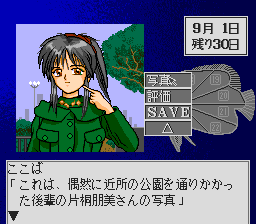
The anime/manga premise gives Hatsukoi Monogatari an appropriately playful tone: an everyday student shares space with Foltjunia, an intergalactic warrior associated with robotic armor, while the game moves between its brief adventure-style introduction and school-life management. Its most memorable imagery comes from that collision of mundane student life and oversized sci-fi setup.
Story
The story begins with an ordinary student finding a floppy disk in the street and loading its data onto his computer. That act summons Foltjunia, who normally fights evil alongside three companions in robotic armor. She has lost her powers, however, leaving her stranded with the hero instead of out in the galaxy. It is a knowingly silly setup, and it earns attention because it is far stranger than the romance-management game it leads into.
Rather than turning that setup into a sprawling space adventure, the story narrows its focus to the hero’s attempt to conquer the love of a schoolmate. Foltjunia becomes the unusual voice of guidance in a familiar coming-of-age situation. That pairing is the game’s strongest narrative idea: cosmic stakes are pushed aside so a powerless warrior can help with school, confidence, and romance.
Do not come in expecting the plot to overpower the simulation. The premise works more as flavor and motivation for the schedule management than as a constantly escalating adventure. Still, if you have a taste for offbeat 1990s anime setups, the image of a lost armored heroine dispensing love advice gives the game more personality than a standard school simulator.
Overall Experience
Hatsukoi Monogatari is for the patient gamer who can enjoy making small, practical choices repeatedly and watching their cumulative effect. Its strongest moments come when you stop treating school and home as two simple turns to fill and start considering what the hero needs next. Study too hard without rest or neglect the social side, and the balancing act loses its shape; spread your attention thoughtfully, and the evaluation screen becomes a useful measure of progress.
The game is also easy to recommend to anyone who likes unusual genre mash-ups, provided the management half sounds more appealing than the prologue. The sci-fi comedy hook is fun, but the bulk of the experience is a constrained Princess Maker-style routine, not an action game about Foltjunia fighting evil. Go in for the daily planning and romantic goal, and her presence becomes a welcome bit of eccentricity rather than a misleading promise.
Its limited options and lack of RPG systems make it less deep than the most ambitious raising simulations, yet that simplicity can make it approachable. There is no need to master combat or juggle elaborate character-building systems. If a compact school-life sim with a weirdly charming anime frame sounds like a pleasant way to spend time, Hatsukoi Monogatari is worth a look; if you need constant narrative escalation or broad strategic freedom, its routine may wear thin before the romance pays off.


Reviews
There are no reviews yet.