 Retro Replay Retro Gaming History, Reviews & Emulation
Retro Replay Review
Gameplay
The first few stages pull you in with the old Super Monkey Ball promise: a simple route, a one-minute limit, and just enough room for one bad tilt to turn a clean run into a fall. You are not directly steering AiAi and friends; you are inclining the stage beneath their balls. That distinction is still the heart of the tension. Small adjustments feel controlled, but a panicked correction can send you skidding in exactly the wrong direction.
Wii Remote tilting is the cleanest fit for that rhythm. The Balance Board is optional, and that matters, because standing on it asks more of you while the Remote still handles the stage inclination. Board play also changes the courses by adding or removing obstacles to account for its added challenge, and it lets you jump in-game. It is a neat alternative when you want to make a familiar kind of precision game more active, not an obvious reason to abandon the Remote.
There is a lot built around the basic clear-the-goal loop. Each themed world contains ten named stages, with the fifth reserved for a 50-banana bonus stage. Bananas matter more often than in the series’ early games because every 20 earns an extra life, and the end-of-stage scoring rewards brisk clears. If you like shaving time from a route, the timer and score structure give replaying stages a clear purpose; if you only want to survive, the on-screen meters and counters can make each attempt feel busier than it needs to.
Co-op is a curious but welcome variation: one person uses a Wii Remote and the other the Balance Board, with extra obstacles added to the level. Up to four people can also join the split-screen multiplayer mode, while the minigames support groups using Remotes and, where applicable, the Balance Board. Marathon mode is the sternest test, asking you to clear the first half, second half, or entire game’s set of levels without a single death. That is where the game stops being a casual party distraction and starts demanding disciplined control.
Graphics
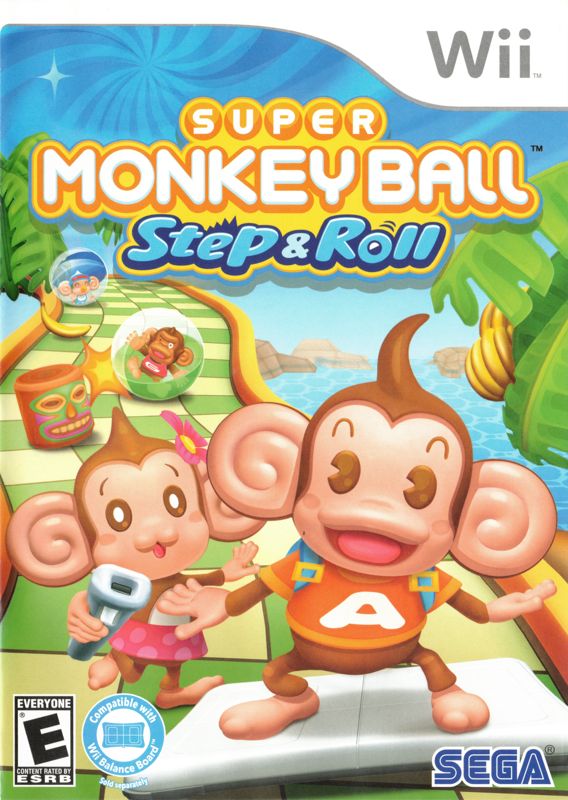
You spend the game looking at AiAi, MeeMee, GonGon, Baby, and newcomer Jam sealed inside their balls as they cross themed courses toward an exit goal. The levels are named rather than merely numbered, and the changing worlds give the long run of courses some welcome visual separation.
Split-screen multiplayer makes room for up to four simultaneous competitors. It suits the game’s direct race-to-the-goal energy, though it naturally makes each individual view smaller when the full group joins in.
Story
Story is barely the point here. AiAi and his monkey friends are once again enclosed in balls and pushed toward exit points, which is enough framing for a game built around balance, routes, and quick restarts.
The themed worlds are specifically unrelated to one another, so you should not expect a growing adventure or a connected campaign thread. Completing any world leads to the credits, and those credits cannot be skipped. That is an odd full-stop after what may only feel like one segment of the game, especially when you are ready to move directly into another set of stages.
On the upside, the lack of story fuss keeps attention on the challenge. Jam’s addition gives the usual monkey lineup one new face, but the real personality comes from how recklessly or carefully you guide the ball when the timer is running out.
Overall Experience
Step & Roll is most satisfying when you treat it as a precision game first and a motion-control novelty second. The Remote delivers the dependable version of Super Monkey Ball’s balancing act; the Balance Board offers a tougher, more physical option for a change of pace. Being able to ignore the board entirely is a practical kindness, not a compromise.
The game has enough modes to suit several moods. You can work through solo courses, share the strange Remote-and-Board co-op setup, crowd around split-screen races and minigames, or commit to the unforgiving no-death Marathon challenges. The abundance is real, although the forced credits after every finished world repeatedly break the momentum of a longer solo session.
At a 6, this lands as a solid continuation rather than a must-own peak for the series. Give it a chance if the thought of repeated attempts, falling off narrow routes, and finally nailing a fast clear still sounds satisfying. Skip the Balance Board if you want the most straightforward experience; bring it out if you want the game to push back harder. For game-specific background, this Step & Roll history page is useful, but the better reason to play is the familiar thrill of recovering a shaky run just before the goal.


Reviews
There are no reviews yet.