 Retro Replay Retro Gaming History, Reviews & Emulation

Retro Replay Review
Gameplay
The first hour of Achron can feel like learning to play an RTS while someone has loosened the floorboards beneath you. At first, issuing orders in the present looks familiar enough. Then you start moving to other points on the timeline, changing what your forces did earlier, and realizing that a battle’s later state is no longer fixed. A force can even fight beside an earlier version of itself. It is an audacious idea, and it makes routine skirmishes feel far less routine.
What starts to click is that speed is not the only advantage. You can reconsider the chain of decisions that led to a bad position instead of treating the current battlefield as an irreversible mess. That turns planning into a question of consequences across time: if you alter an earlier order, what does that do to the units and fights that followed? When you successfully untangle that question, Achron delivers the kind of satisfying tactical reversal that a normal forward-moving RTS cannot match.
The cost is mental bookkeeping. Keeping track of several moments in a battle can make ordinary planning harder to follow, especially when you are already trying to manage separate groups of units. If you want the clean, immediate flow of a conventional game like StarCraft II: Wings of Liberty, Achron can feel awkward and overcomplicated. If you enjoy stopping to think through a knotty strategy problem, its complications are exactly the point.
Graphics
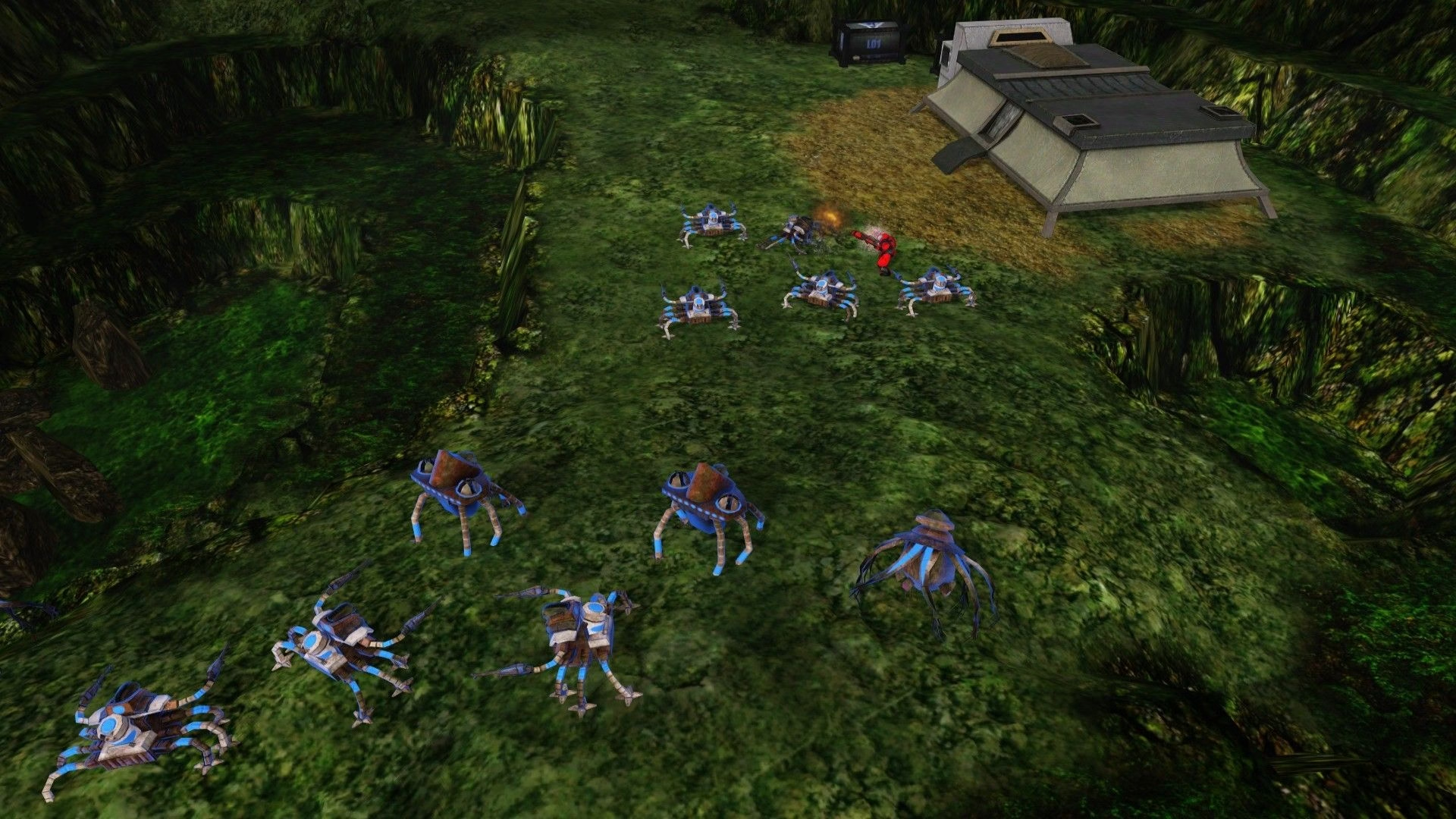
The high angled battlefield view keeps groups of troops distinct: blue spider-like machines and red infantry are easy to pick out around a squat gray futuristic building, while soldiers, walkers, and a low armored vehicle stand apart on a gray moonlike map dotted with huge black monoliths. Rusty orange terrain, blue-striped vehicles, and distant yellow-white explosions add a little color to another battlefield.
Still, the coarse ground textures, dark lighting, and simple angular vehicles leave many maps looking drab. The unit silhouettes do the practical work, but this is not a sci-fi war game you will remember for rich scenery or striking detail.
Story
The campaign begins in the aftermath of an alien invasion. You play a survivor who can perceive events beyond one ordinary moment, which gives the time-bending battles a useful place in the fiction rather than making them feel like a disconnected gimmick.
Your role is to investigate what happened. That premise has enough mystery to push you forward, particularly once the gameplay has taught you to doubt any apparently settled version of events. The strongest story hook is the fit between your unusual perspective and the game’s willingness to let the past remain changeable.
Do not come to Achron expecting the story to overshadow the strategy. Its narrative function is to frame the campaign’s investigation and give its strange temporal perspective some stakes. For this game, that is a sensible focus: the memorable moments come from grappling with the consequences of your own altered decisions.
Overall Experience
Achron deserves credit for taking a familiar genre and changing the question at its center. Rather than asking only whether you can execute a plan faster than your opponent, it asks whether you can understand and revise the plan’s history. That is a real design leap, not a cosmetic sci-fi spin on standard RTS play.
It also will not be for everyone. The same timeline system that creates its best moments can turn battlefield awareness into work, and the plain, dark visuals do little to smooth over that learning curve. Give it time before deciding it is simply confusing. Once the temporal logic starts to make sense, you can see why the game earned such devotion from strategy experimenters.
The four single-player campaigns, multiplayer battles, level editor, and modding tools make Achron more than a one-idea curiosity. It is a flawed but worthwhile recommendation for RTS fans who are tired of fighting only forward. For more on the game and its modes, the official developer listing is a useful follow-up.



Reviews
There are no reviews yet.