 Retro Replay Retro Gaming History, Reviews & Emulation
Retro Replay Review
Gameplay
The first hour of Anodyne feels agreeably familiar if you grew up poking through overhead adventure games. Young explores a broad, connected dream world, swings a broom at hostile creatures, speaks with odd inhabitants, and searches for the items that will open another route. The comparison to The Legend of Zelda: Link’s Awakening makes sense as a point of reference for the exploratory rhythm, but Anodyne is much stranger and less polished in its moment-to-moment feel.
Its strongest idea is dust. You can pick it up with the broom, deposit it where a puzzle needs it, and use it to cross water without sinking. That turns an ordinary-looking obstacle into something worth testing, and it gives backtracking a purpose once new abilities let you revisit older areas. Collecting keys and cards can initially sound like simple gatekeeping, but the game is at its best when each new opening sends you somewhere surprising rather than merely deeper into another combat room.
Combat does not carry the adventure. The broom works, upgrades improve it, and defeated enemies can leave behind health, yet fighting rarely has the snap or variety to be the main attraction. A bigger annoyance arrives in later jump-focused sections, where judging movement from an overhead view can feel clumsy. Fortunately, unlimited continues, manual checkpoints, and discovered portals to the central hub make failure far less punishing than it might have been. Stick with it for exploration and puzzle-solving, not for a demanding action game.
Graphics
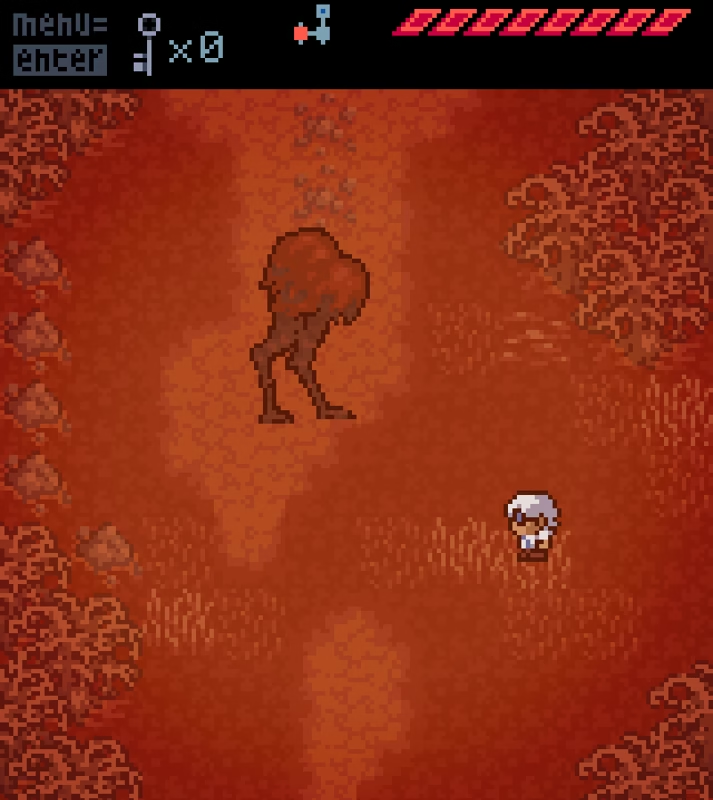
The original Windows version uses small, black-outlined 16-bit-style sprites and tightly limited reds, browns, and blues. Young’s silver hair stands out against rust-red ground and coarse vegetation, while bizarre enemies, including a tall brown jellyfish-like creature on thin legs, make even open spaces feel uneasy.
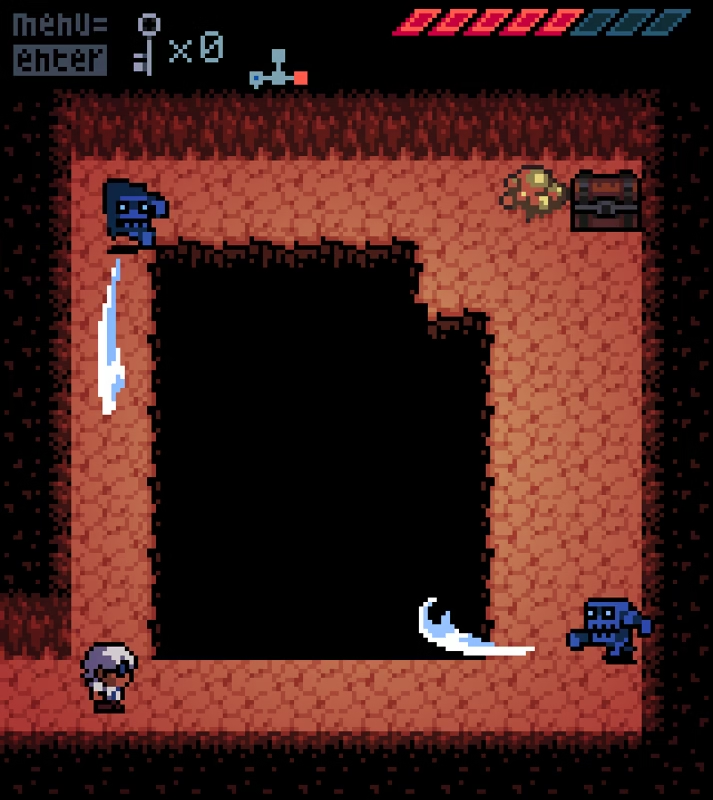
Dungeons lean into that off-kilter look with salmon-red floors surrounding black pits, blue square-faced enemies, pale-blue broom arcs, and odd gold creatures near dark chests. The chunky creatures remain easy to pick out, though repeated floor textures can make some rooms look monotonous.
Story
Young is summoned into a dream world tied to his subconscious, where Sage tells him that The Darkness is spreading and searching for a legendary briar. That setup gives you a clear reason to move forward, but the story is more interested in a drifting, unsettling atmosphere than in laying out a clean fantasy history.
The modern-day touches are important to its tone. A hotel can sit in the same broad journey as forests, temples, cliffs, beaches, and outer-space areas, and the abrupt shifts make the world feel like a place assembled by memory rather than geography. Talking to characters helps sustain the sense that you are moving through somebody’s private, only partly explained logic.
That ambiguity is a strength when the game is surprising you with a new location, and a weakness if you want a firm explanation for everything you see. Do not expect the plot to tie every strange image into a definitive answer. The dream setting works better as a mood that keeps nudging you onward.
Overall Experience
Anodyne is a good game with noticeable friction. It has enough open-ended wandering, secrets, and inventive uses for dust to make its world stick in your mind, even when the combat feels thin and the platforming asks more precision than the viewpoint comfortably delivers.
Give it a chance if you enjoy wandering into weird corners of an adventure game and do not need every question answered. The payoff is not a flawless action-adventure, but a sequence of memorable places and small discoveries that feels more personal than its familiar genre skeleton suggests.
This is the original 2013 Windows release, made by Sean Hogan and Joni Kittaka, rather than a later remake or reinterpretation. For release and original-edition details, the Anodyne original developer press kit is useful context. At 6.9 out of 10, it lands as a flawed but genuinely distinctive excursion that is easier to recommend to curious explorers than to combat purists.


Reviews
There are no reviews yet.