 Retro Replay Retro Gaming History, Reviews & Emulation
Retro Replay Review
Gameplay
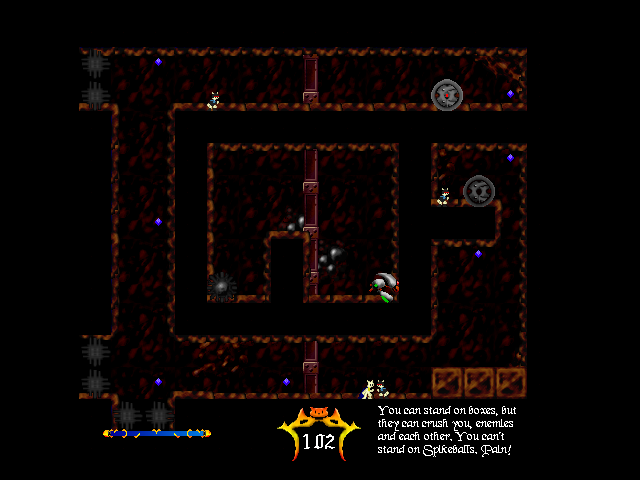
Kaiser Kitty begins like a straightforward platform game: run through a maze-like room, jump between passages, collect every crystal, and enter the portal that opens when the set is complete. The compact stages make the objective easy to understand, but their layouts quickly reveal crystals placed on surfaces that ordinary movement cannot reach.
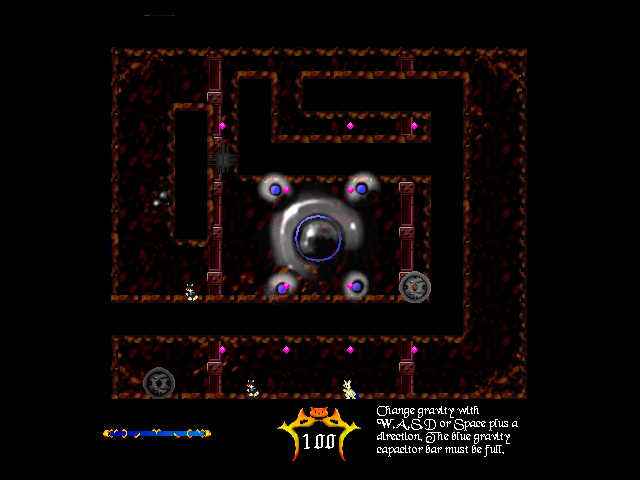
The gravity control supplies the solution. Pressing W, A, S, or D makes the room’s contents fall toward the corresponding side, allowing Kaiser Kitty to walk across ceilings and walls. A capacitor must recharge after each shift, so players need to consider where the character, crates, enemies, and spiked obstacles will land before committing to a direction.
Later rooms combine the central idea with hostile robots and movable objects. Kaiser Kitty has no direct attack, but a well-planned gravity change can drop a crate or another hazard onto an enemy. That interaction gives the puzzles a satisfying chain-reaction quality and makes positioning as important as jumping skill.
Graphics
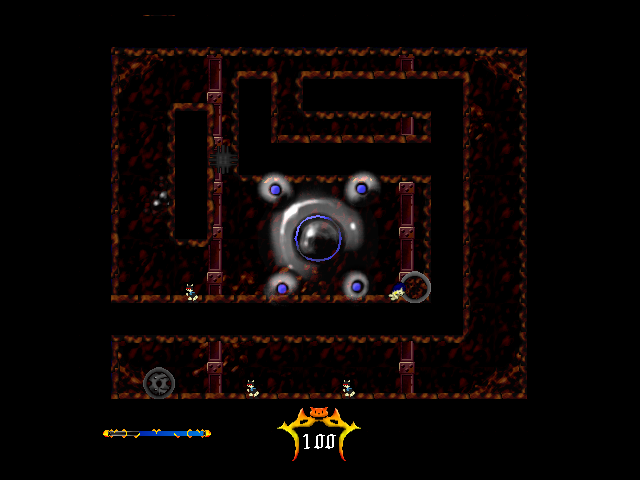
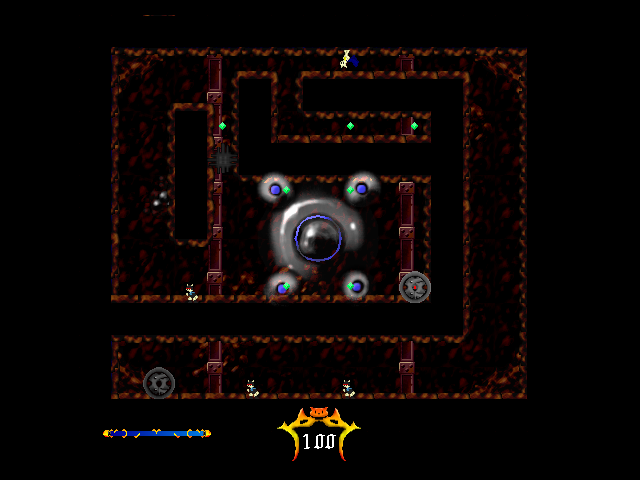
The game uses a colorful, cartoon-like science-fiction setting with clearly separated tunnels, platforms, hazards, and collectible crystals. The bright hero remains easy to locate against the darker asteroid-base interiors, an essential quality when the entire room can suddenly acquire a new floor.
Each stage is presented as a contained puzzle space, letting players read the important routes and objects without losing track of the objective. Crates and robots have distinct silhouettes, while spikes and other dangers stand out strongly enough to inform a gravity change before it becomes irreversible.
The presentation is modest rather than lavish, but it supports the design. The capacitor meter gives a visible indication of when gravity can change again, and the shifting orientation creates the game’s most memorable visual moments as characters and loose objects tumble toward a wall or ceiling.
Story
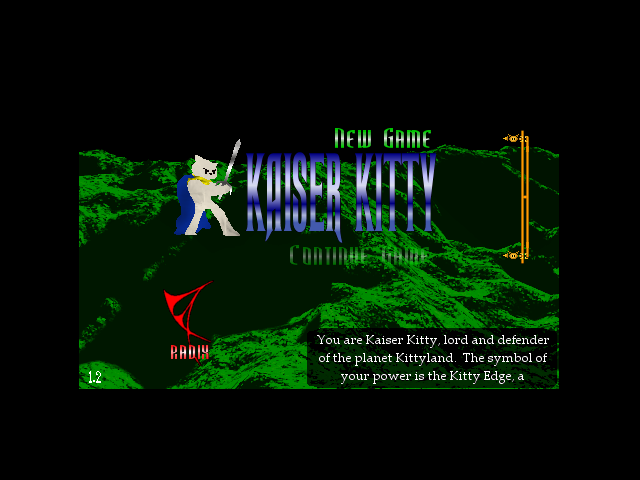
Kaiser Kitty rules Kittyland and carries Kitty Edge as the symbol of his authority. When the Intergalactic Guild of Evil Space Robots steals the sword and hides it inside an asteroid base, he enters the facility to recover it and restore his honor.
The premise gives the game a playful heroic frame without interrupting the individual puzzles. Robots, tunnels, and mechanical hazards fit the invading guild, while the missing sword neatly explains why the hero must rely on gravity and the environment instead of direct combat.
Most of the experience is carried by the journey through the base rather than by extended dialogue or dramatic scenes. Progressing from room to room feels like moving deeper into the thieves’ hideout, with the increasingly complicated defenses providing the story’s rising challenge.
Overall Experience
Kaiser Kitty builds a complete puzzle-platform game around one strong rule. Redirecting gravity is immediately understandable, yet the mechanic supports clever combinations involving walls, ceilings, enemies, crates, and hazards. The short recharge delay prevents frantic switching and encourages deliberate solutions.
The same restraint can slow the pace when a failed attempt leaves the player waiting for the capacitor, and the simple presentation does not offer the spectacle of larger platform games. Even so, the focused room design keeps the central mechanic useful instead of treating it as a brief novelty.
At 7 out of 10, Kaiser Kitty is an inventive and approachable Windows puzzle platformer. Its compact stages reward spatial thinking, and the ability to weaponize falling objects gives the otherwise unarmed hero a satisfying way to outsmart the robotic opposition.


Reviews
There are no reviews yet.