 Retro Replay Retro Gaming History, Reviews & Emulation

Retro Replay Review
Gameplay
The first hour of Melty Blood has a satisfying forward drive because it does not treat fights as disposable interruptions. You pick a character, enter a match, and the result can push the story down a different route. That simple connection gives the single-player mode more urgency than a standard sequence of increasingly difficult opponents. Winning matters, naturally, but losing is not automatically a dead end; it can lead the narrative somewhere else.
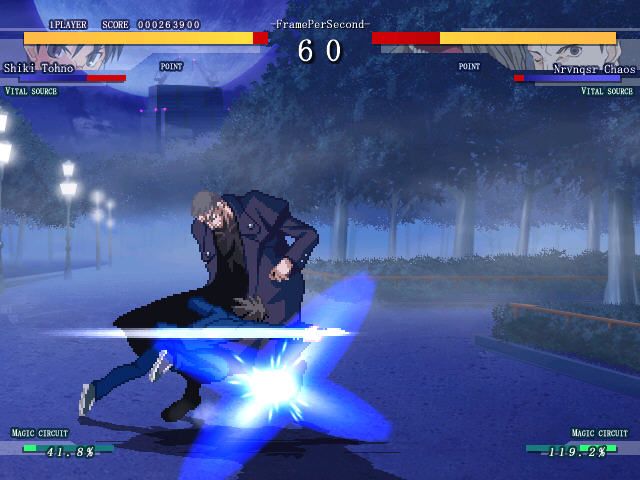
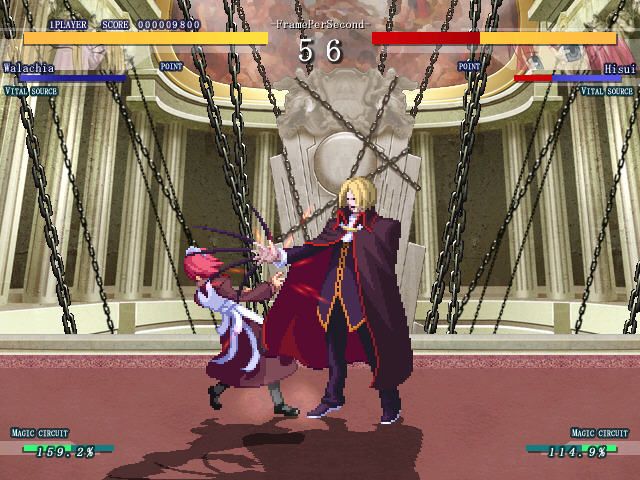
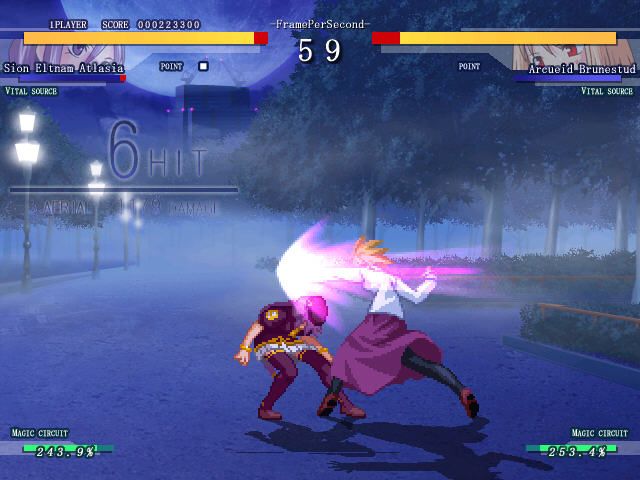
In the ring, this is firmly a 2D versus fighter with the fundamentals you expect: ordinary attacks, special moves, and combos that can be canceled into further offense. The system starts to click when you stop treating every opening as one stray hit and begin looking for ways to extend pressure. Building power toward EX attacks adds a strong payoff to sustained success, turning a stocked gauge into the threat of a devastating blow.
Defense has more to do than simply holding back. EX shielding offers a strengthened defensive answer, and recovery options add another decision point when momentum shifts. That is where frustration can set in for newcomers: the opponents are not built to be overcome by repeating one comfortable string. Still, the game gives you useful tools rather than asking you to endure helplessly. Learn when to spend power, when to shield, and when to recover, and the matches become more deliberate and rewarding.
The starting selection of six fighters is enough to begin experimenting, while story play unlocks eight more. That structure makes progressing through the mode feel worthwhile beyond seeing alternate plot turns. The patched version’s immediately open roster is convenient for anyone who wants to test the whole cast first, but the original unlocking path has its own incentive: each run can reveal both a new combat option and another corner of the story.

Graphics
The game uses a side-view, 2D anime style that suits its visual-novel roots. Battles keep both fighters in clear view, which is important when you need to track spacing, attacks, and recovery decisions at speed.

Story
Shiki Tohno’s supernatural ability—to destroy objects by tracing their outlines with his gaze—gives the mystery a suitably strange center. A year after the events of Tsukihime, he is drawn into murders in Misaki that resemble an earlier case. That setup immediately gives his investigation a personal, uneasy charge rather than feeling like a generic excuse for a tournament.
The story gains momentum when Shiki meets a woman who attacks him, then reveals herself as a vampire searching for a cure. His decision to help her puts him on a path toward opponents whose abilities can stand against his own. It is a good fit for a fighting game: the confrontations have a narrative reason to exist, and the supernatural premise supports a cast of dangerous rivals without losing the central mystery.
What makes the format work is that the visual-novel choices are not separated from the fights. Outcomes affect where the plot goes, so repeated play is not only about mastering another character or chasing a cleaner victory. You are also following alternate directions in Shiki’s investigation. If you like fighting games with a story mode that treats battles as part of the drama, that is the strongest reason to stick with it.
Overall Experience
Melty Blood is a compelling hybrid rather than a fighter with a thin story pasted around it. Its branching narrative gives matches context, while its cancel-based offense, EX attacks, EX shielding, and recovery choices give the action enough tactical texture to reward practice. The two halves reinforce each other well: curiosity gets you into another route, and improving at the fights helps you see where that route leads.
It will be most rewarding if you enjoy learning a character over time. You can begin with the basics, but the game clearly wants you to graduate into smarter combo decisions, power management, and defense. Expect some resistance when tougher opponents expose predictable habits. That difficulty is part of the point, and overcoming it makes a hard-earned win feel tied to genuine progress rather than luck.
Give it a chance if you want an anime-styled fighter with a supernatural detective thread and reasons to replay its story mode. The payoff is not simply unlocking more characters; it is seeing how fight results reshape the route while your own understanding of the combat grows. That combination gives Melty Blood more staying power than a one-and-done arcade run.


Reviews
There are no reviews yet.