 Retro Replay Retro Replay gaming reviews, news, emulation, geek stuff and more!
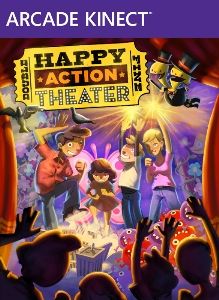
Retro Replay Review
Gameplay
The first few minutes are disarmingly simple: you stand in front of Kinect, see your room and body on the television, and start messing around with whatever absurd situation the current activity drops on top of you. Double Fine Happy Action Theater does not ask you to learn a deep move set or chase a campaign. It wants you to react physically, make a fool of yourself, and see what happens when the game turns a familiar room into a lava pit, an underwater space, or a snowball fight.
That open-ended approach gives the better activities a real playground energy. You can lure pigeons by freezing into a statue, disrupt another person long enough to make them disappear temporarily, or fire at an invading force in a Space Invaders-style activity with your own face attached to the defending craft. The five-photo cloning mode is especially easy to understand and encourages immediate experimentation: kicking yourself or shaking your own hand is exactly the sort of dumb visual gag that becomes much funnier once everyone starts trying to top it.
There are eighteen modes, and having everything open from the start is the right call. You can jump straight to a favorite rather than force the room through weak material, while party mode helps keep a gathering moving by mixing activities together. Support for tracking up to six people gives the game a welcome group focus, although the real value is not in mastering each mode. It is in the bursts of laughter between attempts.
Frustration sets in if you arrive expecting goals, score-chasing depth, or a clear sense of completion. Many activities deliberately cannot be beaten, and their novelty can burn off quickly when you are playing by yourself. Treat it as an interactive toy box rather than a competitive game, and it makes far more sense. A lively group can stretch a simple idea into a memorable half hour; a quiet room may run out of reasons to continue much sooner.
Graphics
The standout image is your own live camera feed transformed into a play space. You and the room remain visible while lava, snow, water, pigeons, and other additions appear around you, making the screen feel like a deliberately goofy home video that has been invaded by a cartoon problem. Some modes instead use player silhouettes, while the cloning activity turns a sequence of photos into the basis for visual jokes.
Because the game keeps putting people on screen, it is at its funniest when everyone can see their own awkward poses and improvised reactions. The main menu is also practical: every activity is available immediately, which suits a party game built around quickly trying the next strange thing.
Story
There is no story campaign tying these activities together, and forcing one onto them would miss the point. Each mode is a small premise: survive a bit of imagined chaos, interact with an augmented version of your room, or create a joke using the camera.
That means the people in front of Kinect become the closest thing the game has to characters. A competitive friend, someone who commits to a ridiculous pose, or a group that suddenly understands how to stage a clone-photo gag supplies the personality that a scripted plot normally would.
The lack of narrative also makes it easy to dip in and out. You do not need to remember where you left off or persuade newcomers to sit through setup; just pick an activity and start moving. It is a thin proposition for solo sessions, but an effective one for a room full of people who want instant participation.
Overall Experience
Double Fine Happy Action Theater is a charmingly unserious Kinect party game whose best moments feel less like playing a level and more like making a short, chaotic sketch with friends. Its augmented-reality activities get to the fun quickly, and the absence of unlock requirements makes it unusually welcoming when you have guests waiting their turn.
Its weakness is equally plain: the game has limited staying power outside the right social setting. Since much of it is intentionally open-ended, you supply the motivation and the comedy. If your group needs detailed rules, goals, or a lasting progression hook, the initial novelty will not carry the night.
But if you still have Kinect connected and want an excuse to get several people standing, pointing, posing, and laughing at themselves, this is one of the more direct uses of the hardware’s camera trickery. It earns its 7.8 with inventive little ideas rather than depth. For background and release details, see the Double Fine Happy Action Theater history.


Reviews
There are no reviews yet.