 Retro Replay Retro Gaming History, Reviews & Emulation
A green lizard walks into a graveyard and immediately starts reviewing the television. He can climb the walls, hang from the ceiling, and knock a monster sideways with his tail. What he cannot do is keep his mouth shut. Somewhere between the jump button and the next bad joke, Gex makes his pitch: you are going to spend a lot of time with this mascot, so he might as well have something to say.
That was a more ambitious promise in 1995 than it sounds today. Mario expressed himself through a few sounds and a remarkably expressive jump. Sonic sold attitude with his shoes and the way he tapped his foot. Gex wanted the whole microphone. He was a couch potato dropped into a platform game, a character whose natural habitat was the spot in front of the largest television in the house.
His games would take him from the struggling 3DO to the PlayStation, through an awkward but memorable transformation into a secret agent, and onto Nintendo handhelds that could barely accommodate his personality. Then the channel went quiet. For years, Gex survived in used-game shops, childhood memories, and jokes made by people who sometimes seemed more familiar with the lizard than with his games.
When he returned in 2025, the strange part was how recognizable he remained. The references had aged. The camera had aged. The obsession with television had become a period detail. But the little reptile who treated an adventure like an excuse to heckle the screen was still there.

A mascot for a machine that needed a hit
Lyle Hall arrived at Crystal Dynamics in early 1993 with experience producing games at Virgin and an opportunity to create something of his own. The new studio was betting on the next wave of CD-based consoles, with the 3DO at the front of the queue. Hall began developing the character who would become Gex almost immediately.

Hall’s proposal used the expensive new hardware for a familiar pleasure: jumping around a colorful world. A 2D platformer at a studio interested in cutting-edge 3D might sound like a cautious choice. His ambition was considerably less cautious. The character would move onto background surfaces, and he would talk to the player along the way. Hall described those aims in a 2007 interview with Game Developer. He wanted the new machine’s graphics and CD audio to make the old genre feel different.
The 3DO gave that idea room to breathe. Its discs could carry recorded speech, rendered introductions, and more elaborate visual material than a small cartridge. None of those things guaranteed a good jump. They did give a mascot another way to enter the room. Gex could show up as a fully voiced character rather than wait for the player to imagine what he sounded like.
There was a commercial urgency behind the creative opportunity. The 3DO entered the American market in 1993 at roughly $700. That was an enormous request for a household already happy with a Genesis or Super Nintendo. A platform game could not erase the price tag, but a character people wanted to bring home might help explain what the machine was for.
Gex was designed to become Crystal Dynamics’ mascot. The studio needed players to recognize the lizard as readily as they recognized the hardware companies’ stars. He would be a face on the box, an identity for the developer, and a game somebody could recommend without first explaining the 3DO’s business model.
Before the sofa, there was a stuntman
Gregg Tavares, the original game’s lead programmer, had worked across the computer and console business before joining Hall at Crystal Dynamics. He was used to making games run under restrictions. At this studio, he encountered a different kind of problem: the expectation that a small team could manufacture the next enormous mascot franchise.

In a Digital Press interview, Tavares confirmed that the project started as Gecko X. The early concept cast its hero as a Hollywood stuntman. The television addict came later.
That change gave the finished series a wonderfully elastic premise. A haunted house, a cartoon landscape, and an absurdly elaborate martial-arts set could coexist because the player was changing channels. A platform hanging in the wrong place did not need a convincing architectural explanation. Television had already excused much worse.
The villain Rez would pull Gex into the Media Dimension, a world of TV-inspired dangers. The gecko’s way out involved finding remote controls. Even the collectible was a miniature joke: the thing normally used to avoid getting off the couch became the reason to run around an entire game.

The game behind the grin
The original production was miserable, according to Tavares’ 1997 postmortem. The initial team was tiny, the expected artwork outgrew the available staff, and the schedule slipped. Material was cut as the company tried to finish. Some developers secretly brought discarded science-fiction art back as bonus content.
His account also describes a nastier confrontation. After a level was changed without the lead designer’s approval, the designer inserted messages attacking the company and directing players to complain to a manager. Testing found them. Tavares says the designer was fired, with management concerned about the effect on its Panasonic relationship.
“GEX was one of those projects from Hell.”
— Gregg Tavares, in his development postmortem
There is something painfully familiar about that gap between the box and the workplace. The gecko was supposed to make the whole enterprise look effortless. The people building him were wrestling with staffing, deadlines, and the moment when a feature someone loved became a feature somebody else wanted removed.
The secret material was not all resentment. In a separate Unseen64 interview, Tavares explained that the large hidden level-selection menu preserved spaces used for designers’ experiments. Its many slots did not mean that dozens of finished stages had been deleted. He also recalled bonus minigames and digitized staff imagery. The original Gex had a little workshop hidden behind its television sets.
Those leftovers are part of its charm. A large commercial release could still contain something that felt like a few developers sneaking a private amusement into the disc. Gex’s wisecracks were the public personality. The secrets gave the game a second personality, visible to players who kept poking around after the advertised adventure was over.
A comedian gets the microphone
Dana Gould supplied the voice that American players would associate with Gex throughout the main trilogy. A stand-up comedian rather than a cartoon animal specialist, he gave the character a distinctly human rhythm: the pause before a crack, the change of register, the suggestion that the lizard had seen this particular movie far too many times.

The original credits place Gould in both the writing and voice work. That connection helped the character sound like somebody talking rather than a mascot reciting its slogan. Gex borrowed the language of television, commercials, celebrity gossip, and movies because that was the junk already filling his head.
For a child playing in the mid-1990s, recognition could arrive in uneven bursts. One joke might point to a familiar cartoon; the next could sail past anyone who had never watched the older show being invoked. The performance carried some of the jokes even when the reference did not. A gleeful delivery could be funny before it was understood.
It could also become exhausting. A comedian on television gets an edit, a change of scene, or an audience reaction. A video-game character may repeat a line while the player misses the same jump for the eighth time. Gex’s greatest selling point had a volume control for a reason. His personality depended on how much time you were willing to spend listening to him.
Sticky feet and a surprisingly stern first adventure
The first Gex reached the 3DO in spring 1995. Under the speech and rendered packaging was a fairly demanding 2D platformer. The gecko’s tail supplied his attack and a bouncing move; his tongue picked up flies; his feet turned suitable walls and ceilings into routes through a stage.
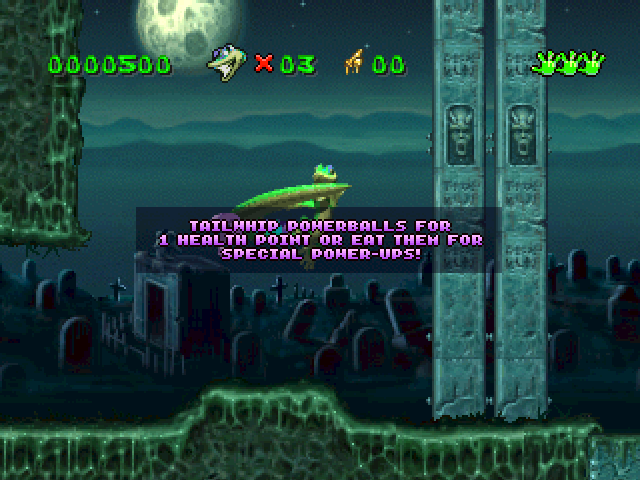
The wall-climbing is the move that makes the game feel like its own creature. A stretch of vertical scenery becomes somewhere to stand. A ceiling becomes a path. The screen asks you to think about the room’s surfaces instead of seeing everything above the floor as decoration.
That freedom comes with an adjustment. Running, attaching to a surface, and jumping away are different states, and the game does not make every transition feel as forgiving as the bright packaging suggests. A player accustomed to a simple run-and-jump rhythm can find the gecko fiddlier than expected. The difficulty begins with understanding what his body is doing.
The opening graveyard supplies gloomy stonework and monsters, while the cartoon stages make a louder claim on the eye. Their chunky colors turn the screen into something closer to a mischievous animation set. Other worlds lean into jungles, martial-arts imagery, and machinery. There is enough visual variety to make the next channel worth finding even when the current one has worn out your patience.
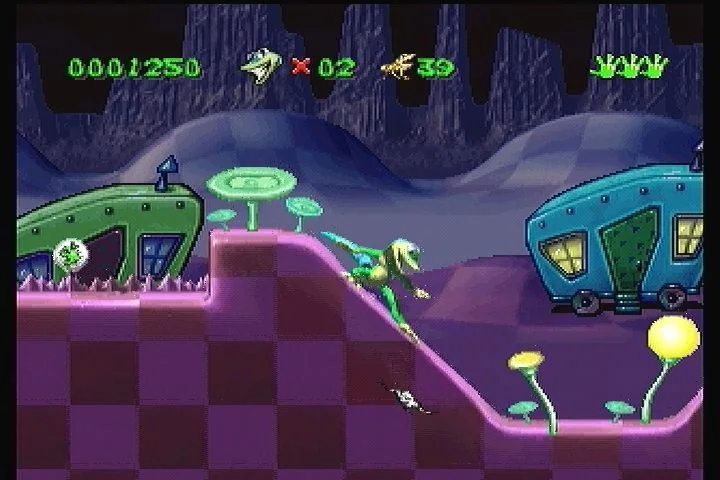
A good stretch has a satisfying physical logic: attach, climb, leap, swing the tail, then find a safer angle. A bad stretch makes you wish the television had an easier channel. Gex is more interesting when the surfaces shape the route than when a conventional hazard simply takes another life.
The design also gives the original a different mood from its sequels. The gecko talks, but the game itself can feel lonely and slightly strange. Its graveyards and mechanical spaces leave him small inside the picture. Later games would give him a tuxedo, a government assignment, and much bigger sets. Here, he still looks like a couch potato who has made a terrible mistake.
Escaping the 3DO
Panasonic bundled Gex with 3DO hardware, giving it an audience beyond people who deliberately bought the game. Hall later recalled seeing it packed with 400,000 consoles. That is his retrospective figure for bundles, not a verified total of separate game purchases.
For those households, the introduction was automatic: open the console box and there was the gecko. He had an audience even among buyers who had come for something else.
Gex did not stay trapped there. Beam Software handled the PlayStation and Saturn conversions, while a Windows edition followed through Kinesoft and Microsoft. The release and credit records chart a game spreading across competing CD platforms in 1995–1996.

On the PlayStation, the lizard now occupied a much busier neighborhood. Buyers could see new games pushing into 3D, alongside elaborate 2D adventures. A talking gecko was no longer enough to represent the future by himself. His first game survived the move; his next game would have to change shape.
The 3DO’s commercial collapse did not take him down with it. Gex had found a way off the failing machine. The difficult part was deciding what a mascot born for one generation should do when the whole genre learned to turn the camera.
Gex puts on a tuxedo
By the time Gex: Enter the Gecko arrived in 1998, a platform hero could no longer assume the player would be happy moving from left to right. Super Mario 64 had made running around a three-dimensional playground feel like a new relationship with a game. Crystal Dynamics had to give its lizard that kind of space without losing the reason anybody remembered him.
The sequel’s answer was to make Gex a secret agent. Rez was back, the government wanted help, and its unlikely recruit was still much more interested in television than responsibility. The tuxedo let him borrow another set of movie mannerisms. It also gave the packaging a cleaner hook than “the previous game, but the camera turns.”
Midway published the North American console sequel, as its release and credit record shows. Crystal Dynamics was the studio making Gex; the name on the publishing side would change as his career continued.

Glen Schofield took charge of this 3D adventure after joining Crystal Dynamics as a producer. An artist who would later help create Dead Space, he came to Gex with experience making pictures and the challenge of turning them into places the player could navigate.

In a career interview with GamesRadar, Schofield remembered finding a promising engine and an art workload waiting to be tackled. He also recalled the difficulty of designing around a character who could climb walls while the camera needed continual attention. The same move that distinguished Gex made the transition harder.
A wall in the first game was a surface visible from a fixed viewpoint. A wall in the sequel belonged to a room you could approach from several directions. Let a gecko climb freely and the designer has to account for where he will go, what he will see, and what the player will think is under his feet. Restrict him too much and the thing that made him a gecko begins to feel like a trick available only when the game permits it.
The sequel compromised with particular climbing surfaces and a much larger range of ordinary running, jumping, bouncing, and kicking. Gex could explore more freely than before, but he had not been given permission to stroll across every ceiling in the Media Dimension.

A cable package you could walk through
The big pleasure of Enter the Gecko is the moment a television turns into an entrance. The hub offers channels that become worlds, and each world offers several assignments. Collect enough remotes and more of the Media Dimension opens. A return visit can send you through a familiar set with another goal.
That structure will look familiar to anyone who collected stars in Super Mario 64. Gex’s achievement was to dress it in an especially unruly television schedule. Horror sets, cartoons, martial arts, science fiction, and other genre spoofs share a game without needing to share a coherent geography.
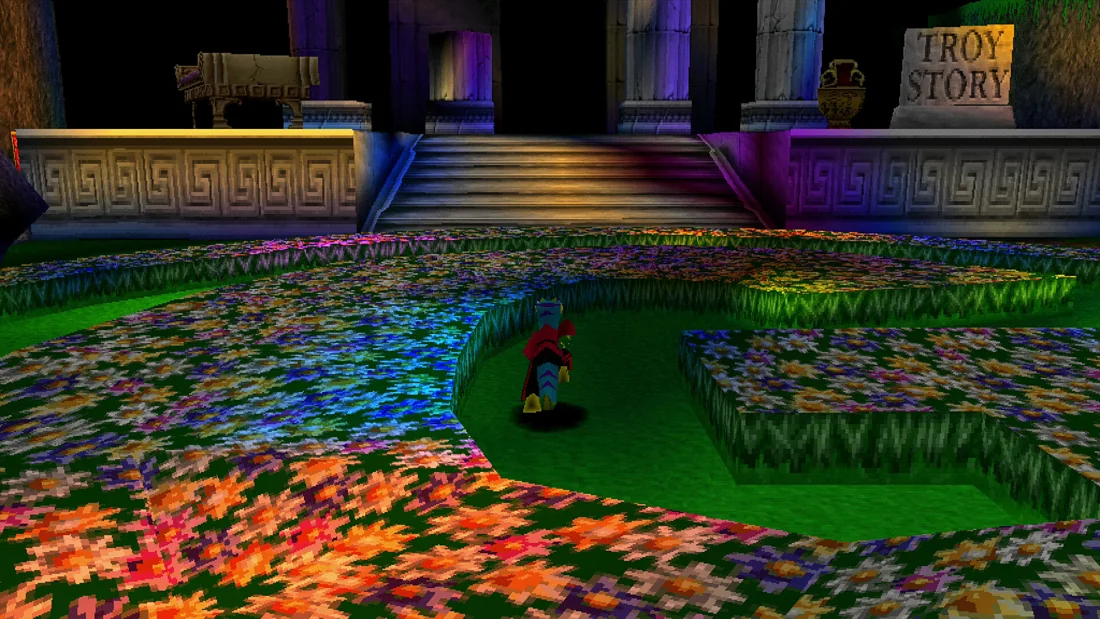
Toon TV is particularly well suited to him. Bright, exaggerated scenery encourages the player to accept a world built out of visual jokes. A gecko can become the target of a cartoon hunter without the premise requiring a long explanation. The character and the channel recognize each other.
Scream TV takes the opposite approach: dim interiors, sinister decoration, and corridors that make the environment feel less friendly. The joke is not simply that a cartoon lizard has wandered into a horror movie. He has wandered into one and refuses to behave like a frightened victim. The player may be trying to work out which way a staircase goes while Gex is busy commenting on the entertainment.
The genre changes give a relatively small cast a lot of range. Rez supplies the recurring menace, but the individual stages can audition an entire television evening. A martial-arts channel changes the atmosphere without requiring a new hero. A science-fiction set trades the haunted-house furniture for machinery and strange colored light. The remote is both progress token and editorial license.
The game’s visual density can become its own obstacle. A new room is entertaining to look at, but the useful route is not always obvious. Collecting the full set of rewards means returning to places you have already learned and checking corners that seemed irrelevant on the first trip. Sometimes the extra visit reveals a clever use of the set. Sometimes it feels like searching under the sofa cushions after the program has finished.
The camera joins the cast, uninvited
For all the new space, Enter the Gecko rarely feels as effortless as its best contemporaries. Gex can be hard to line up against an enemy, and depth can turn a simple-looking jump into a dispute between the player and the camera. The speech keeps going while the player sorts it out.
The collision is comic until it is not. A quip delivered during a successful leap feels like the character joining your good mood. The same quip after a missed landing can feel like the game mocking the person holding the controller. Repetition changes the relationship.
GameSpot’s archived PlayStation review awarded a 6/10, admiring the graphics and frame rate while objecting sharply to the commentary and camera. Its criticism was not that Crystal Dynamics had failed to make a colorful 3D world. It was that spending time there could become frustrating.
Other players loved the same combination. The sequel offered the pleasure of exploring a ridiculous set with a hero who seemed to share your memory of it. Gex did not need to be the most refined mover in the genre to become somebody’s favorite companion. He needed a world they wanted to visit and a voice they wanted to hear.
That voice, however, depended on where they bought the game.
One gecko, several childhoods
American players heard Dana Gould in the main console trilogy. For the British English version of Enter the Gecko, the role went to Leslie Phillips. Known for the cultivated comic charm of British film and television, Phillips made the secret-agent disguise sound like it belonged to a different sort of rogue.

The change was larger than an accent. Gould’s Gex often sounds like a stand-up comedian who has been allowed to comment from inside the set. Phillips gives him a more polished, knowing manner. Both can inhabit the same green body, but they suggest different people under the tuxedo.
When the third game came along, its British English Gex changed again. Danny John-Jules, familiar to Red Dwarf viewers as the Cat, took the part. His television background gave the casting an extra layer of recognition: a character obsessed with the screen was speaking through someone many players already knew from it.

The Japanese sequel also reached players under the title Spin Tail. Gex’s television comedy travelled, but it did not travel as one unaltered performance. The regional release history and the later publisher’s PAL restoration announcement help explain why fans can remember ostensibly the same game so differently.
“for a lot of us in PAL regions Leslie Phillips IS Gex.”
— rushdisciple, in the June 2025 r/gex discussion of the restored regional versions
Another participant, dewittless, identified John-Jules as “definitely my Gex voice.” Those are memories rather than casting records, but they capture the attachment. A familiar voice becomes part of the controls, the rooms, and the afternoon spent playing. Replace it and the game can feel subtly wrong even when every platform is where it should be.
The Nintendo 64 version was its own bargain
Gex 64: Enter the Gecko brought the sequel to Nintendo’s console later in 1998. It also changed the package. Cartridge space constrained the filmed presentation and speech, while some content differed from the PlayStation edition. The Nintendo version included an exclusive underwater Titanic-themed stage, documented in the original MAN!AC review preserved by the magazine’s website.
An extra stage made the port worth examining, but it did not erase its problems. GameSpot’s Nintendo 64 review was harsher than its PlayStation assessment, criticizing difficult positioning, camera movement, and performance. “Same game on the more powerful console” was a poor guide to what a buyer actually received.
The comparison is especially revealing for Gex. A little less speech might seem welcome to a player tired of hearing him. Yet the recorded performance was also central to the game’s identity, and a smaller pool of lines could make the remaining ones more familiar. The port had to juggle the very things that made the character distinctive.
The Windows edition offered another route into the 3D adventure. Today, screenshots from that version can look like the game many PlayStation players remember, but the platform histories should not be collapsed into one release. Gex spent this period being adapted for machines with different strengths, not merely stamped onto different discs and cartridges.
A smaller screen, a different game
The 1998 Game Boy Color version of Enter the Gecko made a more radical change. David A. Palmer Productions created a separate 2D adaptation, published by Crave. It shared the name and television-world premise with the big-console sequel, but its tiny side-scrolling spaces were a different adventure.

That distinction is easy to miss in a modern trilogy discussion. The handheld game could not simply shrink the PlayStation levels and keep their camera, voice library, or scope. It had to decide which parts of Gex survived when the spectacle went away.
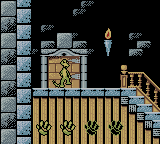
The answer was the recognizable little body, its tail and climbing abilities, and a set of themed stages. The original handheld booklet accompanies a game that returns him to a flat world. Its screenshot of Gex clinging to a wall makes the resemblance to the first game easier to see than the resemblance to its namesake.
Without constant speech, the handheld gecko is a quieter figure. The game asks its small sprites and level themes to do work that the console edition could delegate to a recorded joke. That gives the adaptation a peculiar place in the family: marketed beside the big 3D reinvention, it looks back toward the physical idea that made Gex work in the first place.
Deep Cover Gecko turns the dial further
Crystal Dynamics returned to the main series in 1999 with Gex 3: Deep Cover Gecko. Eidos was now publishing the adventure, following its acquisition of the studio in 1998. Schofield later recalled participating in the choice of buyer; his GamesRadar interview describes a team attracted to the company behind the enormous success of Tomb Raider.
Gex’s next assignment made the spy spoof more conspicuous. Rez had kidnapped Agent Xtra, played in live-action sequences by Marliece Andrada, a model and former Baywatch performer. A real woman now shared the adventure’s packaging and filmed scenes with the computer-generated gecko.

The mixture is a very particular late-1990s sales pitch. The platform hero remains a bright green cartoon animal, while the spy fantasy borrows glamour and suggestive humor from an older audience’s entertainment. Gex had always talked about television. Now a television performer was standing beside him.
The filmed framing does not turn the game into an interactive movie. Most of the time, the player is still collecting remotes in 3D worlds. But the staging makes the broader pitch unmistakable: this mascot wants to be seen as worldly, mischievous, and a little too pleased with himself.
The new costumes give that attitude something useful to do. In various worlds, clothes change more than Gex’s silhouette. A vampire-style outfit can support gliding; a pirate’s hook gives him another way to travel. Vehicles and minigames interrupt the usual hunt. The original PlayStation manual and GameSpot’s account of the Nintendo 64 edition document the expanded moves and activities.
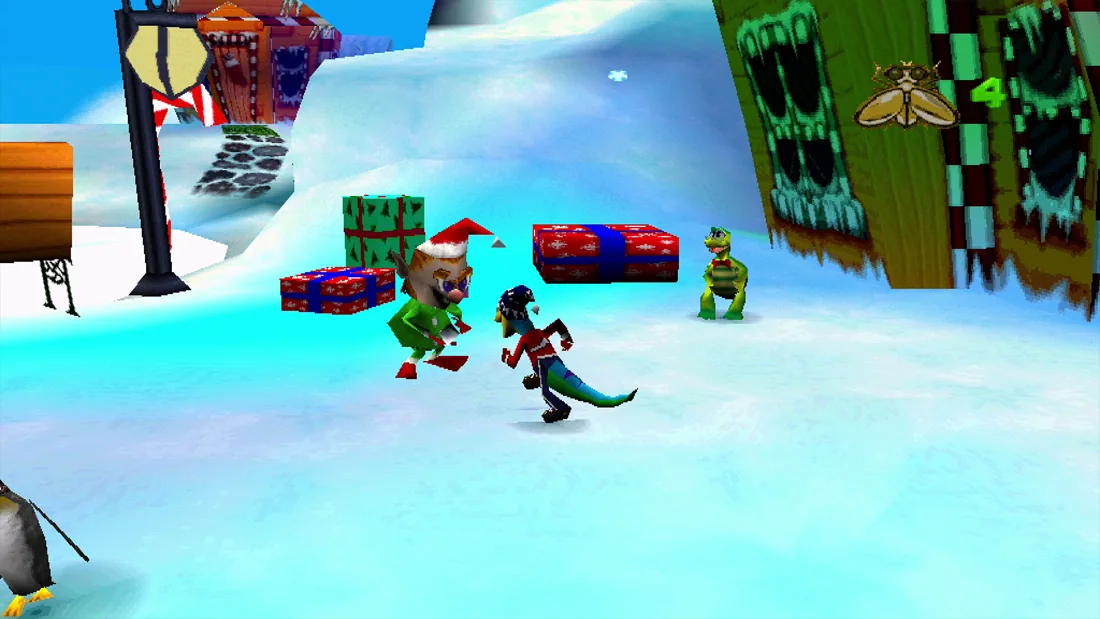
A snowy holiday world is a particularly good fit for the series’ way of thinking. The environment can be festive, hostile, and silly at once. Gex does not need a solemn reason to dress for the snow or find trouble among seasonal decorations. He has entered another channel; the costume department has already gone to work.
The variety makes the third game easier to enjoy in stretches. A different outfit or activity gives the next visit its own texture. It also exposes the limits of expanding an established formula. More things to collect and more tasks to complete do not automatically make a large room more interesting to navigate.
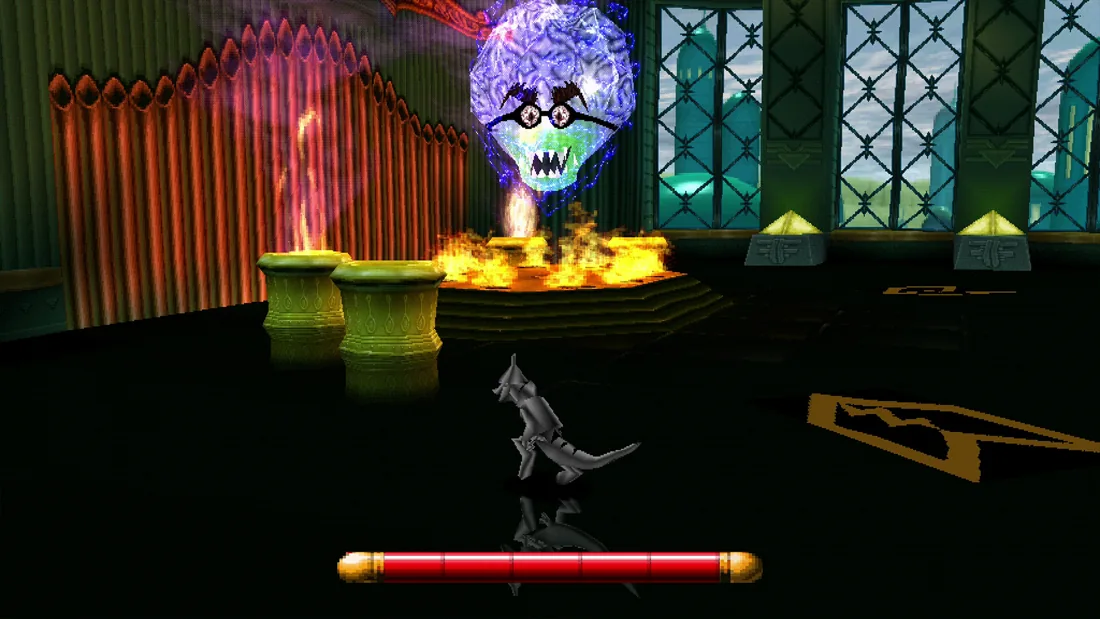
There are moments when the extra business is entertaining and moments when the assignment feels longer than the joke supporting it. The player may be drawn back by a new costume, then held there by another search. Gex’s talkative personality works best when the action keeps pace with him.
Reception remained divided. GameSpot’s Nintendo 64 review gave that edition 5.3/10, finding worthwhile design improvements but faulting the port’s visual and performance problems. It explicitly preferred the PlayStation experience.
“the comedian doing Gex’s voice gets way too repetitive.”
— TKimmel626, in a 2000 GameFAQs PlayStation review that nevertheless awarded the game 8/10
The favorable reader review makes a useful companion to the professional criticism. A player could acknowledge the repeated jokes and still want all the remotes. The series was never as universally despised, or as universally adored, as the loudest modern jokes about it suggest.
Deep Pocket Gecko keeps the television, loses the tuxedo spectacle
The Game Boy Color received another separate adaptation in 1999: Gex 3: Deep Pocket Gecko. Again developed by David A. Palmer Productions, it translated themed missions into a 2D handheld game rather than recreating the console adventure’s spaces.
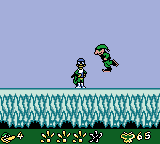
The holiday stages show how much personality could fit into a very small picture. Skating elves become enemies or objectives; a Santa fight supplies a ridiculous destination. The player still has a channel, a task, and a gecko who needs to get through the scenery. The game trades recorded performance for visual shorthand.
It also offered swimming, snowboarding, and a kangaroo ride. GameSpot gave Deep Pocket Gecko an 8.1/10, praising its animation and controls while noting that the tail bounce took practice. The little adaptation earned a warmer assessment from the same publication than either of the Nintendo 64 releases. The smallest Gex had something to brag about.
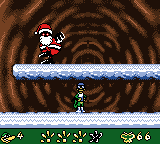
A 2007 player review by 1Wiifan remembered buying it under a ten-dollar budget and being surprised by how much fun it supplied. The complaint was wonderfully practical: forgetting to write down the password meant repeating the opening stages. A portable adventure could survive without the voice acting; remembering where you left off was another matter.
“I never expected a $10 game to be this much fun!”
— 1Wiifan, remembering Deep Pocket Gecko on GameSpot
A player carrying one of these cartridges around had a different Gex from the one on the living-room television. He had smaller stages, a much quieter personality, and enough of his old acrobatics to make the journey recognizable.
By the end of 1999, the series had covered three main adventures and two handheld reinterpretations. Gex had been a 3DO mascot, a cross-platform 2D survivor, and a 3D secret agent. A fourth main game seemed like an ordinary next step. It would remain a missing channel.
And then the program stopped
Gex did not finish his third adventure with an announced retirement. There was no grand farewell to the Media Dimension, no public ceremony for Crystal Dynamics’ mascot. The releases stopped, and the rest of the industry kept moving.
He still picked up guest work. The western versions of Hot Shots Golf 2 let players unlock him as a golfer, and Crystal Dynamics’ Mad Dash Racing brought him into an Xbox racing game in 2001. These documented appearances kept the mascot visible beyond his own platform adventures. A lizard with this much confidence was unlikely to see a golf course as a reason to stop showing off.
The turn of the century was an awkward moment for a character whose identity was so closely tied to the previous decade. New consoles offered larger worlds and more elaborate presentations. A wisecracking animal could still thrive, but the crowded mascot field no longer guaranteed a place simply because a studio had one.
Crystal Dynamics’ later reputation would rest heavily on Legacy of Kain and Tomb Raider. Gex belonged to its history without being the center of its future. The studio’s changing ownership would keep his name circulating in corporate family trees even when no new platform adventure followed.
There are traces of a proposed Gex 4. Unseen64 preserves concept art associated with a cancelled fourth game, while cautioning that its platform and surrounding information are poorly documented. The sketches leave much of that possible next adventure to the imagination.
It is tempting to attach a clean explanation to the silence: a disastrous sales number, a publisher’s revenge, or a sudden rule against talking animals. The surviving public record does not justify that tidy ending. What it does show is that the main series stopped at three games, despite ideas for continuing it.
The little gecko who almost got an audition
Another route forward appeared in a small PlayStation demo dated January 25, 2001. Gex Jr. put a younger-looking gecko in a short 3D level. It came from ImageBuilder Software, a company with a background in CD-ROM entertainment, rather than the team that had made the main trilogy.
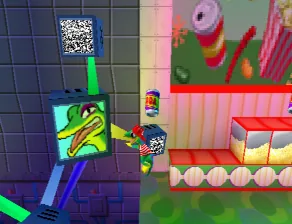
The preservation record at Hidden Palace documents the build and developer recollections. Those recollections describe ImageBuilder learning new 3D skills and making a concept in hopes of selling the idea. The demo resurfaced publicly in April 2022.
Its scale is modest: one short playable space, collectible soda cans, a small selection of moves, and a voice that reaches toward children’s television as well as other pop-culture references. Finish the little level and it starts again. The demo gives its young hero enough room to audition, then sends him back to the beginning.
For a series built around changing channels, these abandoned possibilities have an appropriate quality. Someone tried another program. The audience never got a full episode.
Gex learns to live in reruns
The original games were not erased. Copies remained on shelves and in collections, while digital rereleases on PlayStation hardware gave some players another way back. The character also found a second career as an online punchline.
A 2012 video titled Gex is the Bexst, from the videogamedunkey channel, is one surviving example of that afterlife. In videos and fan discussions, the gecko became shorthand for a particular kind of 1990s excess: a mascot who has watched everything and will tell you about it whether you asked or not.
That reputation can flatten the games. Clip a handful of references together and Gex looks like a novelty delivery system with a jump button attached. Spend time exploring the first game’s surfaces or a sequel’s elaborate channel and there is more design underneath. The joke about Gex and the appeal of Gex can coexist.
His references also changed texture as they aged. A gag that once pointed to something currently on television could become a clue to what the room sounded like in 1998. Younger players might understand the rhythm without recognizing the target. Older ones might recognize it far too well. Gex became an accidental archive of the entertainment his writers assumed was common knowledge.
In 2015, Square Enix offered a possible way out of the reruns. It opened Gex, Fear Effect, and Anachronox to developer proposals through its Collective program. The announcement coverage described an approval and crowdfunding route rather than a newly commissioned sequel.
A developer could now bring an idea to the rights holder, but there was still a game to fund and build. No new Gex adventure emerged from that invitation.
Ownership supplied another opportunity for confusion. Embracer’s 2022 deal included Crystal Dynamics and major associated properties. Gex did not simply follow the studio out of Square Enix. The later collection announcement identified Square Enix as the intellectual-property holder, and the released collection’s copyright notice still names Square Enix.
The studio that created a mascot and the company holding that mascot’s rights were no longer the same corporate story. Gex’s return would come through a specialist in bringing older games back.
The comeback finally gets a release date
Limited Run Games announced GEX Trilogy in July 2023. After decades of gaps, prototypes, and hopeful conversations, there was an actual collection on the way. It would reunite the three main adventures through the publisher’s Carbon Engine.
Before the collection arrived, Astro Bot gave him another guest appearance. The 2024 Winter Wonder update included a Gex-inspired bot called the Square-Eyed Gecko, recorded in the game’s bot roster. A character once trying to become the next major mascot had become part of a newer platformer’s celebration of gaming history.
The digital release followed on June 16, 2025, for PlayStation 5, Xbox Series X|S, Nintendo Switch, and PC. The publisher’s launch announcement described rewind and saving anywhere across the collection, alongside native widescreen and full 360-degree analog movement for the two 3D games.
Those additions address two different kinds of age. Rewinding a missed jump makes an old difficulty spike less expensive. New analog movement changes how Gex responds under the thumb. Neither has to replace the worlds with newly invented scenery to make a return visit more approachable.
The collection uses the PlayStation versions as its foundation. It is an emulation-based restoration with enhancements, not three adventures rebuilt from scratch with contemporary art. The first game is still a 2D game; the other two still carry the layout and habits of 1990s 3D platformers.
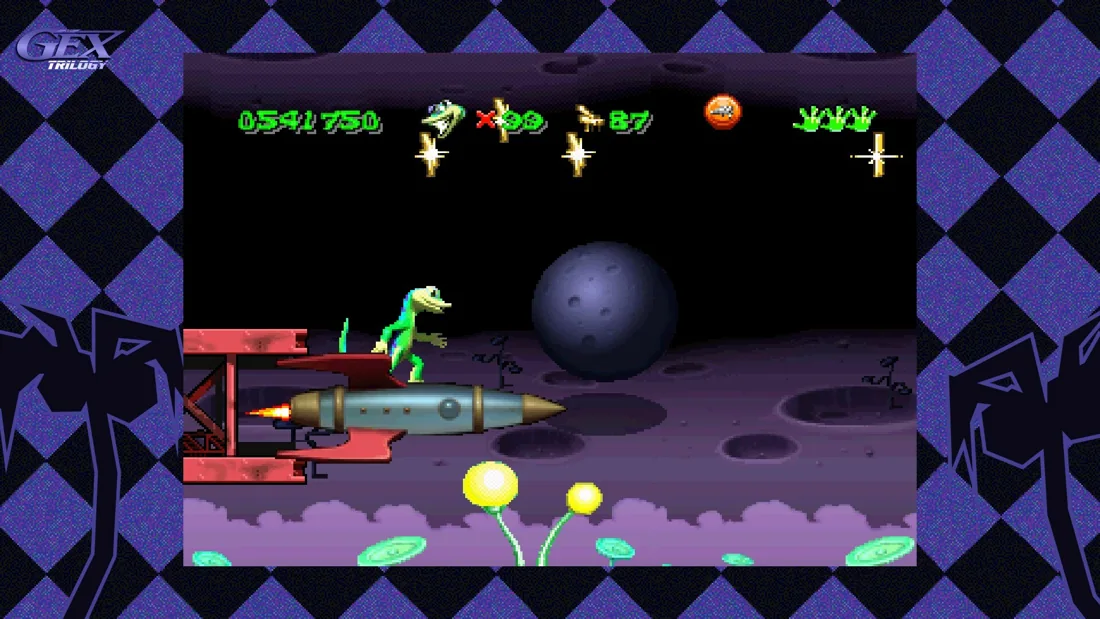
That choice also sets the collection’s boundaries. The Nintendo 64 editions’ differences and the separate Game Boy Color adventures are not additional playable games in the trilogy. A convenient modern package can bring a series back without preserving every branch of its release history.
The official Steam listing also describes a music player, artwork, old commercials, and a new Dana Gould interview. These extras suit Gex particularly well. The surrounding sales pitch was always part of the character, and the commercials preserve the moment when somebody expected this lizard to become the next enormous star.
The collector editions took that impulse to a comic extreme. Limited Run offered a Tail Time Edition priced at $199.99 in its announcement-era range, with assorted physical extras. A series that had spent years as an unlikely comeback candidate was suddenly being sold as a lavish keepsake. Gex had finally escaped the used-game bin, and he was not travelling light.
Bringing back the right voice
The regional recordings were a more consequential part of the comeback than any large box. On June 16, 2025, Limited Run announced that the PAL versions of the second and third games had been added on Steam, restoring Leslie Phillips and Danny John-Jules. Other platforms were to follow through their approval processes.
The publisher’s update notice also warned that saves did not transfer between the regional versions. This was a choice between game builds, not simply a voice slider that could be flicked halfway through an existing save.
For a newcomer, that might sound like a minor menu detail. For the players who had grown up with one of those performances, it decided whether the returning game sounded like home. The arguments in the fan thread were occasionally abrasive, but the basic request was sensible: preserve the version people actually played.
The comeback also needed ordinary repairs. A June 19 Steam patch addressed startup and audio issues and added keyboard remapping. Even a gecko returning from the 1990s had to make it through a modern launch week.
Finding the channel today
For somebody meeting the series now, the three main games offer different starting points. The original supplies the most distinctive climbing-focused 2D design. Enter the Gecko establishes the television playground many fans remember. Deep Cover Gecko elaborates the spy theme with costumes and more varied activities.
GEX Trilogy makes those adventures readily available on modern machines. If you want to revisit your original PlayStation copies, DuckStation is the relevant emulator in Retro Replay’s database. Our first PlayStation setup guide walks through using your own game dumps and BIOS. The 3DO, Nintendo 64, and handheld versions require their respective platforms’ emulators; DuckStation is the route for the PlayStation editions.
The smaller games are worth keeping in the conversation, too. Enter the Gecko on Game Boy Color and Deep Pocket Gecko reveal what designers thought the character could do without the console games’ constant speech and large sets. They complicate the easy story that Gex was nothing but his jokes.
The gecko who stayed on the air
The flaws are still there. A clever premise cannot rescue every jump, and a recorded joke cannot become new merely because the player has heard it again. But the games have a specific appetite for popular entertainment: rummage through it, wear its costumes, borrow its sets, and make a mess.
The best reason to revisit Gex is to see that appetite in motion. A gecko attaches himself to a wall, a remote opens another television, and the next room looks like something somebody watched too late at night. Then the lizard says something ridiculous. Sometimes it is funny. Sometimes it is unbearable. Either way, you know exactly whose game you are playing.
Keep exploring Retro Replay
- The history of Aero the Acro-Bat — another mascot trying to stand out in a crowded decade.
- The complete history of FMV video games — the filmed spectacle surrounding the CD era.
- The rise and fall of Acclaim Entertainment — the publishers, licenses, and sales pitches of the same turbulent market.
Sources and further reading
The reporting draws on developer recollections, original game documentation, release records, archived reviews, preservation work, and publisher announcements. Player quotations illustrate individual memories and opinions.
- Game Developer’s interview with Lyle Hall; his DICE speaker biography.
- Gregg Tavares’ archived Gex postmortem; Digital Press interview; Unseen64 interview.
- Glen Schofield’s career retrospective.
- Original Gex release records and credits; the Game Boy Color Enter the Gecko manual; the Deep Cover Gecko PlayStation manual.
- GameSpot’s Enter the Gecko review; Gex 64 review; Deep Cover Gecko Nintendo 64 review; Deep Pocket Gecko review; MAN!AC’s preserved Gex 64 review.
- Unseen64’s Gex 4 material; Hidden Palace’s Gex Jr. preservation record.
- The 2015 Collective invitation; the 2023 Trilogy announcement; Limited Run’s 2025 release announcement; official updates and the official collection listing.
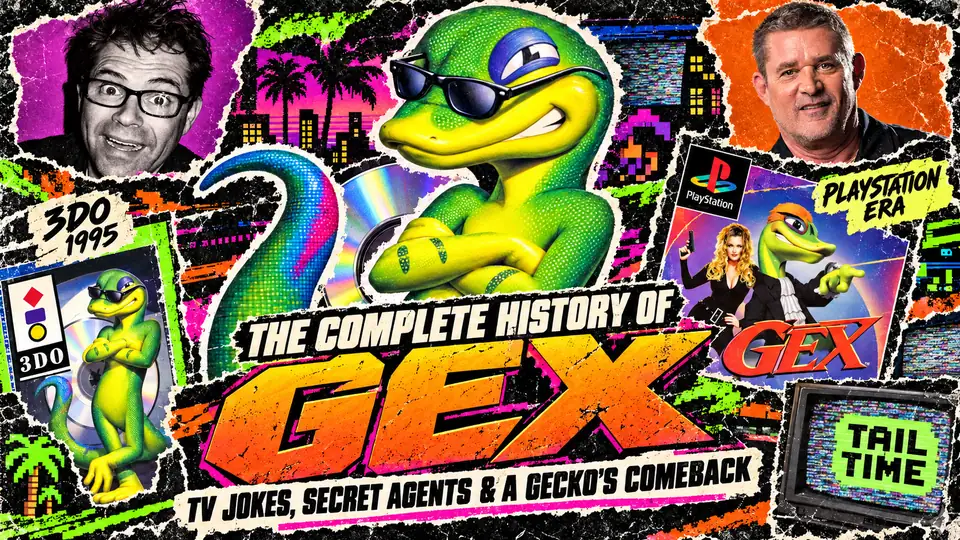
Featured cover: Retro Replay editorial collage generated from original Gex packaging and real portraits. Dana Gould photograph by Mandee Johnson / CleftClips, CC BY 2.0, adapted for the collage; Glen Schofield portrait sourced from PlayStation Blog.






The 3DO price makes Gex’s presentation choices easier to understand. Recorded speech and CD audio helped the mascot feel distinctive on older hardware, but the wall-climbing and platforming still had to carry the game once the novelty of hearing him heckle the screen wore off.