 Retro Replay Retro Gaming History, Reviews & Emulation
Retro Replay Review
Gameplay
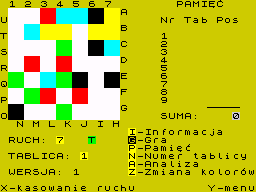
The first few moves in Mam Plan are immediately understandable: pick a row or column, push its colored tiles one square in a direction, and watch tiles at the far edge stay put. That last rule is where the puzzle gets its teeth. A move can reposition several tiles at once, but the immovable edge pieces make every shove feel like you are working around furniture in a room that is too small.
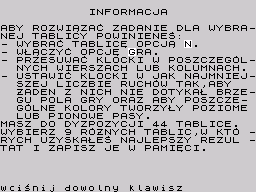
Your target is satisfyingly strict. It is not enough to collect matching colors; every tile must be off the board’s edge, and the colors must resolve into horizontal or vertical stripes. That combination gives each layout a real sense of cleanup. You are constantly balancing a short-term improvement against the risk of leaving a color stranded where it cannot be shifted in the way you need.
The 44 selectable boards are a good fit for the game’s direct, puzzle-box format. You can sit down with one layout, test an idea, undo the mistake, and gradually learn how a solution has to be constructed. Being able to save a state and review the moves you have made matters here, because this is exactly the sort of game where you will want to retrace the bad decision that ruined an otherwise promising arrangement.
Frustration will set in if you want lots of variety beyond the central rule set. Mam Plan commits completely to pushing lines and arranging stripes. But if that specific spatial challenge clicks, the restrictions are the point: each board asks you to think carefully about position, direction, and which tile must be freed first.
Graphics
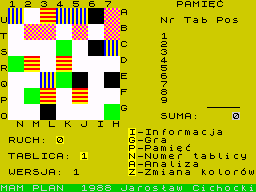
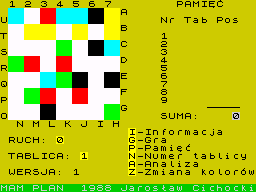
The board is a clean top-down 7×7 grid built from white squares and colored tiles, keeping your attention on where every piece sits and which rows or columns can be shifted. On a black-and-white screen, alternate tile graphics can be selected to make the pieces easier to distinguish, a practical option for a game that depends on tracking colors accurately.
Story
Mam Plan does not lean on a tale to carry you from one puzzle to the next. Its sense of progression comes from the boards themselves: a scrambled set of tiles, a plan forming in your head, and the quiet payoff when the stripes finally line up.
That bare approach suits the game. The objective is clear enough that adding decoration would only distract from the little dramas created by a tile stuck at the edge or a nearly completed stripe that needs one more carefully prepared push.
Think of each layout as its own miniature problem rather than a chapter in a larger journey. The satisfaction is personal and immediate: you make the plan, test it, revise it, and eventually prove it works.
Overall Experience
Mam Plan is a small, stern puzzle game with a clever core. Its best moments come when you stop making hopeful pushes and begin seeing the board as a connected system, where moving one line changes the future of several others. That shift from poking at the grid to deliberately setting up positions is when the game becomes rewarding.
It is especially easy to recommend if you enjoy abstract board puzzles and do not need a lot of ornament around them. The undo function softens the harsher trial-and-error moments, while the move review gives your eventual solutions a satisfying sense of method rather than luck.
Its narrow focus also makes the verdict simple. If arranging colored tiles into stripe patterns sounds like a pleasant mental workout, Mam Plan offers 44 opportunities to get properly stuck and then feel clever for escaping. If you need action, character, or changing modes to stay engaged, this compact grid will likely feel too austere.



Reviews
There are no reviews yet.