 Retro Replay Retro Gaming History, Reviews & Emulation
Retro Replay Review
Gameplay
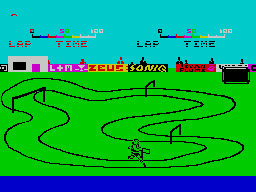
The first few minutes of Ready Steady Go are all about finding a rhythm. You alternate the left and right action keys to accelerate, and the hurdle event immediately asks whether you can keep that rhythm while squeezing in a jump at the right moment. Because the game guides the runner around the five-lap track, there is no course to learn and nowhere to hide: success comes down to speed and clean hurdle timing.
That stripped-back control scheme gets more interesting as the events pile on complications. Canoeing still wants that rapid left-right rowing, but holding an action key also steers, leaving you to balance pace against avoiding rocks and dealing with the current across its two overlapping course screens. It sounds simple until you are losing time correcting a bad line, and the need to finish four lengths while still afloat gives the event a properly punishing edge.
Track cycling is the strongest twist on the formula. Three lanes make positioning matter, the outside lane is quickest, and a crowded track can deny the lane change you need. Charge too hard into a bend and you risk a skid; ride into another bike from behind and you hand them a boost while losing speed yourself. The final penalty-saving event changes the pressure again: ten shots, seven dive directions, two dive speeds, and only one dive per kick. Committing early may save a shot, but it can just as easily leave you stranded.
The qualification structure is both the hook and the likely source of frustration. Events must be cleared in sequence, and solo play pits you against required scores or times rather than letting you casually sample everything. Two players get a more unusual setup, too: one competitor keeps taking turns until qualifying before the other steps up. That makes it less of a constant head-to-head contest than a series of pressure tests, but it suits the game’s insistence on earned progress.
Graphics
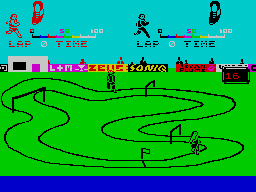
The events are presented through their distinct course layouts: canoeing moves between two partially overlapping screens, while cycling and penalty saving are explicitly framed in 3D. The cycling view has to carry lane position and traffic clearly, and the penalty scene focuses attention on the goalkeeper’s choice of dive direction.
Story
There is no narrative detour here. You enter a short run of sporting events, chase each qualification requirement, and move on only when you have done enough to earn the next discipline.
That bare structure works because each event creates its own little drama. A hurdle approached at speed, a canoe drifting toward rocks, a cyclist trapped behind another rider, or a goalkeeper making one irreversible dive all create immediate stakes without needing characters or cutscenes.
The progression itself supplies the arc. Early success builds confidence, later events add more to manage, and a miss or slow run sends you back into practice rather than onward. If you want a sports game with a tale to follow, this will feel austere; if you enjoy making your own story out of narrow wins and repeated attempts, it has a clear competitive pull.
Overall Experience
Ready Steady Go is an old-fashioned test of coordination, timing, and persistence. Its controls are easy to explain, but they are not automatically easy to master once steering, hazards, lane traffic, cornering, and one-shot dives enter the picture. The game gets mileage from asking you to apply one physical input pattern with different priorities in each event.
The payoff is strongest when you like chasing a qualification line and immediately knowing what went wrong. You pressed too hard through a cycling bend, gave away speed in traffic, steered the canoe poorly, or guessed wrong in goal. That clarity makes retries feel purposeful, even when the strict order means an event becomes a temporary wall.
Give it a chance if you want a concise Spectrum sports challenge that treats every event as a score-and-skill trial rather than a long simulation. It is less suited to relaxed multiplayer sessions, since turns do not alternate freely until qualification is achieved, but a determined solo player can get a lot from learning each discipline’s small set of sharp rules. The game is lean, demanding, and most satisfying when you finally turn a near miss into the qualifying run.


Reviews
There are no reviews yet.