 Retro Replay Retro Gaming History, Reviews & Emulation

Retro Replay Review
Gameplay
The first few minutes of Ballistic Diplomacy make you choose between sensible defense and greed. Castle sections fall from the top of the screen, and you have to fit them around your castle before time runs out. Closing off more ground and protecting more cannons earns points, so merely throwing up a tiny safe enclosure is not enough if you want to win.
That construction round has real tension because unfinished walls are a serious liability once the shooting starts. You are not leisurely designing a fortress; you are making fast compromises, deciding whether an awkward falling piece is worth forcing into place or whether you should save the situation with a less ambitious layout. The game’s top-down view suits this cleanly, keeping the basic geography of walls, open gaps, and cannon positions easy to understand.
Once cannons are placed, the match turns from frantic puzzle-solving into direct siege warfare. Breaking an opponent’s walls is the obvious priority, but the scoring rule means you also need to think about what your own construction has earned. That makes the three-phase loop feel more purposeful than a simple artillery exchange: your aim matters, but so does the fortress you built under pressure.
Five rounds is a smart match length. It gives a bad early round time to matter without making one disaster automatically final, and it keeps multiplayer contests moving. Free-for-all and king-of-the-hill support up to four simultaneous participants, while tournament play accommodates eight over modem. The single-player levels steadily raise the difficulty, making them a solid way to learn how quickly a seemingly minor hole can become a decisive weakness.
Graphics
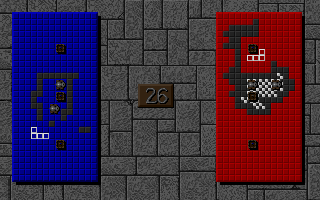
The game is viewed from above, with castle pieces dropping into the build area and opposing fortifications laid out for the combat phase. That practical viewpoint fits the action: you can quickly judge the shape of a wall and see where enemy cannon fire has opened a route inside.
Story
Ballistic Diplomacy’s joke is its whole dramatic setup: castle lords settle diplomatic matters with cannons. It is a light, appropriately combative frame for a game built around fortifying a position and then wrecking someone else’s work.
The stronger moments come from the stories matches create for themselves. A rushed gap in the wall, a daring attempt to score more by enclosing another section, or a well-placed shot that ruins a rival’s plans gives each round a small siege narrative without slowing down the action.
That stripped-back approach works because the game never asks its premise to carry more than it needs to. The diplomacy is in the retaliation: build, get shelled, patch together a better plan next round, and return fire.
Overall Experience
Ballistic Diplomacy is at its best when you enjoy games that make speed, spatial judgment, and aggression pull in different directions. The building phase is not just setup for the cannons; it is where you decide how much danger you are willing to invite for a higher score. When that starts to click, every falling piece feels like a meaningful little problem.
Frustration will set in if you dislike time-limited placement puzzles or want a pure artillery game. A weak wall can hand an opponent a huge advantage, and the game is deliberately unforgiving about that. Still, the punishment is tied to a decision you can understand, which makes losses more likely to produce a better plan than simple resentment.
Give it a chance if Rampart’s build-and-destroy cadence appeals to you and you want more pressure around the construction itself. The escalating solo levels offer a useful proving ground, but the competitive modes are where Ballistic Diplomacy’s quick reversals and score-chasing decisions have the most bite. It is a focused strategy game with a simple loop that remains sharp because every phase feeds directly into the next.



Reviews
There are no reviews yet.