 Retro Replay Retro Gaming History, Reviews & Emulation


Retro Replay Review
Gameplay
The first few minutes of Bravo Romeo Delta are unnerving because you do not begin with a tidy build-up. A Soviet submarine has already fired three missiles at the United States, and you immediately have to think like someone trying to prevent a catastrophe while still preparing to win one. Pick either superpower, assess the incoming danger and your available forces, then start making decisions under a real-time clock. You can speed that clock up, but doing so is an invitation to let a manageable situation get away from you.
This is not a game about simply selecting the biggest weapon and erasing targets. You have access to gravity bombs, submarine-launched ballistic missiles, silo-based ICBMs, and mobile launchers, but each strike must be considered in terms of factors including weather and a missile’s ability to penetrate hardened targets. The useful part is that weapon and vehicle data is available to consult. What begins as dry reference reading becomes the heart of the game: you are constantly trying to match the right payload to the right problem before the enemy does the same to you.
Its central challenge is wonderfully grim. You need to reduce the computer opponent’s ability to command, communicate, and launch attacks while keeping enough of your own nuclear threat alive to remain ahead. That means brute-force retaliation can be a trap. Attack population centers and the computer can answer with mutually assured destruction; let the escalation creep too far and careful planning can collapse into a losing exchange. The computer responds to a slow escalation in kind, so restraint is not passivity here—it is a strategic tool.
Frustration is part of the package. The stated objectives are extremely difficult, and the game asks for patience with an austere interface, coordinate-based locations, and decisions whose consequences are brutally large. Still, the friction has purpose. If you enjoy strategy games where the winning move is often the one you decide not to make, Bravo Romeo Delta creates a rare kind of suspense.

Graphics
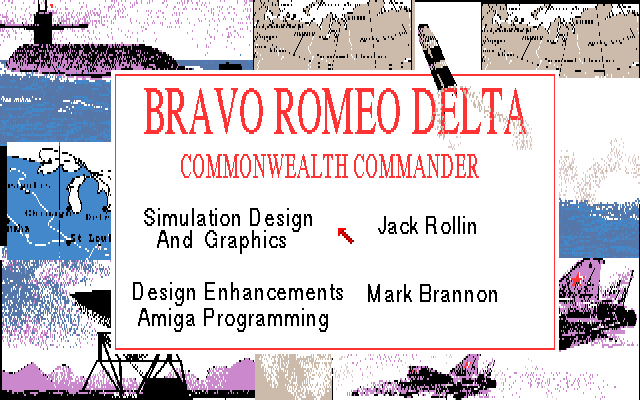
Bravo Romeo Delta is visually bare-bones, built around four screens for reports and input rather than detailed battle scenes. Geographic locations appear as coordinates, while the rest of the view is focused on the information needed to direct an escalating nuclear exchange.
Story
There is no need for a sprawling campaign narrative when the opening situation already carries so much weight. Three missiles launched from a Soviet submarine create an immediate crisis, and your choice of the United States or USSR places you on one side of a conflict where neither side can treat survival as guaranteed.
The story emerges from escalation. A limited response may bring a limited reply, while attacks on population centers can push both sides toward destruction. That structure gives every decision a bleak narrative meaning: are you preserving a deterrent, attempting to cripple the other side’s command, or crossing a line that cannot be uncrossed?
It is a cold-war scenario told through reports, targets, and threat levels rather than character scenes. For this particular subject, that distance works. You are not asked to cheer for destruction; you are asked to understand how quickly a supposedly rational exchange can become impossible to control.
Overall Experience
Bravo Romeo Delta is a stern, specialized strategy game that gets its hooks into you through pressure rather than polish. Its real-time pacing and hard objectives make even a short session feel consequential. When you finally understand that preserving your own command and arsenal matters as much as damaging the enemy’s, the game’s severe logic starts to click.
The four-screen interface and data-heavy decision-making will not charm anyone looking for immediate action or lavish visual feedback. You need to be comfortable reading, comparing, waiting, and accepting that an apparently sensible strike may not deliver the result you wanted. That harshness is exactly why the game has teeth.
Give it a chance if you want an unusually serious nuclear strategy simulation, one where escalation management matters more than raw firepower and victory is deliberately difficult. It is not welcoming, but it is focused: a tense contest of deterrence, timing, and restraint that makes success feel earned.


Reviews
There are no reviews yet.