 Retro Replay Retro Gaming History, Reviews & Emulation
Retro Replay Review
Gameplay
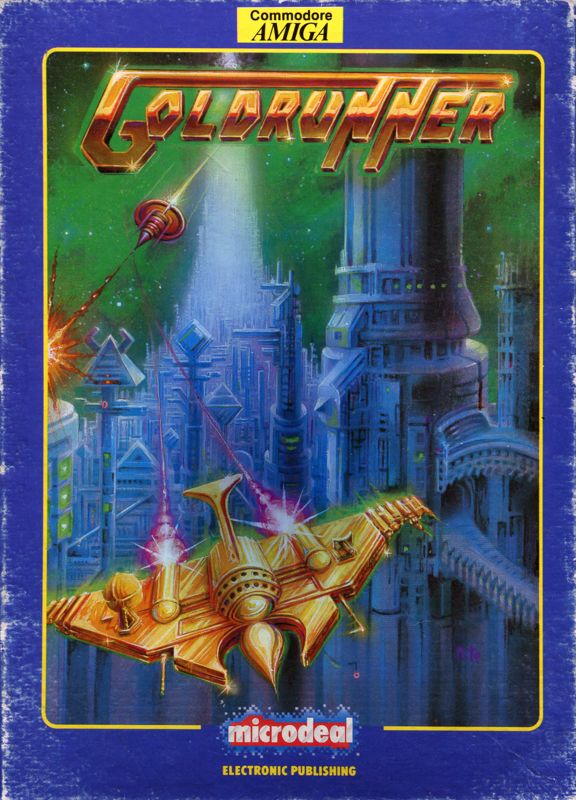
Goldrunner starts by putting you in a small ship with an enormous job: infiltrate Triton’s ring-like space stations and reduce their energy by wrecking the installations within. It is a vertical scroller, but it does not feel like a cautious survival exercise for long. You are meant to drive into the chaos, shoot constantly, and keep enough awareness to avoid the few things that truly matter.
The clever wrinkle is that ramming ordinary enemies does not hurt you; it hurts them. That changes your instincts in a satisfying way. Instead of treating every hostile craft as a wall, you can barrel through opposition and preserve your attention for mines and the high indestructible buildings. Mines chip away at a ship that can endure five hits, while a building collision kills immediately. That contrast creates the game’s tension: you can play boldly, but one bad line through the scenery can erase a strong run.
The turbo boost is more than a flashy extra because speed is both an escape tool and a way to make mistakes faster. Use it when you have a clean route and it feels great to surge through a dangerous section; lean on it blindly and you invite a fatal collision. The goal of destroying enough material to drain each ring’s energy also gives shooting a purpose beyond simply surviving the scroll.
Between-level bonus rounds keep the arcade rhythm moving and feed the high-score chase. Goldrunner is not complicated, and that is part of its charm. Its challenge comes from making fast decisions in cramped, hostile routes, then returning with better knowledge of where not to fly. Frustration will set in if instant-death buildings catch you repeatedly, but the collision rules are clear enough that failed attempts usually feel like lessons rather than nonsense.
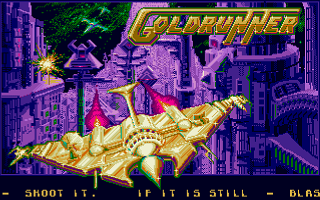
Graphics
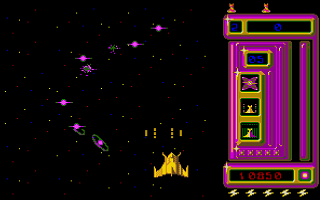
The action is viewed from above as the battlefield scrolls vertically, with your ship threading through enemy forces, mines, and tall structures. The most important visual distinction is practical: ordinary enemies can be rammed, mines are dangerous, and the high buildings are the hard obstacles you must not touch. In a game moving this quickly, that clear separation matters.

Story
The setup is brisk sci-fi pulp. Environmental pollution has forced Earth’s evacuation fleet to travel through Triton, whose inhabitants respond with hostility. Since a frontal assault on their giant rings will not work, your lone ship has to break in and destroy them from the inside.
It is mostly a clean excuse to send you into one hostile station after another, and that is exactly what it needs to be. Goldrunner does not ask you to linger over the evacuation crisis or Triton’s politics. The story gives the destruction a little urgency, then gets out of the way for the score attack.
That directness suits the game’s arcade focus. You are not weighing decisions or following a layered campaign; you are the pilot sent into an impossible-looking route because somebody has to make the rings fail. The premise is thin, but it matches the forward momentum well.
Overall Experience
Goldrunner earns its reputation as a solid, focused old-school shooter through one strong rule change: enemies are often things to plough through, not merely things to dodge. That makes the first hour feel more assertive than many games of its type. You can take space, force a route, and concentrate on the hazards that demand real precision.
Its roughest edge is also its defining one. Instant death from a building can feel brutal after you have handled enemy pressure well, particularly at turbo speed. Yet that severity gives the runs weight, and the five-hit buffer against mines prevents every close call from becoming an immediate restart. Once the risk hierarchy clicks, the game becomes less about random panic and more about controlled aggression.
Give Goldrunner a chance if you enjoy compact arcade shooters where score runs, quick restarts, and route learning are the reward. It will not win over anyone who wants a forgiving shooter or an elaborate narrative, but it has a sharp core and enough danger in its scrolling courses to make improvement satisfying. The payoff is a brisk, demanding game that understands how much tension a single forbidden collision can create.
Reviews
There are no reviews yet.