 Retro Replay Retro Gaming History, Reviews & Emulation
Retro Replay Review
Gameplay
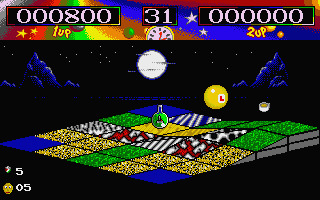
The first few minutes of Manix make its central trick easy to understand and surprisingly compelling. You study the intended arrangement of coloured garden squares, watch grenades ruin the layout, then bounce Filbert across the board to cycle tiles back to their proper colours. Landing on a square and seeing it lock into the correct colour gives you a small, welcome sense of progress.
The catch is that this is not a leisurely tile-restoration puzzle. Filbert is always a bouncing ball, so you are managing momentum and direction while trying to remember the opening pattern. A tile that has been corrected stays fixed, which lets you gradually tame a level, but another grenade can undo that work. That push and pull is where Manix earns its arcade label: you are not merely solving a board, you are trying to solve it while it fights back.
Enemies and hazardous squares keep routes from becoming too obvious, while power-ups can buy extra time or correct several tiles for you. The control-reversing power-up is a nastier proposition. It adds chaos, certainly, but it can feel like the game is yanking away the clean control you need to recover from a bad bounce. The time limit also makes memorisation matter more than it might in a calmer puzzle game.
With 128 levels, Manix has real endurance for anyone who clicks with this particular mixture of recall and reflexes. The downside is that its frustrations are built into the formula: losing a run because of pressure, hazards, or a late grenade is likely to sting. You need to enjoy repeated attempts and the gradual improvement that comes from learning a board’s demands.
Graphics
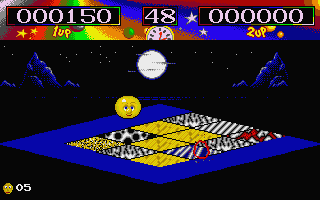
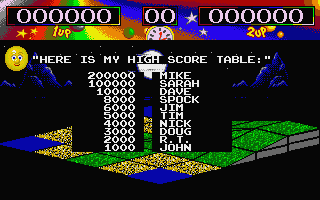
Manix is viewed from an isometric angle, with each level laid out as a garden surrounded by water and divided into coloured squares. That perspective gives the boards a clear toy-box shape, and the shifting tile colours keep the immediate goal visible as you bounce around the playfield.
Story
There is barely any story to slow things down, and that is appropriate here. Filbert’s garden is caught up in a war, grenades fall from the sky, and the damage has to be repaired. It is a functional excuse for the puzzle rather than a narrative you will follow for its own sake.
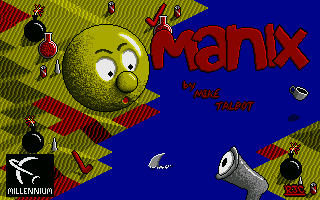
Still, the opening image does give the action a little more character than an abstract colour-matching challenge. You are not simply changing squares because a rule says so; you are restoring a place that has just been wrecked. The water-ringed gardens and airborne grenades make each level feel like a tiny emergency.
Do not expect plot turns or a developed cast. Filbert is a bouncing ball with a job to do, and Manix stays focused on that job. The spare setup works because it gets you into the first board quickly and keeps the stakes legible whenever a grenade overturns your progress.
Overall Experience
Manix is a sturdy, slightly mean arcade puzzler whose best moments come when you recover a messy board through quick thinking and precise movement. Correcting the last troublesome colours under a ticking limit can be genuinely satisfying, especially after the game has forced you to restart and reconsider your route.
It is less persuasive when interference feels arbitrary rather than challenging. Grenades can spoil completed work, hazards punish mistakes, and reversed controls can turn an already tense run into a scramble. If you want a relaxed exercise in colour matching, this will wear you down fast.
But if you have patience for 1990-style challenge and like puzzle games that demand both memory and hands-on control, Manix is worth sampling. Its idea is clear, its levels are plentiful, and its rough edges are part of a demanding package rather than evidence of a game without direction. At 6.2, it lands as an interesting mid-tier curio: enjoyable in short, focused bursts, but not always graceful when the pressure rises.



Reviews
There are no reviews yet.