 Retro Replay Retro Gaming History, Reviews & Emulation


Retro Replay Review
Gameplay
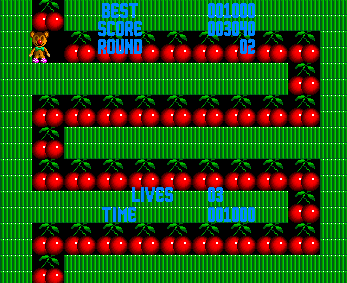
Robbeary is at its strongest when you stop treating a level as a collection errand and start treating it as a route-planning problem. Every screen asks you to collect all of its fruit, but the patrolling monsters make the obvious path a bad habit. You jump gaps, climb ladders, watch where danger is headed, and try to leave yourself an exit rather than blindly vacuuming up the nearest fruit.
The one-screen format gives each level a nice arcade immediacy. There is no long trek between objectives: you can see the whole problem, make a quick decision, and live with it. The holes at the bottom, which send Berrie through corresponding holes at the top, add a useful wrinkle. They can save a route or dump you into trouble, so learning when to use them is more satisfying than merely reacting at the last second.
The timer-driven enemy mutation is Robbeary’s best source of tension. Slow play is punished when the monsters turn into much quicker threats, and that means a cautious run can suddenly become the worst possible approach. Pickups that can turn enemies into diamonds or increase movement speed offer timely relief, but they do not remove the need to plan. The result is a brisk, sometimes unforgiving platform game that rewards familiarity more than improvisation.
With 24 levels, this is a compact game rather than an endlessly expanding challenge. Its basic loop does not change dramatically, so the fun depends on whether you enjoy squeezing cleaner runs out of fixed screens. If you like vintage arcade games where a single mistake can make the board feel much smaller, Robbeary has a pleasingly sharp edge. If you want constant new ideas, the repetition will arrive quickly.

Graphics
The side-view screens are built around platforms, ladders, gaps, fruit, and wandering monsters, keeping the action easy to parse while you are plotting a route. Berrie Bear’s bear-shaped criminal premise gives the game a light, cartoonish hook, while the enemy-to-diamond pickup creates a clear on-screen reward for grabbing the right extra at the right time.

Story
There is not much plot to interrupt the arcade work. Berrie Bear is an established criminal, and this time he is robbing the local store. That is the whole excuse for clearing screen after screen of fruit under pressure.
It is a silly setup, and that is the right call. A bear named Berrie Bear committing a robbery is more memorable than a generic hero rescuing anything, even if the game never develops the joke into a fuller narrative.
Do not come to Robbeary for character drama or a grand payoff. The story functions as a quick label on the action, then gets out of the way so the levels can carry the game.
Overall Experience
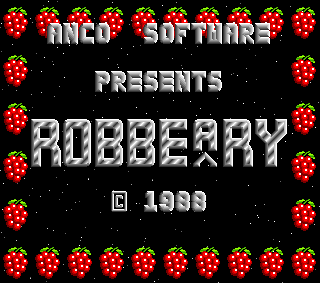
Robbeary is a decent slice of 1988 arcade platforming: direct, compact, and more stressful than its playful bear-thief concept initially suggests. The race against enemies that accelerate if you linger gives each screen urgency, and the wraparound holes keep the layouts from being completely straightforward.
Its limitations are equally plain. Once you understand the ladders, gaps, collectibles, and enemy patrols, the game is asking you to refine that same skill set across its 24 stages. There is satisfaction in that focus, but not much room for anyone who needs variety to stay engaged.
Give it a chance if you enjoy fixed-screen platformers that demand quick routes and steady nerves. Robbeary is not a must-play landmark, but it has enough clever pressure in its rules to make a short session feel earned—especially when you clear a screen just before its mutated enemies close in.



Reviews
There are no reviews yet.