 Retro Replay Retro Gaming History, Reviews & Emulation
Retro Replay Review
Gameplay
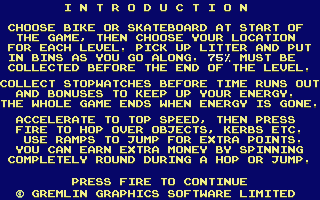
Skidz starts with an immediately understandable job—collect litter, carry it to dust bags, and hit 75% before you can move on—but it does not let you coast through that job. You build speed by holding a direction or button, then press again at high speed to jump. That rhythm makes the first few minutes feel wonderfully physical: get moving, line up an obstacle, and hope your timing is right. It also means one sloppy approach can turn a routine pickup into a crash.
The best part is that the litter is not simply laid out along a safe route. Some of it sits in places that demand tricky jumps, so you are constantly weighing whether a risky detour is worth the points and progress. The 75% target keeps the game from becoming a joyless scavenger hunt; you can leave a few especially nasty pieces behind. Still, the timer pushes you to keep moving, and that pressure is where Skidz becomes more than a novelty.
Crashes sting because health drops when you hit the scenery or citizens, roll over broken bottles, miss jumps, or fail a stunt. Some citizens even try to hurt you, adding another hazard to runs already full of bad landing spots. Stunts can earn bonus points, but they are a gamble rather than a free flourish. Coins matter between levels because they buy useful equipment, while health and time power-ups can rescue a run that is going sideways.
The skateboard and bike choice does not substantially change how the game plays, so pick whichever fits the fantasy you prefer rather than expecting separate handling styles. The extra race mode, a one-on-one contest through jumpable obstacles, is a welcome change of pace. Skidz is at its best when you accept that clean runs come from learning a route and respecting its speed system, not from blindly charging at every bit of rubbish.
Graphics
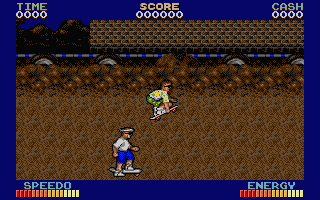
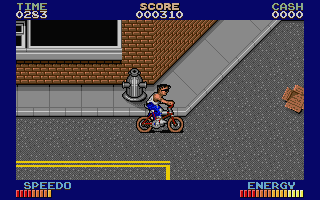
Skidz uses side-view, 2D scrolling levels, keeping your rider, the scattered litter, obstacles, and approaching citizens in the same busy strip of action. That perspective suits the game’s jump-focused design: you can judge the immediate obstacle ahead, but the speed of a run still makes poor timing costly.
Story
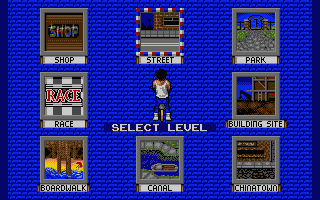
There is no elaborate tale pulling you through Skidz. You are cleaning up litter across five levels, trying to dispose of enough of it to earn access to the next area. It is a thin setup, but an appropriate one for a game that wants to get you rolling quickly.
What little character the game has comes from its mischievous framing. You are not carefully tidying a calm street; you are racing through hazardous spaces where citizens can be a problem and broken bottles punish careless lines. The cleanup theme gives the score-chasing a purpose without slowing the arcade pace.
That simplicity is a strength here. Skidz does not ask you to invest in plot or personalities; it asks you to care about the next jump, the remaining litter quota, and whether you have enough time to turn a messy run around. If you want a story-heavy campaign, look elsewhere. If you like an old-school premise that stays out of the way, this does exactly enough.
Overall Experience
Skidz is a compact, prickly arcade game whose central trick holds up better than its premise suggests. Building speed before you can jump gives its routes real tension, while the litter quota creates a nice balance between completionism and survival. You are not merely racing to the finish; you are deciding which risks are necessary.
Frustration arrives when the game punishes momentum you have spent time building. A mistimed jump, a collision with the environment, or a badly chosen stunt can drain health and momentum at once. That is very much the point, but it will feel harsh if you want a forgiving platformer or a pure racing game. Skidz expects repeat attempts and rewards familiarity.
For the right mood, the payoff is there: a short run becomes a tense little routing puzzle, and a successful jump feels earned because failure is always nearby. Its bike-versus-board choice is mostly cosmetic in practical terms, but the combination of collection goals, hazards, power-ups, stunt bonuses, and race mode gives the game more texture than a single gimmick. A 7.1 fits: imperfect and demanding, yet distinct enough to recommend to fans of brisk, unforgiving 16-bit arcade challenges.
If you are curious about where it fits in its era, Skidz’s release history is useful context. More importantly, go in ready to learn the jump timing. Once that clicks, cleaning up these levels becomes surprisingly satisfying.


Reviews
There are no reviews yet.