 Retro Replay Retro Gaming History, Reviews & Emulation


Retro Replay Review
Gameplay
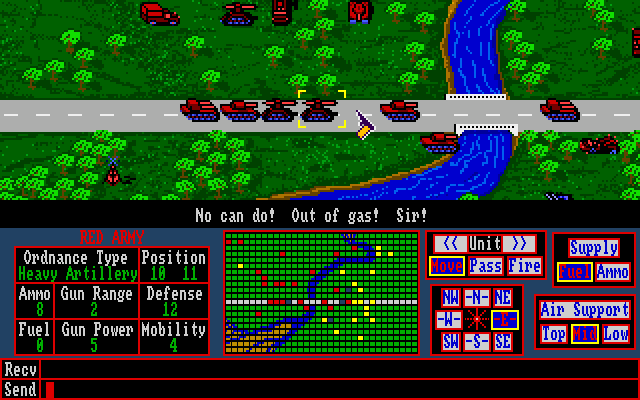
TeleWar starts with a wonderfully immediate tactical question: where can you move without clogging your own army? You cycle through units with the mouse, point them toward a destination, rotate turrets, and fire through controls along the bottom of the screen. That direct setup makes the opening turns easy to understand, but it does not take long before the battlefield starts punishing casual decisions.
Fuel and ammunition are the heart of the game. Light and heavy armour, light and heavy artillery, and supply trucks all have different reach, firepower, and reserves, so you cannot simply shove every combat unit forward. Let a truck fall behind and an attack can stall. Pack units too tightly and one slow mover can hold up the entire advance. The result is a compact tactical game where your formation matters constantly.
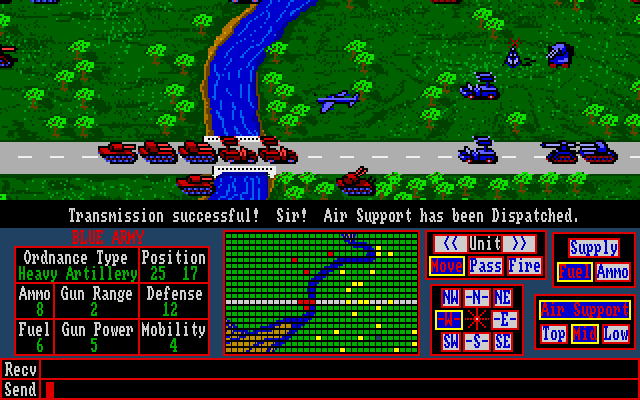
The eight-direction firing rule gives placement real bite. Artillery and armour are not interchangeable pieces; range and facing ask you to anticipate where a fight is heading rather than react after it begins. Air support adds a tempting gamble, since it costs a turn and depends on your radio antenna surviving. That is the kind of decision TeleWar handles well: a clear tradeoff that can swing a battle without feeling arbitrary.
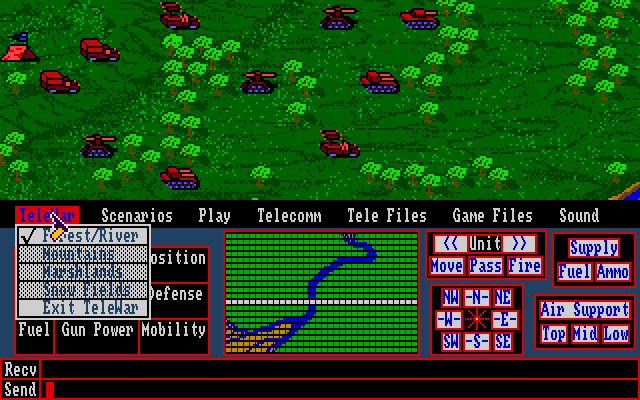
Its focus is firmly on head-to-head play. Modem and null-modem games fit the design naturally, while hot-seat play lets two people argue over the same computer. The four scenarios, four terrain types, and two victory routes—destroy the enemy force or capture the flag—give you enough structure to make each match feel like more than a straight shooting contest.
Graphics
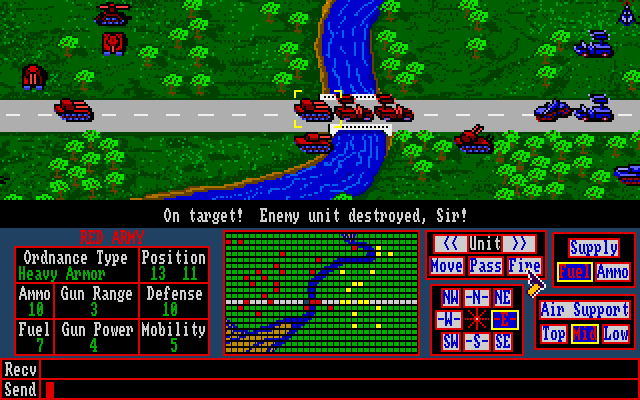
TeleWar splits the screen in two: low-resolution battlefield graphics occupy the top half, while a high-resolution control area and chat log sit below. It is a cramped arrangement, but it matches the game’s practical priorities. You are looking at unit positions and directions first, then using the lower controls to issue the next precise order.
Story
TeleWar tells its conflicts through the shape of the battle rather than through a long campaign tale. Each scenario begins as a military problem: protect your force, keep it supplied, break the opposing army, or make a run for the flag.
That stripped-back approach works because the units create their own tension. A supply truck trying to reach a stalled tank column, an artillery piece held in place to cover an approach, or a radio antenna that becomes vital when air support is on the table can make a match feel surprisingly dramatic.
The strongest stories here are the ones you and your opponent create. A reckless push can become a desperate recovery; a cautious formation can turn into a slow squeeze. If you need character-driven stakes, TeleWar will feel dry, but competitive tactics fans can get plenty from those emergent battlefield turns.
Overall Experience
TeleWar is most satisfying when you accept that it is a game of restraint. The winning move is not always firing first; it may be holding a lane open, saving ammunition, or spending a turn on air support at exactly the right moment. That makes victories feel earned, especially against another person who understands the same constraints.
Frustration can set in when the cramped field turns movement into a bottleneck. A single slow unit blocking several others is deliberately part of the challenge, but it also means a poor marching order can waste turns before the interesting shooting starts. You need patience and a willingness to plan around your own traffic.
For turn-based strategy fans, that friction is largely the point. TeleWar turns a small set of unit types into a serious contest of supply lines, firing lanes, and positional discipline. It is a focused recommendation for two players who enjoy measured tactical duels and do not mind learning through a few costly mistakes.


Reviews
There are no reviews yet.