 Retro Replay Retro Gaming History, Reviews & Emulation
Retro Replay Review
Gameplay
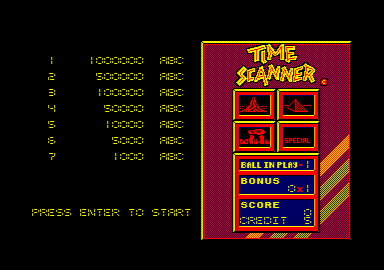
The first few minutes of Time Scanner feel familiar: bat the ball upward, catch it with the paddles, and hope a fortunate bounce finds a bumper or target. What separates it from a more ordinary pinball table is that you are not merely chasing points. Each board has a finish line, and that gives your shots a purpose beyond survival. You start watching for specific lanes, targets, holes, and blocks instead of simply reacting to wherever the ball happens to go.
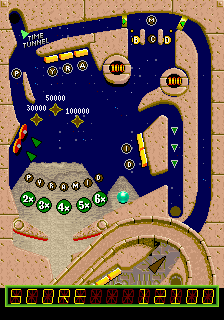
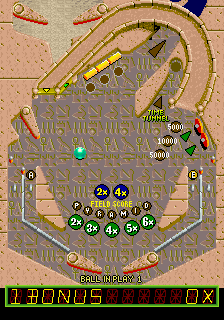
The divided-table structure is the game’s defining wrinkle. Each table has two sections with separate paddles, and the view only scrolls when the ball heads downward. That means a descent is not automatically a loss, but it can still be disorienting: you have to shift your attention to a new set of flippers at exactly the moment the ball is escaping. When you recover and send it back toward an objective, the layout creates a satisfying sense that you have saved a run rather than just prolonged it.
Volcano and Saqqarah make you spell their names through their respective objectives, a simple goal that gives repeated shots a useful focus. Ruins is more involved: after clearing targets and collecting two balls in the central hole, you release a fireball and need to guide it back into that hole to win. That is the table where the game’s objective-led design clicks best, because the board asks you to build toward a specific payoff.
The fourth table changes the rhythm with Breakout-style blocks that must be vaporized. Unlocking it by beating the first three gives the campaign a modest but welcome sense of progression. Still, Time Scanner demands patience. Pinball always carries an element of chaos, and goals that require precise hits can make a lost ball feel harsher than it would in a pure score attack. If you enjoy memorizing a table and gradually turning lucky rebounds into deliberate shots, that friction is part of the challenge.
Graphics
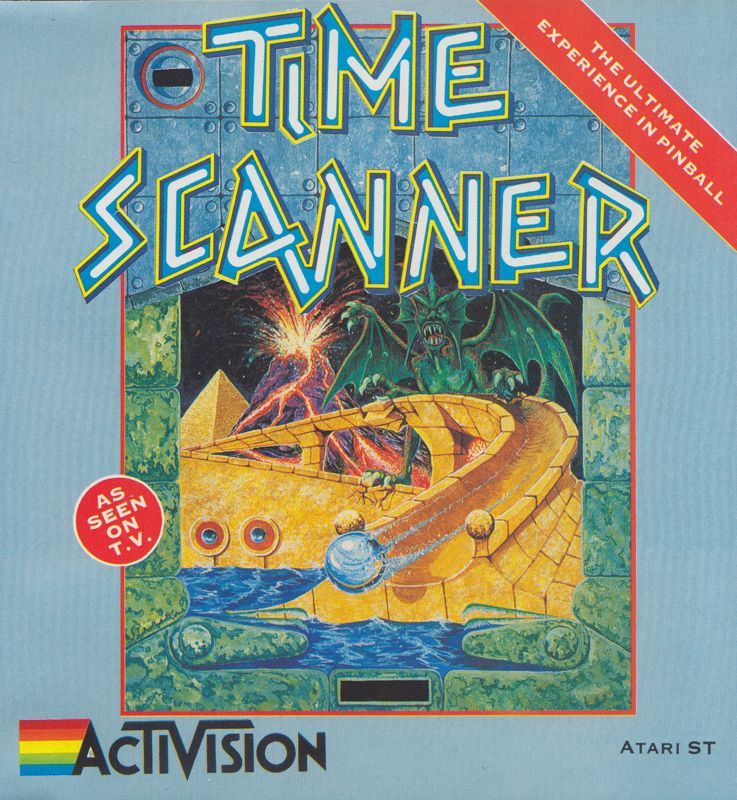
The tables lean hard into their themes: Volcano centers on volcanic lanes, Ruins places its important collect-ball hole in the middle, Saqqarah uses a pyramid setting, and the final board foregrounds rows of blocks. The scrolling between upper and lower table sections is also central to what you see and how you track the ball, rather than being a static single-screen pinball layout.
Story
There is no character-driven story pulling you from table to table. Time Scanner instead frames its progression through themed boards and their individual win conditions. Your journey is a practical one: conquer Volcano, Ruins, and Saqqarah, then earn access to the block-vaporizing final table.
That light structure suits the game. The “story” is really the sequence of increasingly distinct pinball problems: spelling a name, preparing a special ball, returning it to a hole, then clearing blocks. It gives the tables more personality than four interchangeable score boards would have had.
Do not come in expecting narrative context or dramatic twists. The reward is mechanical progression, with each completed board acting as proof that you have understood its layout well enough to bend the ball’s unpredictable path toward a goal.
Overall Experience
Time Scanner is a better fit for you if pinball is more fun when it behaves like a series of small board-specific challenges. Its strongest idea is not the paddles themselves, but the insistence that each table has something to solve. That turns repeated attempts into practice, and the freely selectable first three tables let you spend time on the board whose challenge appeals most.
At the same time, the split-screen scrolling and objective requirements make it less immediately relaxing than a straightforward pinball score chase. You can be playing well, understand exactly what you need next, and still watch the ball take an unhelpful route. The game asks you to accept that volatility and keep learning.
A 6.6 feels fair. Time Scanner has a genuinely appealing structure, especially in the Ruins table and the Breakout-flavored finale, but its ideas are more compelling than effortless. Give it a chance if you want vintage pinball with concrete goals and a little campaign-like progression; skip it if you only want a smooth, uncomplicated table to zone out with.


Reviews
There are no reviews yet.