 Retro Replay Retro Gaming History, Reviews & Emulation
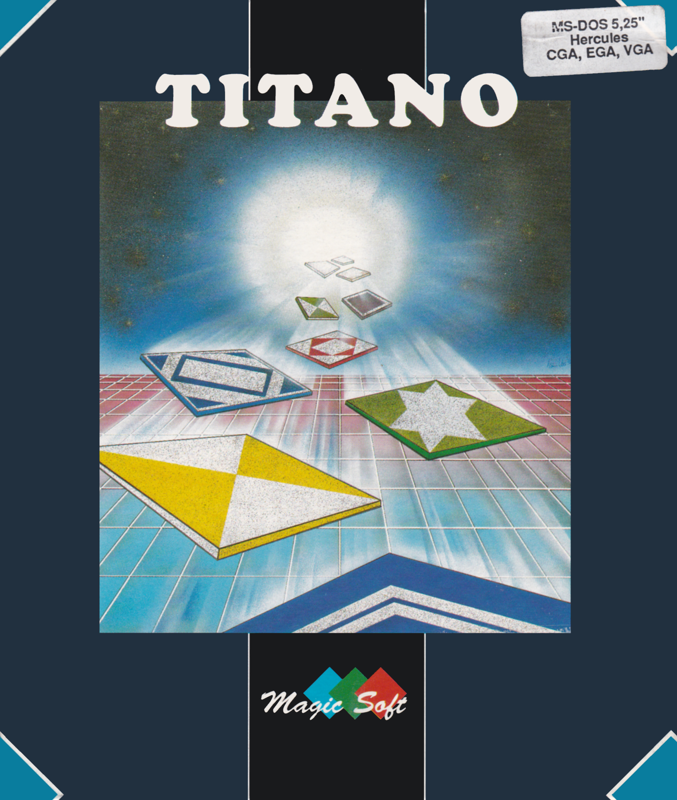
Retro Replay Review
Gameplay
Titano starts with the kind of rule you can understand in seconds and spend a long time respecting. Stones come in combinations of symbols and colours, with each exact stone duplicated among the 72-piece set. When you draw a stone, you must place it beside existing stones while satisfying every neighbour through a shared colour or shared symbol. That extra requirement is where the puzzle earns its teeth: a location that looks legal against one side may fail the instant a second or third adjacent stone is considered.
The first hour is mostly about breaking the habit of making the obvious match. A convenient placement can be a trap if it creates awkward edges for the next draw, while a less exciting move may preserve several future routes. You start scanning not just for where the current stone fits, but for which open spaces remain flexible. That is the point where Titano stops feeling like a tile-laying diversion and begins to feel like a compact strategy game.
Scoring gives that planning real pressure. Better matches earn more points, encouraging you to build opportunities rather than settle for the first legal square. But putting an unusable stone back into the pile costs points, so the board can punish a few shortsighted decisions long after you made them. It is a pleasingly stern system: recovery is possible, but you have to earn it through cleaner placements.
Mistakes have another consequence. Try to force an illegal placement and special stones appear that can remove a stone or cut your score. That makes experimentation riskier than it first seems and can turn frustration into a useful lesson about checking every bordering match. Titano is at its best when you slow down, trace each neighbour, and treat each draw as a problem to be solved rather than a piece to unload.
Graphics
Its top-down board view keeps the focus on the stones: their colours and symbols are the information you need to read every possible placement. On a 12-by-8 grid, the clean board layout suits the deliberate pace, since the important question is always how one stone relates to the spaces and pieces around it.
Story
Titano’s drama comes from the board rather than characters or plot. Each draw writes a tiny new chapter: a promising stone appears, a planned gap suddenly matters, and a previously harmless corner becomes an obstacle.
That stripped-back approach fits the game’s cold-blooded logic. Colours and symbols are not decoration here; they are the language through which each turn creates tension. You gradually build a personal history of smart saves, squandered openings, and painful returns to the pile.
The result is a puzzle with a surprisingly clear emotional arc even without a conventional narrative. Early confidence gives way to caution, then to the satisfying sense that you can read the board several turns ahead—until the next awkward stone humbles you again.
Overall Experience
Titano is a focused, demanding abstract strategy puzzle with very little wasted motion. Its central placement rule is easy to learn, but the requirement to match every adjacent stone creates enough friction to keep the board interesting. The score system and penalties prevent it from becoming a relaxing exercise in filling squares; you are always weighing immediate points against future breathing room.
You should give it a chance if Ishido-style stone matching sounds appealing but you want a game that presses harder on positional discipline. The duplicate stones offer patterns to anticipate, yet random draws ensure you cannot solve the board by rote. That mixture makes success feel earned and failure feel traceable to choices you can improve next time.
Frustration can set in when a draw has no clean home and returning it eats into your score, especially after you have spent several turns setting up a tidy board. Still, that tension is the reason Titano works. It is not generous, but it is coherent: the same rules that punish a careless move also make a well-prepared placement deeply satisfying. For puzzle fans willing to think before every drop, the payoff is absolutely worth the occasional sting.


Reviews
There are no reviews yet.