 Retro Replay Retro Gaming History, Reviews & Emulation
Retro Replay Review
Gameplay
Wild Wheels earns attention quickly because it treats a ball game like a demolition derby with positions to fill. Each match puts two five-car teams on the field, asking you to drive the ball into the opposing goal while surviving opponents that can knock you out of the contest entirely. Goals matter, but the scoring system pushes you toward bolder play: risky moves and wiping out the entire enemy team can pay more handsomely. That makes a straightforward attack feel less predictable than it first appears.
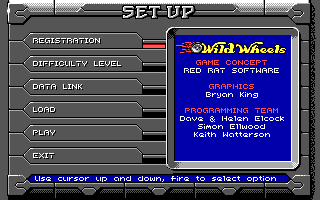
You control only one car, so the match lives or dies on how comfortable you become with the driving. Arcade mode lets you turn directly and is the sensible place to begin when you want to get into the action. Professional mode instead rotates the car with left and right inputs, giving it a more deliberate, demanding feel. Neither approach is inherently superior; the important thing is that the choice changes how quickly you can react when the ball breaks loose or an enemy car bears down on you.
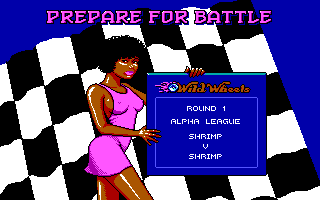
The single-player campaign is a ladder of elimination matches across increasingly difficult leagues, which is a modest structure but a useful one. Goals earn points, points buy stronger cars, and those cars fall into five match roles. The upgrade loop gives defeats some sting, since you can see how a better machine might help, but it also gives victories a practical reward beyond simply advancing. Stick with it long enough for the purchasing decisions and rising opposition to matter, and Wild Wheels becomes more than a one-off novelty.
Frustration will set in if you expect the clean flow of a conventional sports game. Cars, collisions, goals, destruction, and special field areas all compete for your attention at once. Yet that unruliness is also the point. A safe goal may win a match; an aggressive play can make the whole contest swing. Wild Wheels is at its best when you stop trying to make every drive tidy and start embracing the chance that a collision can be as valuable as a score.
Graphics
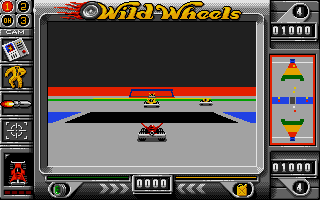
Wild Wheels lets you view the action from several camera positions, most notably directly behind your car or from above. The behind-car view puts you close to the driving, while the top-down angle is the more useful choice when you want to track the ball, both goals, and the movement of the full ten-car match.
Story
There is no elaborate narrative carrying Wild Wheels from match to match. Its story is the competitive climb: start in the lower leagues, survive elimination contests, earn money through goals, and build toward tougher opposition with better cars.
That stripped-down approach suits the game. You are not here for characters or dramatic detours; you are here to turn one more score into enough cash for an improved vehicle and take another shot at the next league. The stakes remain mechanical, but they are easy to understand.
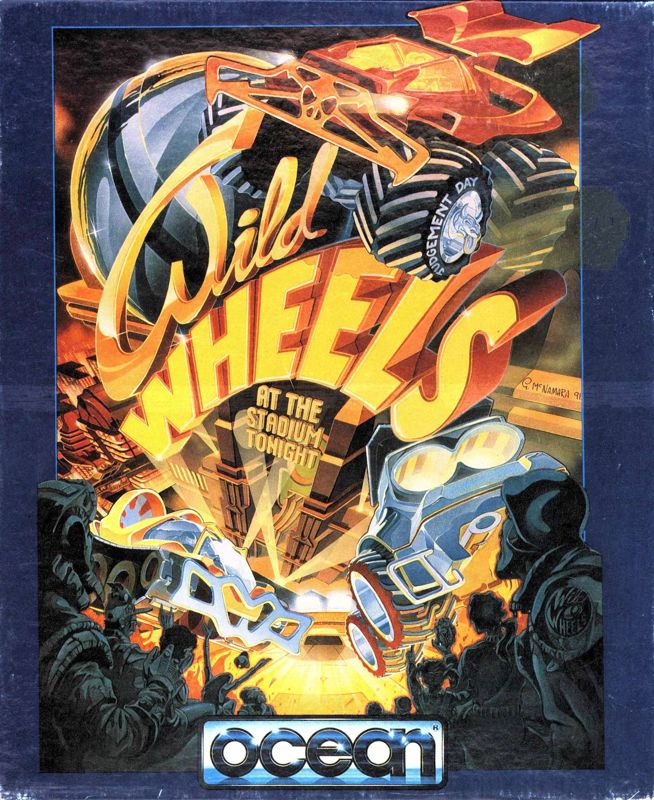
For background on the game’s 1991 release across DOS, Amiga, and Atari ST, see this Wild Wheels history and release overview.
Overall Experience
Wild Wheels is a curious, energetic collision of driving, sport, and combat. It has the kind of premise that sounds almost too simple until a match turns messy: the ball is loose, cars are crashing around it, and the best scoring opportunity may be a reckless one. Its 6.5-level appeal comes from that willingness to be rough rather than polished.
Give it a chance if you enjoy old-school games that mash genres together and ask you to adapt to their particular controls. Start with arcade steering, use the overhead camera when the field gets confusing, and treat your early earnings as part of the learning process rather than a reward you can ignore. The campaign’s league progression and car upgrades give the battles enough momentum to keep experimenting.
It is less convincing for anyone looking for deep simulation driving or a carefully structured team sport. Wild Wheels runs on chaos, pressure, and the satisfaction of converting a risky charge into points. If that sounds like a good afternoon on a DOS, Amiga, or Atari ST machine, its oddball pitch is worth playing.


Reviews
There are no reviews yet.