 Retro Replay Retro Gaming History, Reviews & Emulation
Retro Replay Review
Gameplay
The first thing Crete 1941 gets right is scale. You are not signing up for an endless campaign; after deployment, the whole fight runs for 28 turns, from the morning of 20 May to the night of 27 May 1941. That fixed timetable makes each decision feel loaded. There is little room to waste a turn moving into a merely decent position when a hill, a landing area or a threatened route could decide the next phase of the battle.
Its strongest idea is the uneven match-up. Commanding the Germans means dealing with paratroopers dispersed by their landing, with cohesion carrying special importance for units trying to regroup under pressure. Morale and experience also shape the force, so the pieces are more than anonymous counters. German reconnaissance and airstrikes offer useful leverage, but the Allied side has its own answers in tanks, anti-aircraft guns that can threaten landing paratroops and gliders, plus infantry, engineers, artillery and anti-tank weapons.
Terrain is not background decoration here. Crete’s mostly hilly ground affects combat losses, which gives defensive placement real bite and rewards paying attention to where a fight happens rather than simply where you want it to end. The optional rules are a thoughtful concession, too: turning off wind drift makes German drops less punishing, while allowing Allied failures to intercept supply convoys eases another source of pressure. Start with those aids if airborne operations sound more frustrating than fascinating; turn them back on once the basic rhythm of the battle clicks.
Graphics
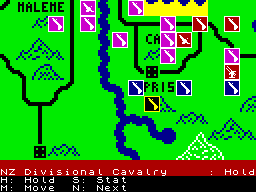
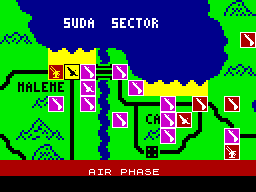
The top-down view suits a turn-based wargame about maneuvering troops across hilly terrain. On ZX Spectrum and Amstrad CPC, this is a functional battlefield view built for following positions and planning moves, not a lavish recreation of Crete.
Story
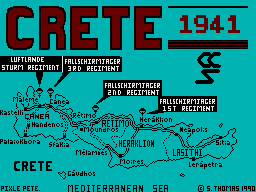
There is no need for invented drama when the historical premise already carries weight. The game recreates Operation Merkur, the German airborne invasion of Crete in 1941, then the largest invasion of its kind. That context makes the German opening especially compelling: you are not simply advancing a front line, but trying to turn a risky drop into a viable campaign.
The Allied perspective gives the scenario its other half. Greek, British, Australian and New Zealand forces are not framed as a generic opposing army; they are defending against an invasion under intense time pressure. The historical Allied evacuation is included in the scoring, so a fight that looks lost on the map can still demand careful decisions about what can be preserved.
That is the story Crete 1941 tells best: a battle of fractured forces, difficult ground and competing priorities. You may be trying to consolidate a landing as Germany, or delaying and extracting as the Allies. Either way, the campaign’s short date range prevents the history from becoming vague background and keeps the focus on a single decisive week.
Overall Experience
Crete 1941: Fallschirmjager is a focused historical wargame with enough asymmetry to make both sides worth learning. The German force has the more immediately dramatic challenge, since dispersed paratroops and drop accuracy can create problems before the campaign has properly begun. The Allied side should satisfy you if you prefer holding difficult terrain, using tanks and guns carefully, and making the invader pay for every gain.
Its age and machine-specific limitations mean this is unlikely to win over someone who wants cinematic warfare or a sprawling strategic simulation. But the design has a clear point of view: put a consequential airborne invasion into a tight turn limit, make terrain and unit condition matter, then force you to live with the consequences. That remains a sturdy recipe for tension.
Give it a chance if you enjoy compact, historically grounded turn-based battles and can appreciate a game that asks for deliberation over spectacle. The adjustable difficulty options make the entry less harsh, while the evacuation scoring gives the Allied campaign a purpose beyond simply trying to erase every German unit. For a 1990 home-computer wargame, that is a sharp, worthwhile slice of World War II strategy.

Reviews
There are no reviews yet.