 Retro Replay Retro Replay gaming reviews, news, emulation, geek stuff and more!
Retro Replay Review
Gameplay
The first few minutes make it clear that Ian Botham’s Test Match wants you to think like a captain as much as a batter. Setting all nine fielders before an over is not a decorative pre-match step; it is the point where you decide how aggressively to defend. You move a fielder icon around the pitch with the arrow keys, press Fire to place them, then live with the consequences once the bowler starts running in. If you enjoy cricket’s little battles of placement and pressure, that hands-on setup is immediately more interesting than a game that handles the field for you.
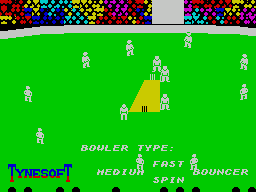
Bowling has a pleasingly direct structure. Pick fast, medium, spin, or a bouncer, press Fire, and the bowler delivers. The choice is limited, but it gives each over a basic plan: try pace, vary it, tempt a mistake with spin, or send down the bouncer. Repositioning the field every over reinforces that tactical loop. This is a deliberately paced game, and that will either feel appropriately cricket-like or painfully deliberate depending on your patience.
Batting is where the keyboard demands the most from you. Holding Fire while using the numeric keys to select a shot direction, then releasing at the latest possible instant for maximum power, creates a risky timing challenge. You can alter the direction until release, so there is room to adjust, but success still rests on nerve. After contact, you select a fielder to pursue the ball; a touch can produce a catch or a throw at the wicket for a run-out attempt. Even the decision to appeal for LBW carries uncertainty, since the umpire can reject it. That gives matches a welcome sense that not every outcome is fully under your command.
The range of match lengths is sensible. A limited-over game is the place to start, while the one-day match and Test match ask for increasingly larger stretches of commitment. Two people can take turns on keyboard or joystick, and the personal team-selection option lets you enter your own team names. It is a slow, methodical cricket game, but that is also why its individual balls can matter.
Graphics
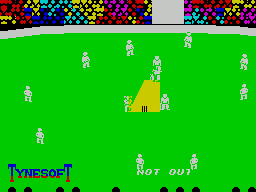
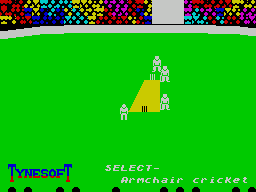
You see a cricket pitch populated by the bowler, wicket keeper, two batsmen, and the fielders you place around them. The fielder icon makes the pre-over positioning clear, while the bowler’s run-up and delivery give each ball a visible start rather than reducing play to a text readout.
Story
There is no authored drama pulling you through Ian Botham’s Test Match. Its story is the scorecard you create: a field placed too tight, a ball hit into space, a chase toward the boundary, or a late appeal left to the umpire.
That makes the game more convincing when you bring your own investment in cricket. A Test match can become a long contest of small decisions, while a limited-over game gives the same core actions a brisker frame. The changing match format does more for the sense of occasion than any scripted scene could here.
The personal team-selection option adds a small but welcome personal touch. Entering your own team names can make a local two-player fixture feel less anonymous, especially when a mistimed shot or a rejected LBW appeal decides an important moment. It is not narrative in the usual sense, but it can create the kind of match memory sports games live on.
Overall Experience
Ian Botham’s Test Match earns its interest through cricket detail rather than speed. Field placement, bowler selection, shot direction, chases, catches, run-out throws, and fallible appeals all feed into a game that understands a match is more than batting. For a 1980s sports game, that is a meaningful amount of responsibility to put in your hands.
Frustration can set in if you want immediate action. The controls ask you to coordinate Fire with the number keys, every over begins with another fielding decision, and the longer match modes are a genuine commitment. The game does not rush you toward highlights; it asks you to value the build-up. Start with limited overs before deciding whether you want to settle into a one-day game or a Test.
If you like old cricket games because they make you participate in the sport’s tactical texture, this is worth a look. The payoff is not flashiness but the satisfaction of seeing a field plan and a well-timed decision affect a ball. Gamers after a quick arcade knockabout may find it laborious; patient cricket fans will find a sturdier contest underneath the period controls.


Reviews
There are no reviews yet.