 Retro Replay Retro Replay gaming reviews, news, emulation, geek stuff and more!
Retro Replay Review
Gameplay
Infodroid drops you into the least glamorous corner of science fiction: package logistics. That sounds dry until you are threading a droid through busy streams, watching for rivals that want to ram you, and trying to complete a job before another collision turns your profits into repair costs. Its opening minutes have a nice immediate tension. You accept a delivery, get moving, and quickly learn that the road between pickup and destination is the real game.
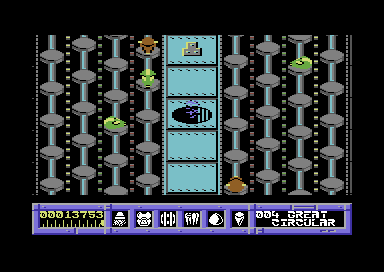
The five-stream layout gives the action its character. Two routes move one way, two move the other, and the static central stream lets you enter the rooms that keep your company alive. Jumping between streams is both your escape tool and your navigation language. A badly timed move can put you in the path of a rival droid; a smart one gets you to a junction or out of danger. Once that rhythm clicks, the game feels less like random traffic and more like a brisk contest of positioning.
The business side gives those dodges some weight. Dispatch rooms let you take and finish jobs, garages deal with the damage caused by collisions, and information rooms handle options. Money is not merely a score counter: it buys additional droids and upgrades for existing ones. Shields make the hostile traffic less punishing, while boosts that cross multiple streams at once can open up safer, faster routes. That progression is the strongest reason to stick with Infodroid after the initial novelty wears off.
Frustration comes from how exposed you are while navigating competing traffic. Rival droids do not just occupy space; they actively threaten your vehicles, and repairs can make a bad run feel expensive. Infodroid asks for alert movement and a willingness to learn its lane behavior rather than letting you coast on delivery errands. If that sounds stressful, it probably will be. If you enjoy old arcade games where every small improvement makes the next run feel more manageable, the pressure is part of the fun.
Graphics
The game uses a top-down, 2D scrolling view centered on the moving droids and their five traffic streams. The central stationary route stands apart from the moving lanes, helping you spot when it is time to break away for junctions, dispatch rooms, information rooms, or a garage. It is a functional view built for following traffic and making quick lane changes.
Story
There is not much narrative baggage between you and the work. You are running a startup on a planet devoted entirely to administration, information, and package delivery, trying to grow large enough to matter against established competitors. It is a thin setup, but it fits the game’s oddball premise perfectly: your grand sci-fi ambition is becoming better at logistics than the other droid companies.
The rival firms give the premise a useful competitive edge because their droids do more than represent a business chart somewhere. They are physically out there on the routes, trying to ram your machines. That turns the corporate climb into something more immediate than a number going up after each job.
Infodroid does not need a sprawling plot to make its setting memorable. The administrative planet is strange enough to give the deliveries a faintly comic, futuristic flavor, while the startup goal explains why money, repairs, new droids, and upgrades matter. You are not saving the world; you are trying to keep a small operation alive in a very unfriendly market.
Overall Experience
Infodroid is an unusual blend of arcade dodging and small-scale company building. Its strongest moments come when a routine delivery becomes a scramble: traffic shifts around you, rivals close in, and you have to decide whether a quick jump is worth the risk. The next completed job then has a purpose beyond survival, because it can improve the fleet that handles the following run.
It is not an effortless pick-up-and-play game. You need to accept that collisions, repairs, and the behavior of the streams will punish careless movement. The rules are compact, but the game asks you to turn them into habits. Give it enough time to understand how the lanes, rooms, and upgrades connect, and its peculiar logistics loop becomes much more satisfying than its premise initially suggests.
For a gamer with affection for Commodore 64 or Amstrad CPC curiosities, Infodroid is worth a look precisely because it is not another straightforward shooter or racer. Its delivery-company hook, hostile traffic, and upgrade economy make it feel distinctive. The payoff is modest but real: master the routes, protect your investment, and slowly turn a vulnerable startup into a more capable operation.



Reviews
There are no reviews yet.