 Retro Replay Retro Gaming History, Reviews & Emulation
Retro Replay Review
Gameplay
The first hour of Life-Term asks you to accept its terms: you are alone on a prison planet, your way forward is hidden in written descriptions, and progress comes from typing the right instruction rather than following a marked route. That can be immediately absorbing if you love the feeling of probing a place for weaknesses. Every new detail in a room description might be a clue, an object, or the edge of a puzzle solution.
Its recycling-plant premise gives the adventure a stronger frame than a generic escape story. Jake Stalin is not merely trapped somewhere unpleasant; he is assigned to process waste into raw materials for a dozen nearby planets. That workmanlike, degrading routine puts useful pressure on the escape goal. You are not exploring Souzel for sightseeing. You are trying to understand the machinery of the place well enough to get out of it.
But this is a text adventure from an era that expects patience. You type commands to examine the environment and complete tasks, so the pleasure depends on your willingness to phrase ideas, reconsider descriptions, and persist when a solution is not obvious. There is no reason to rush it. Read closely, keep notes on places and objects, and treat failed attempts as information. For the right kind of puzzle fan, that deliberate back-and-forth is the point; for anyone wanting quick momentum, it can become a wall.
Graphics
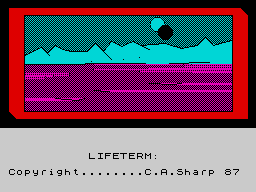
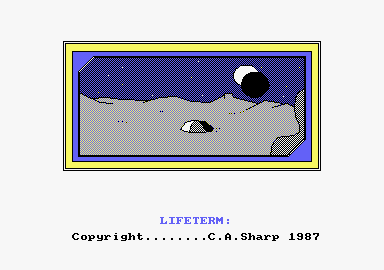
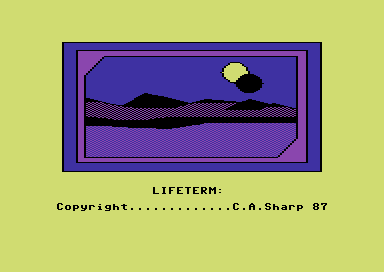
Life-Term pairs its text with pictures of your current surroundings, rather than leaving Souzel entirely to your imagination. These static location images give each area a concrete face and offer a welcome visual break between blocks of parser text, while the written descriptions still carry the important detail.
Story
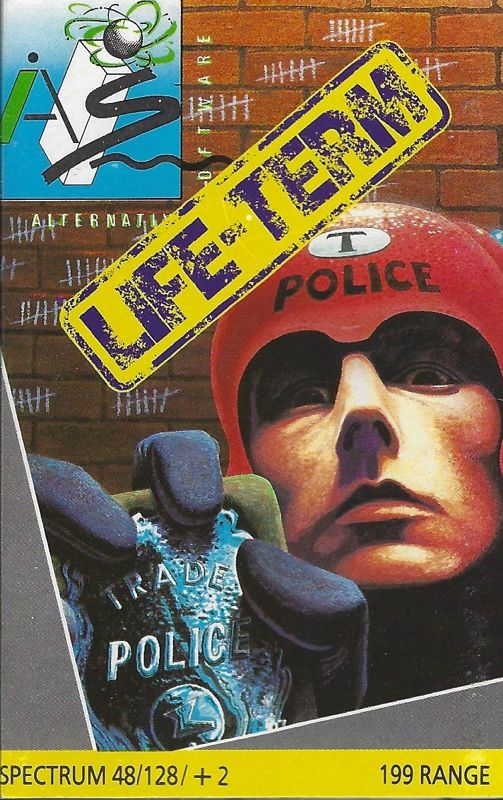
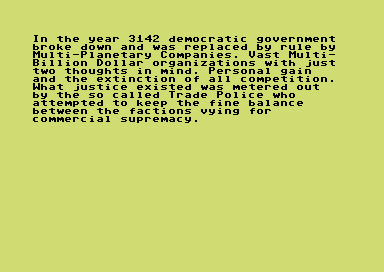
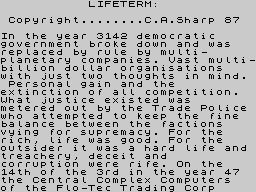
Wrongly convicted of murder, Jake Stalin receives a life sentence on Souzel because there is no death penalty. It is a blunt, effective opening: a man insists he should not be there, yet the system has already decided that the rest of his life belongs to a remote industrial prison.
The central question is appropriately simple: can Jake escape, or will he spend his remaining days recycling other people’s waste? Life-Term gets mileage from that contrast between an enormous personal injustice and a very mundane punishment. The sentence is not a dramatic battlefield or a glamorous space frontier; it is endless rubbish processing.
That makes the game a good fit if you prefer sci-fi that begins with confinement and problem-solving rather than grand heroics. The narrative pull comes from the situation itself and from uncovering a route through it, so your own investigation carries much of the dramatic weight.
Overall Experience
Life-Term is a compactly cruel premise turned into a classic parser-adventure challenge. Its strongest quality is the way its prison-labour setup makes escape feel necessary rather than optional. You are not simply collecting solutions to puzzles; you are trying to claw free of a life that has been assigned to you.
It asks for a particular mood: slow down, read every line, type carefully, and accept that progress may arrive one small realization at a time. Gamers raised on more guided adventures may find that rhythm punishing, especially when they are used to direct interaction instead of command entry. Yet there is a real satisfaction in this older style when a stubborn problem finally yields.
Give it a chance if graphic text adventures and austere 1980s science fiction sound comforting rather than intimidating. Life-Term will not win over someone who dislikes parser puzzles, but its unjust imprisonment hook and industrial escape setting make it more memorable than a bare sequence of typed commands. The payoff is worth pursuing when you want an adventure that makes you earn each step toward freedom.


Reviews
There are no reviews yet.