 Retro Replay Retro Gaming History, Reviews & Emulation

Retro Replay Review
Gameplay
Nibbler starts with a wonderfully clear goal: steer the snake around a garden section and pick up almost all of its charms. The immediate temptation is to sweep the board casually, as if this were a slower Pac-Man without ghosts. That instinct lasts about a minute. Because Nibbler grows every second, an open route quietly turns into a corridor crowded by your own body, and every decision begins to have a cost.
The clever part is that the game does not demand every last charm. Being able to leave a few behind gives you a vital escape valve, but it also creates the central judgment call of every section: is that distant charm worth the extra length and the dangerous return trip? Good runs come from reading the layout early, taking efficient passes, and resisting the urge to turn a manageable route into a heroic but doomed cleanup job.
There are no enemies chasing you, so the tension is unusually personal. You lose a life by hitting your own tail, and you also cannot sit still for long waiting for a safer opening. That second rule keeps the game from becoming a puzzle you can pause with your hands off the controls. It asks for commitment: keep moving, keep calculating, and accept that a small turn made several seconds ago may be what ends the attempt.
Five lives leave room to learn, but Nibbler is not especially gentle about lessons. Its challenge comes from execution and foresight rather than surprises, which can feel brutally fair when you recognize your mistake and frustrating when a growing tail closes off the route you thought you had. Still, the nine-section structure gives each successful clear a satisfying sense of progress. This is an arcade test for gamers who enjoy mastering a strict set of rules instead of being carried along by spectacle.

Graphics
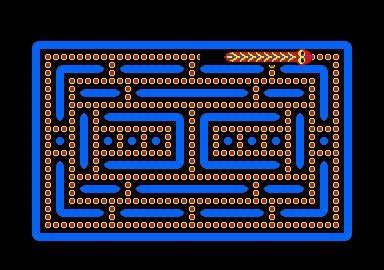
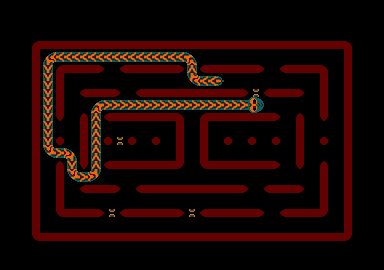
The top-down garden sections keep the important information in view: Nibbler, his increasingly long tail, and the charms that determine your route. That plain overhead view suits the game because the danger is geometric; you need to see where the body is and where the remaining pickups can still be reached.
Story
The setup is cheerfully strange. A cruel witch has transformed the people around her, including the player, into animals called wondrous wurpels, and the scattered charms in her garden offer a way to lift the spell. It is a small excuse for the action, but it gives the collecting a purpose beyond chasing a number on a score display.
Nibbler is the active hero of the tale, while the transformed player depends on the snake to reclaim the charms across the garden’s nine sections. That reversal is amusing: you are ostensibly the one under the spell, yet your fate rests on an increasingly unwieldy snake making careful turns.
Do not come to Nibbler for plot development. The witch, the curse, and the charms frame the challenge, then the game lets the escalating board-management problem do the talking. For an arcade game, that is enough; the premise is odd enough to stick in your mind while you are trying not to trap yourself.
Overall Experience
Nibbler earns its tension honestly. At first, collecting charms while avoiding your tail sounds like a familiar snake-game variation. Then the real rhythm clicks: chart a route, collect efficiently, leave a few pickups when greed would kill the run, and continually account for a body that will be longer by the time you reach the next turn.
Its biggest strength is how little it needs to create pressure. With no hunters on your heels, every failure feels like the result of a plan that was not quite good enough or hands that were not quite steady enough. That can make a successful section feel more satisfying than its simple premise suggests, since you have solved a moving spatial problem under a clock you cannot stop.
The same purity narrows its audience. Nibbler offers little cushion for impatient play, and anyone who finds self-collision games repetitive will not be won over merely by the witch-and-charms wrapper. But if you like old arcade games that turn a single rule into a demanding skill test, this is a compact, cleverly escalating challenge. Give it time past the first easy routes; that is when the garden starts to feel like a trap of your own making.



Reviews
There are no reviews yet.