 Retro Replay Retro Gaming History, Reviews & Emulation
Retro Replay Review
Gameplay
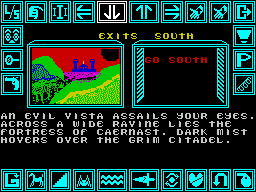
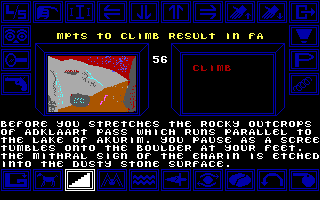
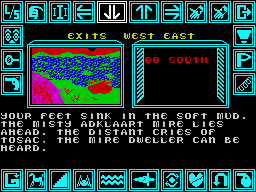
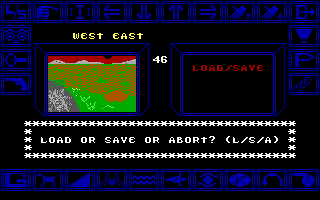
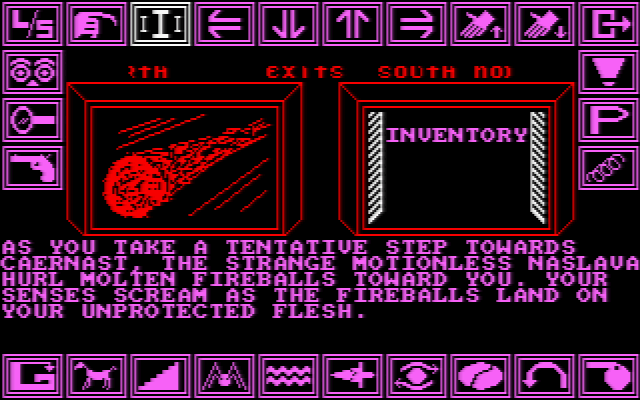
The first thing you notice in Shard of Inovar is that it wants to spare you one of the oldest frustrations in interactive fiction: guessing the exact command the author had in mind. Instead of typing directions and actions, you select icons from panels around the main view. For an adventure from 1987, that is a genuinely welcoming choice. You can get on with investigating the crisis around the Cairnrue rather than repeatedly wondering whether the game prefers one verb over another.
The useful twist is the item-giving command. After choosing an inventory object, the game highlights names in the most recently displayed text so you can select the intended recipient. It is a small convenience, but a smart one in a story full of names such as Arthermin, Rimarlion, Sunquat, and Kiron. You spend less time carefully retyping fantasy names and more time considering who should receive what.
Do not mistake the icon interface for a modern, guided adventure, though. The core remains text-adventure investigation with puzzle elements: read closely, keep track of your possessions, and make connections between the world’s history, its magical objects, and its cast. That can be satisfying when a clue clicks into place. It can also become slow if you want immediate direction or dislike combing through text for the next useful lead. Keyboard and joystick support give you options, but the deliberate pace is part of the deal.
Graphics
This is a first-person text adventure with graphics, framed by action panels above, below, and beside the play area. The icons are more than decoration: they put the game’s basic actions in front of you and give its interactive fiction structure a tangible, game-like shape.
Story
The story begins with rain failing to fall because the Cairnrue, a protective magical barrier, has become a threat in its own right. You play Varwield Secunda, apprentice to the aging and bitter Varwield Arthermin, and the duty of performing the Rite of Decairn lands on your shoulders. That is a strong opening predicament because it is both personal and urgent: you are not a celebrated hero arriving after disaster, but an apprentice stepping into a job your master should have handled.
Its fantasy history is elaborate. The ancient Eharin created the Inovar to hold back the deadly Nagroma plague; a split shard helped Arthermin make the Naslava; Kiron fled with the larger stone; and Rimarlion, Daughter of the Earth, was turned to stone after opposing Arthermin. There is plenty here for anyone who enjoys legends layered beneath the immediate quest.
At the same time, the names and backstory arrive in a dense cluster. You will get more from the game if you settle in and treat the opening as lore worth sorting out, not as a quick briefing before the action starts. The conflict between an apprentice, an overreaching master, a damaged natural order, and a divided magical artifact gives the journey a pleasingly old-fashioned fantasy weight.
Overall Experience
Shard of Inovar is most interesting as a bridge between command-driven interactive fiction and a more approachable graphical adventure interface. The icon system does not remove the need for careful thought, but it removes a layer of parser anxiety that can make older text adventures feel needlessly hostile. If you have ever liked the idea of classic interactive fiction more than the act of typing at it, this is the reason to try it.
The payoff depends on your tolerance for dense fantasy terminology and patient puzzle-solving. There is no indication here of a fast, action-heavy quest; its strengths lie in following a substantial magical crisis through text, choices, objects, and character interactions. Give it time to establish its world, and the premise has enough stakes to carry the slower pace.
For everyone else, it is an artifact of a particular adventure-game moment rather than an essential stop. But for a gamer willing to meet it on its own terms, the combination of an urgent ritual, a treacherous mentor, and unusually considerate command handling makes it more inviting than many of its contemporaries. A 6.6 feels fair: solidly interesting, often thoughtful in its interface, and best suited to patient fans of vintage fantasy adventures.



Reviews
There are no reviews yet.