 Retro Replay Retro Gaming History, Reviews & Emulation
Retro Replay Review
Gameplay
The first hour of Dark Continent is defined by vulnerability. Starting an expedition after the supplies and money have disappeared gives every discovery weight, because you begin with nothing to fall back on. The stated objective—recover King Solomon’s diamond and make it home to England—keeps the game pointed in a useful direction, even as the immediate problem is simply surviving a strange country without equipment.
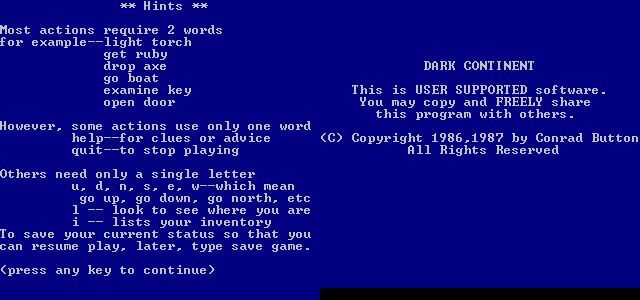
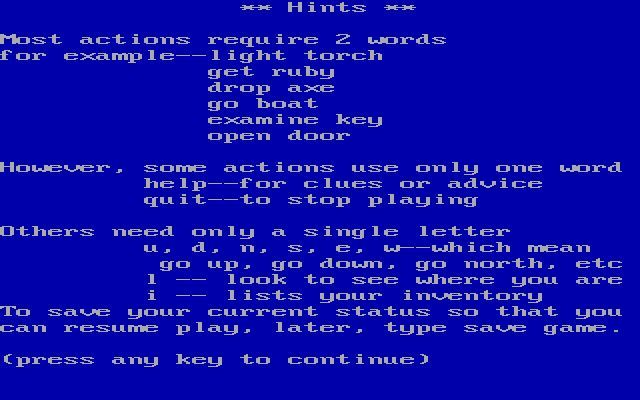
This is traditional parser-driven interactive fiction. You type two-word instructions such as GET THING and GO PLACE, while the familiar directional shortcuts—N, S, E, W, U, and D—speed up travel. That makes the basic interaction easy to learn, but not necessarily easy to master. If you enjoy pausing over a description and trying deliberate, literal commands, the format can pull you in. If you want immediate feedback from a controller, map, or visual action, it will feel austere fast.
Save early and often with SAVE GAME. In a game built around being stranded with no possessions, experimentation is part of the experience, and a saved position lets you test an idea without turning a wrong turn into a full restart. The concise command style is a real virtue once it clicks: you spend less time wrestling with elaborate sentence construction and more time deciding what is worth attempting.
Graphics
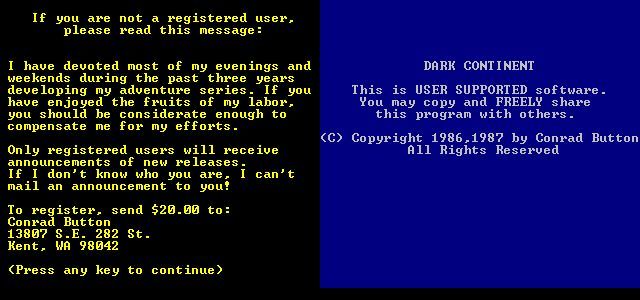
There are no illustrated locations or animated characters here; the world lives in the text you read and the places you imagine. Under DOS, it occupies a single window. When run through a Windows DOS window, the play area sits in the left pane while copyright information fills the right, so this is an interface you read rather than a landscape you look at.
Story
The premise is blunt and effective adventure-fiction fuel. Your expedition is already in tatters, the bearers have fled with the supplies and cash, and the treasure hunt has become a personal escape plan. Beginning on the third day is a smart choice because it skips preparation and puts you directly in the consequences.
King Solomon’s diamond gives the journey a clear prize, but getting back to England prevents it from becoming a simple treasure grab. You are stranded, empty-handed, and trying to turn a disastrous expedition into a successful return. That combination gives the text adventure a useful sense of stakes without needing a complicated setup.
The setting belongs to an older pulp-adventure tradition, and it carries that era’s framing of Africa as an exotic expedition ground. That will be a meaningful drawback for many modern players. The game’s historical context is outlined in this Dark Continent history page, but the game itself is most interesting as a snapshot of a direct, survival-minded text-adventure setup.
Overall Experience
Dark Continent is for the gamer who finds a blank command prompt inviting rather than intimidating. Its strongest move is making you feel immediately disadvantaged: no money, no supplies, no companions, and a distant way home. The treasure objective supplies just enough momentum to make that isolation feel like a challenge instead of mere inconvenience.
The trade-off is severe simplicity. You will be reading, typing, interpreting responses, and building the adventure in your own head. There is no visual cushion between you and the puzzle-solving mindset. That can make progress feel satisfying in a uniquely personal way, but it also means impatience with parsers will overpower the game’s premise before the hunt has a chance to develop.
Give it a chance if you like 1980s interactive fiction, especially adventures where a tight initial predicament does most of the dramatic work. Go in ready to take notes, try concise commands, and use saves freely. For everyone else, it is more a historical curiosity than an easy recommendation; its payoff depends almost entirely on whether that old text-adventure conversation still feels alive to you.


Reviews
There are no reviews yet.