 Retro Replay Retro Gaming History, Reviews & Emulation
Retro Replay Review
Gameplay
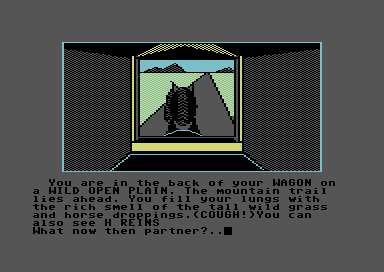
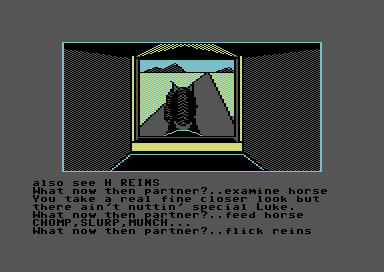
The Legend of Apache Gold asks you to slow down almost immediately. You read the description of where Luke is standing, study the accompanying picture, then type what you want to do. A simple action such as getting the wagon moving begins with feeding the horse and flicking the reins, which tells you exactly what sort of adventure this is: one where noticing the practical details matters.
That pace can be satisfying when you are in the mood to interrogate every scene. Instead of being carried forward by action, you make progress by deciding what deserves attention and expressing that decision through typed commands. The ambush and captivity at the start at least give the first stretch a concrete problem to work on, rather than leaving you to wander aimlessly after the gold.
The catch is the familiar friction of parser-driven adventures. The game wants you to solve whatever puzzle is in front of you, but it also requires you to phrase your intentions in a form it accepts. If you enjoy the back-and-forth of testing ideas, revising a command, and finally finding the useful response, that tension is part of the fun. If you want immediate feedback and little guesswork, it is likely to become a roadblock.
Graphics
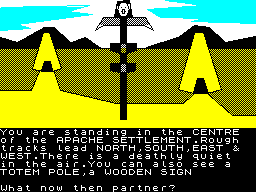
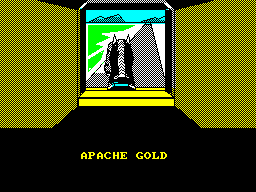
Each location is shown with a picture alongside its written description. These images are there to establish where you are—whether you are at the saloon, on the wagon trail, or held in a tent—while the text carries the detail you need to act.
Story
The plot starts with a very direct motive: Luke Warme has no money for a drink, hears that an Indian Chief has died, and pursues the legend of gold supposedly buried with him. It is an uncomplicated hook, and the immediate decision to hitch up the wagon gives it a clean, brisk opening.
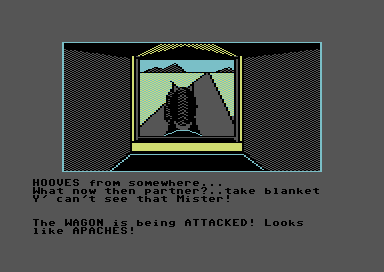
Then the game pulls the rug out from under that treasure hunt. Luke is ambushed, taken captive, and confined in a tent, turning a greedy expedition into an escape-and-investigation adventure. That early reversal is the story’s strongest move because it gives the puzzles a situation to grow out of.
The setup also leans on a dated Western-adventure treatment of Native people and burial treasure. That is part of the game’s premise, not something the writing complicates in the supplied outline, so your tolerance for that old pulp framing will heavily affect how inviting the journey feels.
Overall Experience
This is a narrow but recognizable kind of 1986 adventure: a Western-flavored text puzzle game with pictures to ground each room and a parser that demands patience. Its strongest draw is the pleasure of being stuck in a specific predicament, reading closely, and working out a way forward one typed instruction at a time.
Give it a chance if you already like graphic text adventures and can enjoy a game that asks you to meet it halfway. The modest premise becomes more engaging once the opening ambush turns the hunt for gold into a problem of captivity and puzzle solving. You should skip it if you need smooth guidance, fast momentum, or a more thoughtful take on its Western subject matter.
The payoff is conditional rather than universal: successfully untangling a parser puzzle can feel great, but the same design can leave you stalled when your idea and the game’s expected wording do not meet. For genre veterans, that is an accepted part of the bargain. For everyone else, it is a tough ask.


Reviews
There are no reviews yet.