 Retro Replay Retro Gaming History, Reviews & Emulation
Retro Replay Review
Gameplay
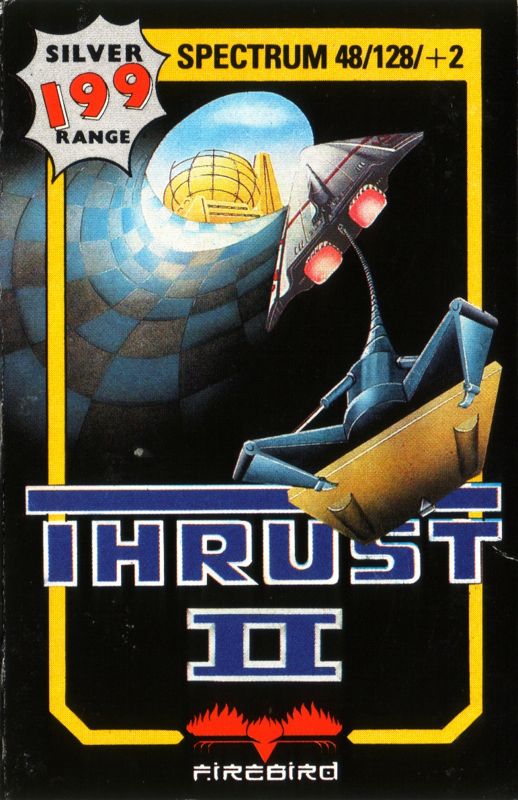
Thrust II is built around an intentionally restricted control scheme: turn the craft left or right, then apply thrust. That simplicity does not make it forgiving. Navigation depends on controlling momentum through confined tunnels, where contact with the scenery is immediately fatal to the craft.
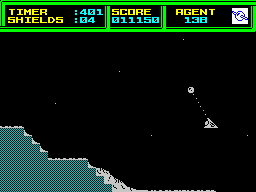
The central objective is to retrieve 16 orbs from around and beneath the artificial planet, carrying them one at a time to a designated surface site. An orb is not merely a collectible: its mass changes the ship’s handling, so each recovery asks you to adjust to a different burden rather than repeat one perfected route.
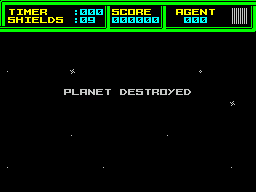
The countdown that begins after an orb is collected gives the game its sharpest pressure. You must make a clean escape before time expires and the planet is destroyed, while androids and narrow passageways threaten an instant loss. Limited-duration weapon pickups can clear every on-screen enemy of a particular type, but they are a temporary advantage rather than a replacement for careful flying.
Graphics
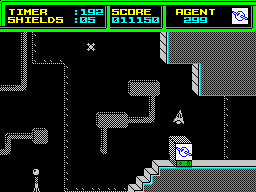
The side-view presentation is designed to serve the flight challenge. The planet’s tunnels are maze-like spaces whose walls define both the route and the danger, making readable positioning more important than decorative excess.
The craft, carried orbs and patrolling androids provide clear functional priorities on screen. Since both walls and enemies can destroy the ship or a collected orb on contact, the visual language has to support quick judgments about space and hazards, and the game’s direct layout suits that need.
There is no indication that Thrust II aims for elaborate spectacle; its visual identity comes from the contrast between open surface areas and hazardous subterranean routes. Players looking for detailed scenic variety may find the presentation utilitarian, but that economy fits a game focused on controlled movement and route planning.
Story
The premise places you in a war between the Federal Resistance and the Galactic Empire. The Resistance has seized an artificial planet of strategic value, but its atmosphere still requires purification.
Your search for the 16 orbs has a practical narrative purpose: they are needed to construct an atmospheric processor. That framing gives the repeated retrieval and delivery tasks a coherent goal rather than presenting them as unrelated score-chasing exercises.
The story remains a compact science-fiction setup rather than an elaborate character drama. Its most effective narrative element is the escalating consequence attached to each collection attempt: fail to deliver an orb before the timer ends, and the entire planet is destroyed.
Overall Experience
Thrust II is a focused action game for players who enjoy demanding momentum management and the satisfaction of mastering dangerous routes. Its challenge comes from precision, planning and composure under a timer, not from a large move set or a broad range of systems.
The decision to use one interconnected game world gives the orb hunt an exploratory quality. Instead of simply moving through isolated levels, you are working through a shared planetary space, deciding how to approach orbs scattered across the surface and below it.
Its severe collision rules and escalating handling problems make it a game that can feel punishing, particularly when an orb delivery fails after a difficult descent. Yet those same rules give each successful return real weight. It is a worthwhile, if somewhat austere, follow-up for readers who want physics-led arcade tension over a more relaxed flight adventure.


Reviews
There are no reviews yet.