 Retro Replay Retro Gaming History, Reviews & Emulation


Retro Replay Review
Gameplay
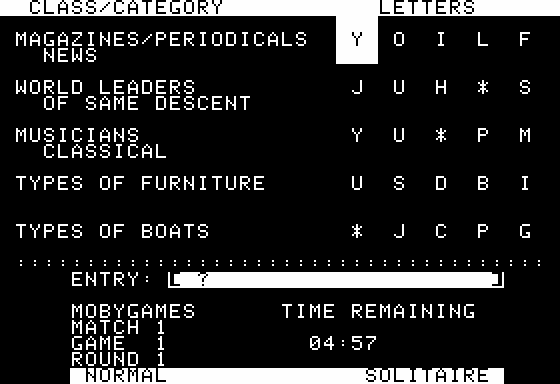
The first round has a wonderfully cruel rhythm. You see five categories and a grid of letters, and suddenly a fact you have known for years is nowhere to be found. Then one answer breaks loose, another follows, and the race becomes less about broad trivia knowledge than quick recall under pressure. That five-minute limit is long enough to think, but short enough that hesitation hurts.
What lifts Computer Facts in Five above a plain quiz is its scoring. You are not merely collecting isolated answers; filling rows and columns earns extra value, so a weak-looking letter can become the key to a strong round. Five rounds also make the session feel fairer than a one-shot contest. A terrible draw can sting, yet you have time to claw back points with a better set of categories.
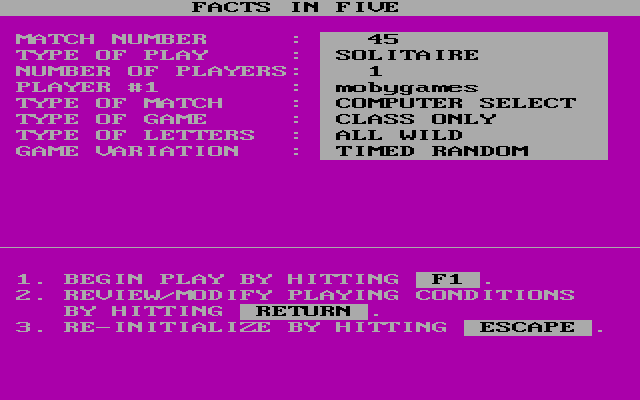
The computer format earns its place through variety. More than a thousand category and subcategory combinations can turn up, while selectable or player-created categories let a regular group tune the difficulty and subject matter. You can move around the letter grid yourself or let the game call for answers in random order. That small choice changes the mood: navigation favors planning, while random prompts make the timer feel more immediate.
Solitaire play is a stern test, but the game becomes livelier with two people trading five-minute turns or a larger group using the supplied score sheets in party mode. Blind typing can add another layer of pressure for competitive groups. The catch is answer verification: you and your fellow players must vote or consult a reference. With a relaxed, good-faith table, that creates entertaining debates; with pedantic competitors, it can become the part everyone remembers for the wrong reason.
Graphics
The screen is spare: a list of categories beside a grid of letters, with answer entry handled at the bottom. It is a functional board-game translation rather than a decorative one, but the grid puts the important choices in front of you and keeps the timed rounds easy to track.
Story
There is no narrative campaign or cast to carry you from round to round. The drama comes from the category in front of you and the embarrassing silence after you draw a blank on a letter that should have been easy.
That lack of story suits the format. Each round creates its own miniature arc: early confidence, a mid-round panic, then a last-minute attempt to complete one more line before time expires. It is the kind of tension a good word or trivia game creates without needing plot around it.
The real anecdotes arrive after the clock stops. Someone insists an answer belongs, someone else challenges it, and the reference book settles the score—or starts a fresh argument. If you enjoy trivia as a social sport, that is more memorable than any authored storyline could be.
Overall Experience
Computer Facts in Five is an unusually durable conversion of a board-game idea because it understands what a computer can improve: it can rapidly serve up fresh combinations and enforce the pace without getting in the way. The underlying game remains delightfully simple, yet scoring rewards more than random fact dumping.
You should give it a chance if you enjoy trivia that tests recall rather than multiple-choice recognition, especially if you have a friend or family group willing to play referee. It asks for a broad base of knowledge, quick thinking, and a little humility. Expect to feel clever one minute and completely stumped the next.
Its age is visible in the stripped-down screen and the reliance on players to validate answers, but neither flaw undermines the central contest. The payoff is a tense, replayable five-round trivia match where a single recovered name can rescue a scorecard. For the right group, that is plenty.



Reviews
There are no reviews yet.