 Retro Replay Retro Gaming History, Reviews & Emulation
Retro Replay Review
Gameplay
The first few minutes of Flobynoid are comfort food if you know Arkanoid: move the paddle, keep the ball alive, and break every target on the board. That straightforward rhythm is exactly why it works. You can settle into the bounce pattern, then suddenly have to make a sharp correction because the ball has clipped an awkward angle or one of the flying pests has knocked it somewhere unexpected.
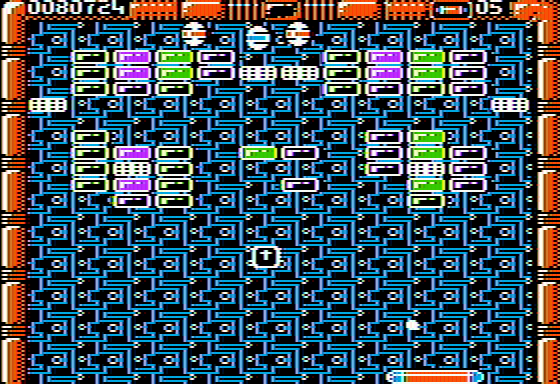
Its brick layouts create the right kind of friction. Ordinary blocks disappear quickly, two-hit bricks make you earn openings, and indestructible pieces turn a simple sweep into a routing problem. You are not merely reacting to the ball; you are trying to carve a safe lane through the board while keeping enough control to reach the stubborn bricks later.
Power-ups give each board a useful burst of uncertainty. Catching a wider paddle can rescue a shaky run, while the brick-vaporising laser lets you tear through obstacles that were slowing everything down. The instant-death pickup is a harsher joke. It makes every falling item worth identifying before you greedily slide underneath it, and that sting will frustrate anyone who wants bonuses to be purely helpful.
The ability to begin at level 0 or choose a later starting point is more thoughtful than it first sounds. Newcomers can learn the rhythm from the beginning, while experienced hands can skip ahead to tougher boards rather than replaying familiar ground. The built-in level editor is the real extra: if the supplied challenge has taught you what makes a brick pattern interesting, you can start building your own cruel little puzzles.
Graphics
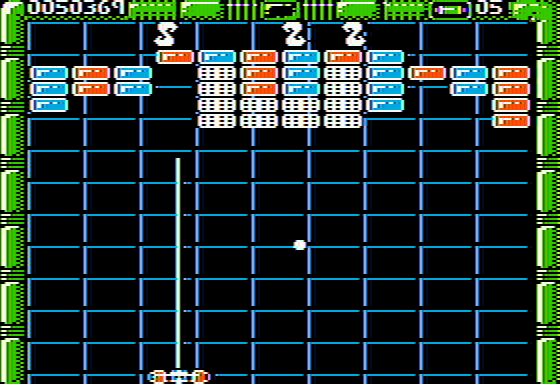
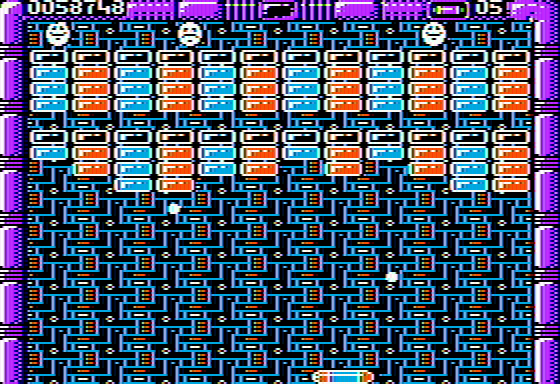
Flobynoid keeps the action in a side-view playfield of bricks, ball, paddle, falling items, and roaming airborne hazards. That clean arcade layout matters because the ball can change course quickly; you need to be able to track it, the gaps you have opened, and the objects dropping toward the paddle at a glance.
Story
Flobynoid does not pause its arcade action for a plot. Your momentum comes from the board in front of you: clear the remaining bricks, survive the next dangerous rebound, and move on.
That suits the game’s stripped-down design. A long story would only interrupt the pleasure of seeing a stubborn formation finally collapse after several carefully managed returns.
The closest thing to a narrative arc is the run itself. Early boards teach you to trust the paddle, later starts let you jump into the harder work, and a bad power-up can turn a confident attempt into an immediate restart.
Overall Experience
Flobynoid is a solid, knowingly familiar brick-breaker rather than a reinvention. Its best moments come when a controlled rally becomes messy: flying hazards interfere, a power-up falls, and you have just enough time to decide whether to chase it or protect the ball.
The game asks for patience with the genre’s old-school punishments. An instant-death pickup can feel unfair when you are already concentrating on a fast return, and the basic goal never grows beyond breaking bricks. If that loop has never worked for you, the level editor will not change your mind.
But if you like Arkanoid-style games, Flobynoid understands the essentials. It has tricky block types, worthwhile bonuses, enough interference to prevent autopilot, flexible starting levels, and an editor that invites experimentation. Give it a chance when you want direct arcade pressure with a little room to make the challenge your own.


Reviews
There are no reviews yet.