 Retro Replay Retro Gaming History, Reviews & Emulation
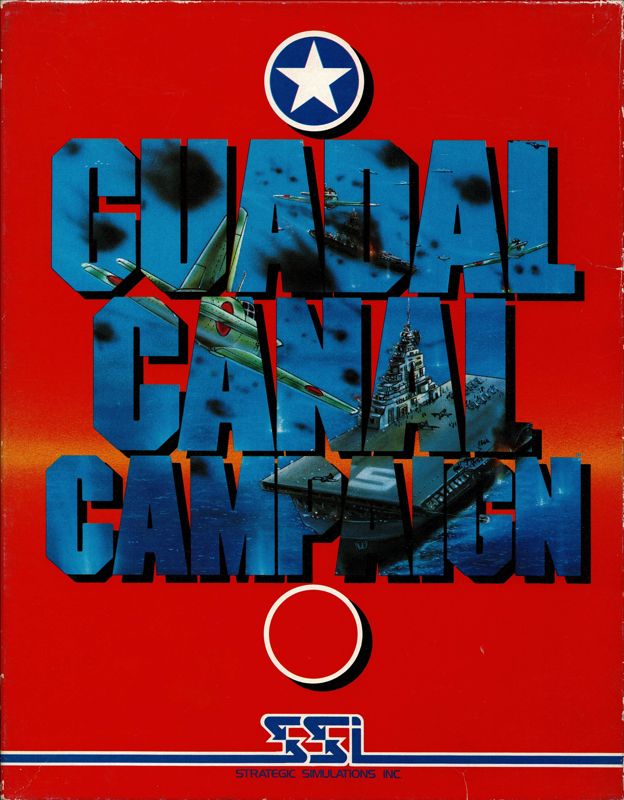


Retro Replay Review
Gameplay
The first turns of Guadalcanal Campaign make its priorities clear: this is command work, not a quick tactical skirmish. A single turn covers 12 hours, and before combat resolves you must reinforce troops, reposition forces, send task groups across the map, and assign air missions and patrols. That sequence gives each decision weight. Moving a ship or force into place is not an isolated action when aircraft, enemy fleets, and distant bases all matter to the same campaign.
The full campaign has real staying power because it runs from August 7 to December 31, 1942, at two turns per day. You are not handling a tiny battle box; you are managing an operation across a 40-by-40 grid stretching from Truk to northern Australia. Key ports and airbases give the map meaningful anchors, while the mix of destroyers, aircraft carriers, troops, and aircraft forces you to think across land, sea, and air rather than mastering only one front.
What starts to click is the rhythm of preparation and consequence. Reinforce, position, launch missions, then live with combat resolution. The available air arm includes fighters, several bomber types, and reconnaissance floatplanes, so reconnaissance and air activity are part of the wider operational puzzle rather than background decoration. If you enjoy games that make you consider whether a force is in the right place before the shooting starts, there is plenty to chew on.
Frustration will set in if you want immediate feedback or a short route to a decisive win. A 147-day campaign demands attention, and the final result comes down to victory points rather than a single dramatic showdown. The shorter October-to-December campaign and the Coral Sea, Eastern Solomons, and Santa Cruz scenarios are sensible places to begin; they let you learn the turn structure without committing immediately to the full historical grind.

Graphics
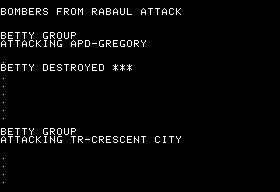
On Apple II, Guadalcanal Campaign is built around a top-down grid map of the South Pacific. The useful visual information is positional: sea space, land, ports, airbases, and the forces you are moving between them. It is a map-first wargame view, suited to tracing long naval routes and judging the distance between objectives.
Story
There is no authored character drama here. The story comes from the 1942 Battle of Guadalcanal itself and from the campaign calendar: August 7 through December 31, with the American side facing Japan. That historical frame gives the long game more tension than an invented conflict would have.
You make the operational narrative through deployments, reinforcements, patrols, and attacks. A task force sent toward a key area, troops committed to a position, or aircraft assigned to a mission can all become part of your own account of the campaign. The game’s focus stays firmly on command decisions rather than personalities.
The included shorter scenarios add recognizable slices of the wider Pacific war: Coral Sea, Eastern Solomons, and Santa Cruz. They are valuable not because they tell separate scripted tales, but because each offers a tighter historical situation in which to test your judgment.
Overall Experience
Guadalcanal Campaign is a serious early computer wargame with an admirably broad view of its subject. It asks you to coordinate American land, naval, and air power over months of simulated time, and that scale is its strongest argument. When you want a game about the operational strain behind a campaign, the long horizon is rewarding.
It is also plainly a niche proposition. The Apple II format and turn-by-turn workload mean you need patience, a willingness to study the map, and comfort with outcomes being measured through victory points. Anyone hoping for fast battles or a story-led World War II adventure will likely find the pace punishing.
For dedicated historical wargamers, though, the payoff is a compact but substantial command problem. Start with one of the short scenarios, learn how troop movement, task-force positioning, air operations, and reinforcement fit together, then move to the campaign when the map begins to feel less like a grid and more like a chain of hard choices. It is demanding rather than welcoming, but its scope earns respect.


Reviews
There are no reviews yet.