 Retro Replay Retro Gaming History, Reviews & Emulation


Retro Replay Review
Gameplay
North Atlantic ’86 starts by asking you to think like a theater commander, not the captain of a single ship. You organize NATO vessels into task forces, choose where they need to go, then live with the consequences across a huge North Atlantic grid. The first hour is mostly about getting your bearings: a square spans 100 km, turns cover 12 hours, and every movement decision can put a convoy, a base, or a valuable naval group within reach of the enemy.
What begins to click is the relationship between sea control and air power. Task forces are not just counters to push toward a target; they are the tools through which you interdict sea lanes, move troops and supplies, evacuate forces, or bombard land. Air missions and missile attacks add another layer before combat resolves, so success comes from concentrating the right assets in the right place rather than simply spreading ships across the map.
That breadth is also where frustration sets in. North Atlantic ’86 is unapologetically procedural: you build or adjust forces, move them, launch air missions, fire missiles, and then resolve combat. A careless plan can take time to reveal itself, and the scale means immediate tactical gratification is not the point. Save after combat when you need to step away; these campaigns are built for sustained consideration, not a quick ten-minute skirmish.
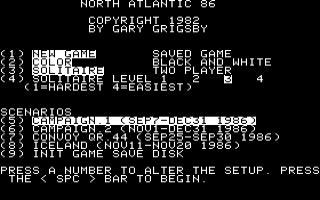
The scenario selection helps enormously. The September-to-December and November-to-December campaigns offer the full operational commitment, while the Iceland invasion and September convoy operation are better places to learn what the game wants from you. NATO must be human-controlled, but having the option to put either a human or the computer in charge of the Soviets makes the game flexible for solo and head-to-head sessions.

Graphics
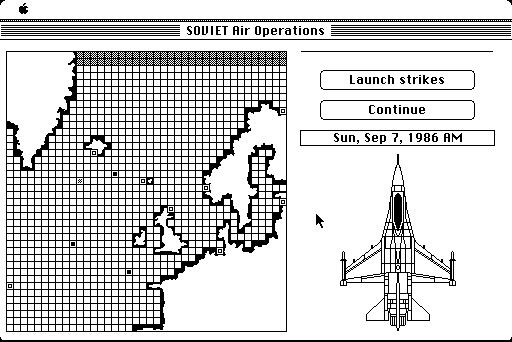
The view is a top-down 40-by-40 square map of the North Atlantic. Land, ocean, bases, Soviet task forces, and NATO task forces are represented directly on that grid, keeping the important geographic relationships in front of you rather than burying them in a more decorative display.
Story
There is no character-driven narrative here, and that is the right fit. The story is the hypothetical 1986 conflict itself: NATO and Soviet air, land, surface-naval, and submarine forces fighting for control of the North Atlantic.
Each operation creates its own stakes. A convoy run is not merely a scenario label when enemy interdiction threatens the route; an evacuation or troop transport becomes a question of whether you can assemble enough protection and air cover before the situation worsens. The game gets mileage from that escalating chain of operational consequences.
The dated-but-effective Cold War framing gives the campaigns a concrete sense of purpose. You are not conquering abstract territory for points alone. You are trying to maintain routes, protect forces, and deny the opponent room to operate across an ocean where distance is one of the main enemies.
Overall Experience
North Atlantic ’86 is for the wargamer who enjoys stopping, studying the map, and committing to a plan with imperfect certainty. It asks more patience than many strategy games because its payoff comes from seeing a carefully assembled operation survive the turn sequence and accomplish something meaningful.
Its strongest quality is focus. Everything revolves around task-force management and the effective use of air power, and the game keeps returning you to that central operational problem from different angles. The campaigns supply the long-form challenge, while the mini-games provide a less intimidating route into the system.
Give it a chance if naval logistics, convoy protection, and Cold War operational planning sound more exciting than micromanaging individual units in real time. For another North Atlantic-themed game, North Atlantic Convoy Raider is a relevant companion. North Atlantic ’86 can be stern and slow, but once you understand why a distant task force and a well-timed air mission matter, its deliberate tension is worth the effort.


Reviews
There are no reviews yet.