 Retro Replay Retro Gaming History, Reviews & Emulation


Retro Replay Review
Gameplay
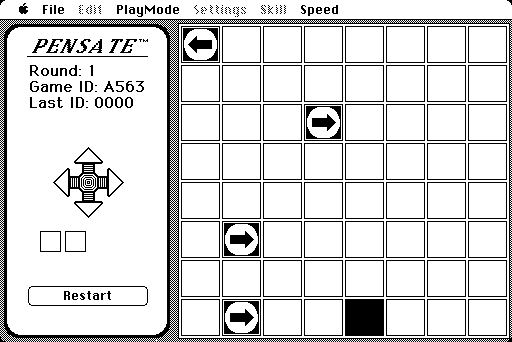
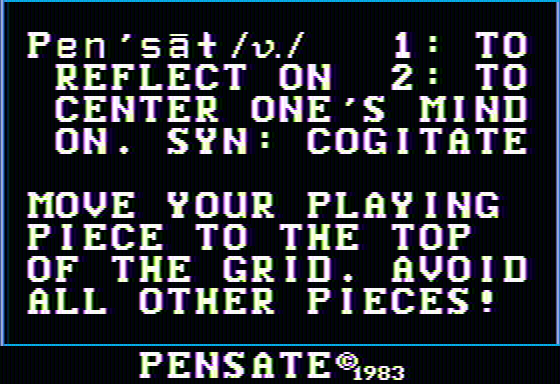
Pensate grabs you with a wonderfully clean challenge: get your castle from the bottom of the board to the top while enemies move at the same time. You can move up, down, left, or right, which sounds almost too basic until the board starts filling with pieces that respond to your choices in completely different ways. A move toward safety can cause an opposing mover to close in, while another enemy may mirror your direction or rotate it. Every turn becomes a small attempt to read several futures at once.
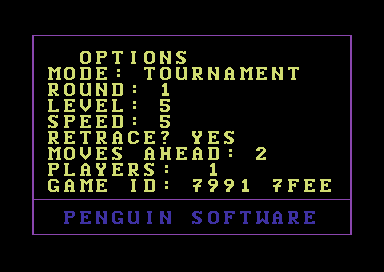
The option to set one through four moves per turn is more important than it first appears. With fewer moves, you have room to reassess and play cautiously. More moves make each decision feel like a commitment, because a bad route can leave you exposed before you get another chance to correct it. That adjustable pace gives the game a useful difficulty lever without changing its central rules.
Practice mode is where Pensate earns its keep. Building your own enemy selection lets you isolate the behavior that is causing trouble, especially the enemies that copy or alter your movement and the knight-like foe that can jump to a non-adjacent square. It is a smart way to learn through experimentation rather than repeatedly crashing into a tournament setup you do not yet understand.
Tournament mode supplies the sterner test, adding more and tougher enemies as its rounds progress. The frustration is real when a carefully planned advance unravels because you missed one interaction, but the rules are consistent enough that failure can teach you something. Two-player play also gives the same board puzzle a competitive angle, with one side crossing from top to bottom rather than making the usual climb.
Graphics
Pensate is built around a checkerboard playfield, with your castle and the enemy pieces sharing the board. That fixed, top-down view suits the game well: you need to see positions and movement lanes clearly, and the board keeps the focus squarely on the puzzle.

Story
There is no elaborate tale pulling you through Pensate. The drama comes from the immediate situation on the board: your castle has a destination, hostile pieces occupy the routes ahead, and you need to find a safe sequence of moves.
That stripped-down approach works because the enemy movement patterns create their own tiny stories. One turn looks like a simple opening; the next reveals that an enemy’s reversed or rotated response has turned it into a dead end. You are not following a plot so much as writing a sequence of escapes and mistakes.
Tournament progression gives those encounters a modest sense of escalation. Each new round asks you to carry forward what you learned about earlier enemy types while accounting for a tougher mix, so advancement feels tied to growing understanding rather than a change in setting or character.
Overall Experience
Pensate is a lean, cerebral board puzzle that gets deeper once you stop treating it as a straight race. Its best moments come when you can finally anticipate how several enemy types will react to the same command and spot a route that looked impossible a turn earlier.
You will need patience. This is not a game that flatters impulsive play, and its minimal movement vocabulary means there is nowhere to hide if you have not thought through the board. But that directness is also why it remains satisfying: success feels like the result of reading the rules correctly, not stumbling into luck.
Give it a chance if you enjoy turn-based puzzles built around deterministic movement, chess-like spatial planning, and learning a system piece by piece. Practice mode makes it friendlier than the tournament’s rising pressure might suggest, while the two-player option offers a neat variation for someone sitting beside you. It is small in scope, but it asks for—and rewards—serious attention.


Reviews
There are no reviews yet.