 Retro Replay Retro Gaming History, Reviews & Emulation

Retro Replay Review
Gameplay
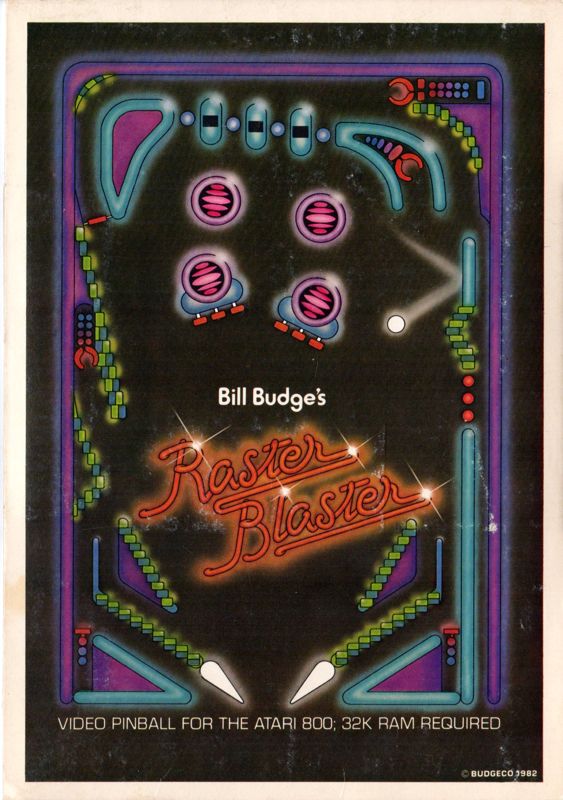
Raster Blaster has the kind of first-hour pull that pinball does best. You sit down expecting a quick look, then keep restarting because the last ball ended too soon and you are sure you can do better. There is no clutter around that central loop: keep the ball in play, chase points, and live with the consequences when your timing fails.
The difficulty choice is more meaningful than it first sounds. Easy mode keeps a ball shield active all the time, making it the sensible way to learn the table’s rhythm without every mistake feeling terminal. Hard mode asks you to activate the shield yourself, which adds pressure at exactly the moment you might otherwise relax. Start on Easy if you are new to old-school computer pinball; move to Hard once the safety net begins to feel too generous.
Taking turns with up to four players is where the score chase gets sharper. Even without a large set of modes or tables, passing control after each turn gives every ball an audience and turns small score swings into bragging rights. That makes Raster Blaster a better fit for a short shared session than a solitary all-night obsession.
Its age shows in the narrowness of the offering. You are committing to one pinball table and the satisfaction of improving at it, not progressing through a long sequence of new challenges. Still, the limited scope also makes the game refreshingly honest: if the simple act of chasing one more good run hooks you, it has done its job.

Graphics
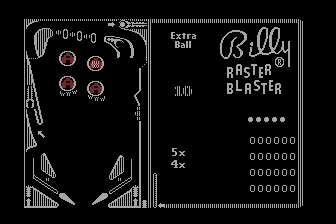
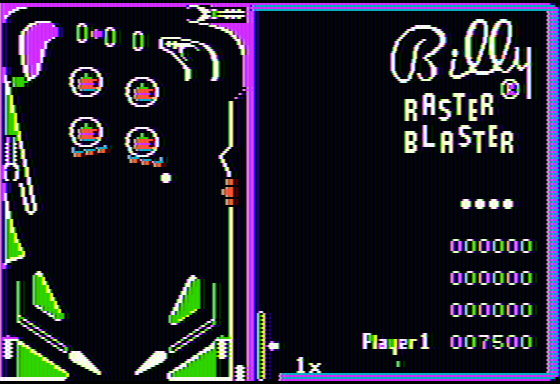
The top-down view keeps the focus on the pinball table and makes the ball’s path the thing you watch most closely. Raster Blaster is from the earliest days of computer pinball, so its look is firmly rooted in that era, but the straightforward table view suits a game built around quick reactions and score chasing.
Story
Raster Blaster does not ask you to follow a cast of characters or unravel a plot. Its hook is the pinball table itself, an unofficial computer adaptation of Williams’ Firepower, and the drama comes from whether you can rescue a threatened ball or squander a promising run.
That lack of narrative is not a weakness here. Pinball creates its own tiny stories: a safe early turn, a late collapse, a score that seems unreachable until somebody edges past it. In multiplayer, each player’s turn becomes a compact little contest with a clear before-and-after.
There is also a pleasing bit of game-history context behind it. Bill Budge would later build on this foundation with Pinball Construction Set, so Raster Blaster feels like an early step toward a much more influential idea. That matters most if you enjoy seeing how computer games were learning to translate physical play into something you could have at home.
Overall Experience
Raster Blaster is easy to recommend to anyone with patience for early computer games and a real affection for pinball. It does not need a complicated premise to earn another try; the tension between a protected Easy-mode ball and the more demanding Hard-mode rules gives you a clear reason to improve.
You should temper your expectations if you want lots of tables, elaborate progression, or a story to carry you between games. Raster Blaster is a focused single-table score chase. Its value comes from repetition, growing familiarity, and the stubborn urge to make the next ball count.
For most gamers, the historical interest will be the reason to try it, while the competitive turn-taking will be the reason to stay longer than planned. It is a small but worthwhile artifact of computer-game history that still understands the basic pleasure of pinball: one more ball, one more chance, and maybe a better score this time.


Reviews
There are no reviews yet.