 Retro Replay Retro Gaming History, Reviews & Emulation

Retro Replay Review
Gameplay
The Alien earns its tension immediately because you are not simply moving armed crew through a ship and waiting for a target to appear. The alien is obscured by the escaped animals on the life-sign scanner, so the opening becomes a genuine search problem. You have to decide who acts, what they do with the tools at hand, and how much of the Thrasybulus you are willing to expose while trying to narrow down the creature’s location.
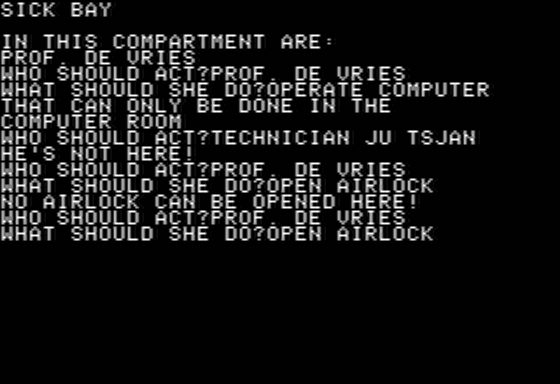
The crew roles are the game’s best idea. Officers can reach the armory and initiate self-destruct, scientists work with the lab equipment and computer system, and engineers can rig equipment into improvised weapons. That division means a plan can fall apart if the wrong person is on the wrong side of the ship. It also gives the turns a satisfying, board-game-like rhythm: set up the right specialist, use an action, then move people into position for what may happen next.
The action list sounds methodical, and it is. Picking up and combining items, catching animals, operating systems, and using weapons all take their place in the same turn structure. That deliberate pace will either be the hook or the hurdle. If you want immediate action, the repeated room sweep can feel fussy; if you enjoy working through a dangerous situation one careful decision at a time, the friction is exactly what makes the hunt unnerving.
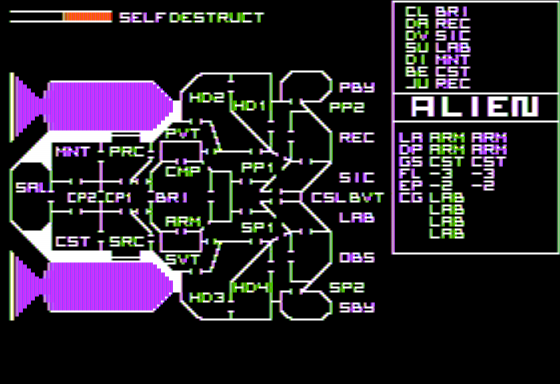
The map of 30 rooms is especially important because it keeps the ship from becoming an abstract maze. You can track crew and equipment status alongside scanner readings, then plot movements with a clear goal in mind. The alien’s ability to metamorphose quickly keeps certainty out of reach, which prevents the game from becoming a solved route through the ship.
Graphics
The key visual tool is the ship map, which lays out the Thrasybulus’s 30 rooms and shows crew, equipment, and life-scanner information. It is a practical view for a game built around coordinating a search across a confined vessel.
Story
The Alien wears its 1979 sci-fi-horror inspiration openly, but the setup remains effective: a specimen brought aboard has escaped, the crew cannot trust the scanner, and a routine voyage turns into a containment disaster. The immediate stakes are clear before you make a single move.
What gives the scenario more than a basic monster hunt is the mess surrounding the escape. The loose lab animals are not flavor text; they directly compromise the crew’s ability to find the threat. That small complication makes the ship feel like a workplace thrown into panic rather than a clean arena built for combat.
There is also a pleasing range in the possible outcomes. You can capture the alien, kill it, or accept the worst-case solution of activating self-destruct and escaping by shuttle. That makes your final objective feel contingent on how badly the situation has deteriorated, not just on whether you can win a fight.
Overall Experience
The Alien is most compelling as a slow-burn survival strategy game. Its strongest moments come from making a sensible plan, realizing the scanner cannot tell you enough, and then deciding whether to spend another turn preparing or push farther into the ship. The rules turn uncertainty into the central opponent.
It is not a game for someone looking for a breezy science-fiction adventure. You need patience for predefined actions, specialist management, and deliberate movement through rooms. The reward is a compact tactical puzzle where officers, scientists, and engineers each matter for concrete reasons instead of being interchangeable counters.
Give it a chance if the idea of running a desperate shipwide containment operation sounds more exciting than directly controlling a lone hero. The Alien’s premise is familiar, but its mix of imperfect information, role-based crew decisions, and multiple escape routes gives the crisis real strategic bite.


Reviews
There are no reviews yet.