 Retro Replay Retro Gaming History, Reviews & Emulation
Retro Replay Review
Gameplay
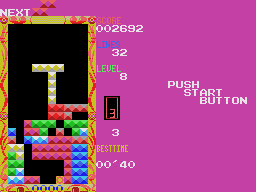
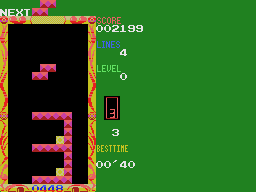
Flashpoint starts with the comfortable rhythm you expect from a Tetris variant—recognizable pieces, familiar rotations, and that immediate urge to flatten the mess before it climbs too high. Then you notice the bombs tucked into the board’s existing pattern. Suddenly, a line clear is not just housekeeping. You are trying to reach particular rows, preserve enough space to build toward them, and avoid burying the very targets that will end the stage.
That objective gives the game a sharper purpose than a plain score chase. Pre-filled boards force you to react to what is already there rather than build from a blank well, so a good placement often has two jobs: it keeps your stack manageable and opens a route to a bomb. The best moments come when a routine clear also detonates a target you had been working around for several drops. It makes even small successes feel intentional.
Pressure arrives gradually if you linger too long on a stage, as the falling speed increases. That can turn a carefully considered board into a scramble, which is exactly where Flashpoint becomes frustrating: a puzzle that looked solvable at leisure can demand quick, imperfect decisions. The reset to the default speed after each completed stage is a smart mercy, though. You can clear a tough board and immediately breathe again instead of carrying the previous stage’s panic forward.
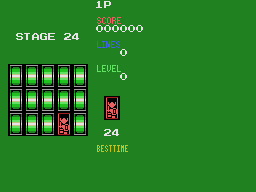
Ninety stages give the central idea proper mileage, and the stage-by-stage structure makes it easy to play in short bursts or chase a longer run. Two-player gameplay is a worthwhile extra because the shared familiarity of falling blocks means another person can understand the tension instantly. Flashpoint is not trying to replace the pure, endless satisfaction of Tetris; it earns its place by turning line clearing into a targeted demolition job.
Graphics
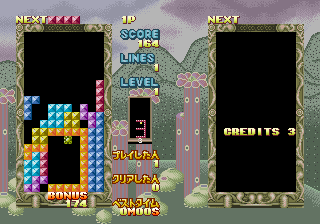
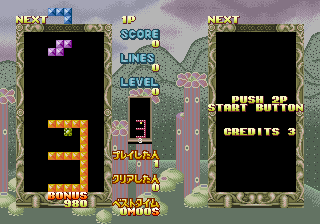
The boards are built from block patterns that form symbols, characters, and other simple images, so each stage begins with more visual personality than an empty Tetris field. Bombs stand out as the important pieces in that arrangement, and the final stage explosion gives completion a fitting visual punctuation mark.
Story
Flashpoint frames its progression through destruction rather than a conventional plot: each board is a constructed image, each bomb is a target, and each cleared stage ends in an explosion before the next challenge appears. It is a simple arcade-style throughline, but it gives the sequence of puzzles more momentum than a disconnected set of boards.
There is a small pleasure in seeing a pattern gradually dismantled. At the start, the arrangement can look like an obstacle or a little picture to work around; by the end, your own pieces have reshaped it into the rows needed for detonation. That makes advancement feel like resolution, not merely another tally of completed lines.
The game’s real drama is mechanical: can you keep the board open long enough to reach every bomb before the pace rises? Because stages reset the speed after completion, each new board feels like a fresh scene with its own problem rather than an exhausting continuation of the last crisis.
Overall Experience
Flashpoint is a genuinely good variation on an all-time great formula because it changes the reason you clear lines without changing the immediate language of play. You already know how the pieces behave, so the first hour is about learning to read bomb placement and resist the instinct to clear whichever row happens to be easiest. Once that clicks, the game becomes more thoughtful than a straightforward clone.
Its limitations are also part of its character. Every stage still lives or dies on falling-block placement, and the increasing speed can make an otherwise tidy plan unravel fast. If you want a relaxed, purely meditative stacking game, that pressure may wear thin. If you like being handed a constrained board and finding the cleanest route through it, the tension is a feature rather than a flaw.
The payoff is worth it for puzzle fans who enjoy familiar rules used in a more goal-driven way. Flashpoint has the instant readability of Tetris, but its bomb-clearing stages ask you to think ahead in a different direction. Give it a chance if you want compact arcade puzzles with clear objectives, a sizable set of stages, and a satisfying burst of destruction at the end of each solved board.


Reviews
There are no reviews yet.