 Retro Replay Retro Gaming History, Reviews & Emulation

Retro Replay Review
Gameplay
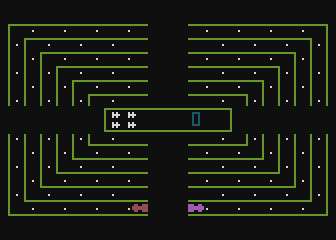
The first few laps of Dodge Racer are almost disarmingly simple. You steer around a six-lane circuit, collect the dots lining each lane, and try not to collide with a car coming the other way. Then you realize you cannot switch lanes whenever panic strikes: changes are restricted to the middle of each straight. That one limitation gives the game its bite. You are not merely swerving around traffic; you are committing to a route and hoping you read the next approach correctly.
The speed button is where the game starts to click. At normal speed, you shift one lane at a time. Double speed lets you jump two, making it both an escape tool and a way to create trouble for yourself. A rushed acceleration can save a run, but it can also put you in the wrong lane for the next straight. That push-and-pull gives a very old-school score-chasing loop more thought than its stripped-down premise suggests.
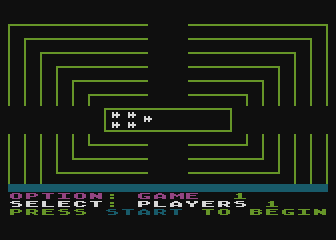
Clearing every dot advances you, while five crashes end the game, so the tension comes from balancing clean-up work against survival. The variant settings matter because they change that balance: restoring dots after a crash softens the punishment, while adding a second computer car or allowing crash cars to accelerate makes the circuit much less forgiving. Up to four people can take turns, but the standout multiplayer idea is competitive mode, where one person controls the crash car and actively hunts the other. It turns a solitary evasive challenge into a compact game of prediction and spite.
Graphics
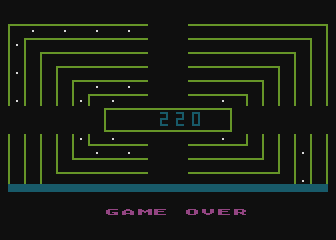
The game uses a top-down, fixed-screen circuit view: cars circle six clear lanes while dots mark the work still left to do. It is a plain arcade board rather than a detailed road scene, but the overhead layout makes lane positions and oncoming danger easy to track at a glance.
Story
There is no narrative detour here. Dodge Racer puts you straight into its contest of timing, lane choice, and nerve, which suits a game built around repeated short attempts.
That absence of story also makes each mode feel like a different ruleset challenge rather than a new chapter. You make your own little drama out of a near miss, a mistimed speed burst, or a rival driver finally catching you.
If you want the historical basics around this 1981 Atari 8-bit release, the Dodge Racer entry is useful background. In play, though, the whole point is immediate: see the danger, choose a lane, and live with the decision.
Overall Experience
Dodge Racer is a focused arcade game whose best moments come from turning a simple track into a trap. The restricted lane changes prevent it from becoming mindless weaving, and the double-speed button gives you just enough control to feel responsible when a crash happens.
Frustration can set in when a bad position leaves no safe answer, especially with tougher options enabled. But that harshness is part of its rhythm: runs are short, the rules are clear, and you can quickly tell whether the next attempt failed because you got greedy, hesitated, or simply misread the other car.
Give it a chance if you enjoy early arcade games that ask for concentration rather than elaborate systems. Solo play has a satisfying route-planning pulse, and competitive mode is the better reason to bring another person along: handing one driver the job of causing the wreck makes this tiny racer far more mischievous than it first appears.


Reviews
There are no reviews yet.