 Retro Replay Retro Gaming History, Reviews & Emulation
Retro Replay Review
Gameplay
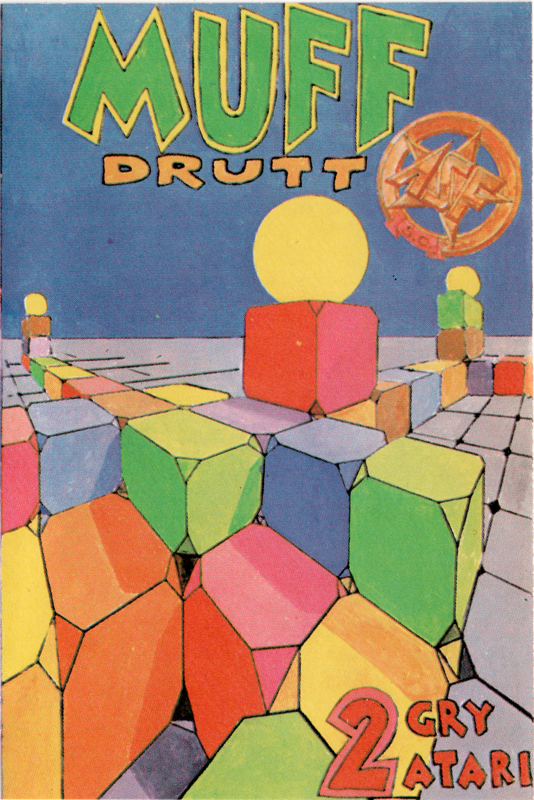
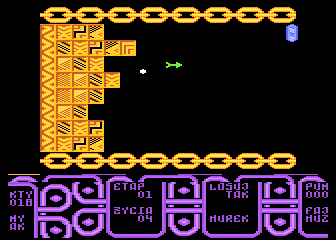
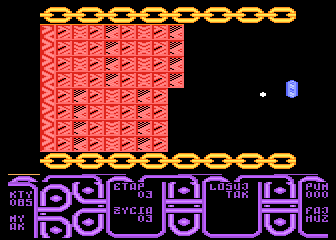
Muff starts from a proven arcade hook: keep the ball alive and tear down a wall. Placing that wall on the left side of the screen changes the familiar Arkanoid-clone rhythm just enough to make its own demands. You are not simply clearing a field of bricks; you are working against a fixed target while trying to maintain control of a ball that can quickly make a calm run feel frantic.
The bonus arrows are where Muff finds its personality. Since their extras can be positive or negative, grabbing one is not automatically a reward. That uncertainty gives each falling arrow a small burst of tension: take the chance for help, or avoid a modifier that could spoil your current control? It is a simple wrinkle, but a good fit for an arcade game built around rapid reactions and repeat attempts.
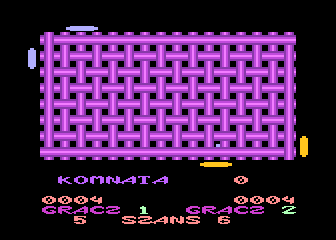
Drutt is the more unusual half. Two people play simultaneously, each handling both a vertical and a horizontal paddle, and the goal is to make the other person fail to return the ball. That is a lot to manage at once, especially at first. Once the controls settle into your hands, though, the match becomes a direct contest of anticipation and composure rather than a solitary endurance test.
The split between the two games is the compilation’s real strength. Muff suits a quiet attempt to improve, while Drutt is made for sitting beside someone and seeing who cracks under pressure. Neither concept is elaborate, and that is fine: the rules are clear, the stakes are immediate, and the two-player mode gives the package a useful second gear.
Graphics
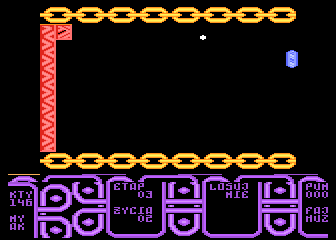
Muff’s playfield centers on the wall positioned along the left side, keeping your target plainly in view as the ball rebounds around it. Drutt’s two-paddle setup has to show both horizontal and vertical control at once, giving its competitive matches a busier, more functional arcade screen.
Story
Muff / Drutt does not build toward a story; it puts the contest first. Muff asks you to destroy a wall, and Drutt asks you to outlast the person opposite you. The lack of narrative framing is not a distraction because the games are designed around immediate, self-explanatory goals.
That stripped-down approach suits the era and the format. You can begin a round without needing to absorb character motivations or a larger premise, then let the ball movement and paddle control create the drama. In Muff, a risky bonus arrow can change the mood of a run; in Drutt, the other player supplies the tension.
If you want an arcade game with a tale to uncover, this will feel bare. If you enjoy games that create their own tiny stories through close saves, missed rebounds, and rematches, it has the right kind of simplicity.
Overall Experience
This is a modest but sensible pairing. Muff delivers recognizable single-player brick-breaking with enough uncertainty in its bonus arrows to prevent every attempt from feeling identical. Drutt then takes the same ball-and-paddle foundation in a more competitive direction and asks both participants to multitask under pressure.
The main frustration is also part of the intended challenge. A negative extra in Muff can turn opportunism into regret, while Drutt asks you to coordinate two paddle directions while an opponent is trying to force a mistake. You will either enjoy that abrupt arcade cruelty or find it more demanding than its simple premise suggests.
Give Muff / Drutt a chance if you like lean Atari-era arcade design and can appreciate a compact compilation that alternates between solo concentration and local rivalry. Muff alone may be too familiar to carry the whole package, but Drutt makes the collection worth remembering: it is the mode that turns basic paddle control into a proper head-to-head test.


Reviews
There are no reviews yet.