 Retro Replay Retro Gaming History, Reviews & Emulation
Retro Replay Review
Gameplay
OiX gets its first bit of tension from a simple question: where do you put a single O or X when almost the entire 20-by-20 board is still empty? Requiring five symbols in a row gives the familiar tic-tac-toe contest more room to breathe. Early turns are not immediately decisive, so you have time to think about which areas of the grid could become useful before the computer starts contesting them.
Choosing whether to play O or X and whether to move first is a welcome bit of control for such a compact game. Going first lets you stake out an idea, while moving second puts you in the position of answering the computer’s first claim. The fundamentals are easy to understand, but a board this large asks you to keep track of more possible rows than ordinary tic-tac-toe ever does.
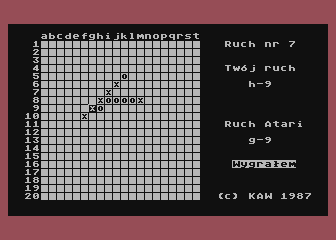
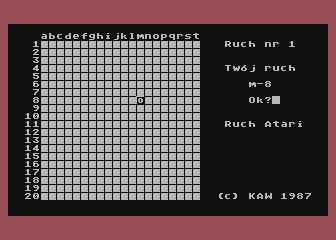
Entering coordinates is the dividing line. It makes each turn deliberate, and it suits anyone who enjoys mentally mapping a board. It also slows the rhythm down. You are not simply pointing at a square and reacting; you are translating your choice into an input, then waiting for the next position. That can make a close match feel focused, but it can also turn routine moves into a chore.
There is still a real strategic pull in watching a harmless-looking cluster of marks develop into a possible five-in-a-row. The best moments come when one placement can contribute to your own line while making the computer’s answer more urgent. OiX is narrowly built, yet the larger win condition gives its single idea enough depth to sustain a few thoughtful matches.
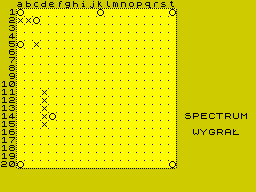
Graphics
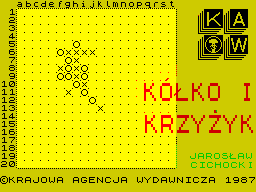
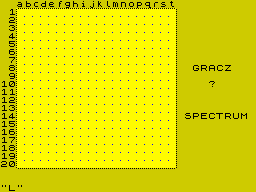
The game centers on a fixed, top-down board of squares and O/X marks. Its important visual task is showing the expanding grid and the positions of both sides, so the look is necessarily plain and functional rather than decorative.
Story
OiX is a direct abstract board-game contest, not a narrative game. There are no characters or plot threads pulling you from one match to the next; the conflict is entirely between your marks and the computer’s marks.
That stripped-down setup puts all the drama into the board state. A row beginning to form becomes the closest thing OiX has to a story beat, especially when a move can either extend your threat or interrupt the computer’s.
For some games, that lack of narrative framing is exactly right. You sit down, choose your side and turn order, and face a clean puzzle with no detours. Anyone wanting context beyond the match itself will find very little to hold onto.
Overall Experience
OiX is a modest but legitimate twist on tic-tac-toe. Moving from three-in-a-row to five-in-a-row on a 20-by-20 board changes the scale enough that you cannot rely on the tiny, solved-feeling patterns of the schoolyard original. It asks for broader attention and rewards you when you notice a line developing before it becomes obvious.
The coordinate-based input makes this a better fit for patient, methodical play than quick casual rounds. If you like old computer board games that make you slow down and consider every square, the friction can feel purposeful. If your idea of a good five-in-a-row game involves rapid placement and immediate visual feedback, the interface will likely wear on you.
Give OiX a chance if a bare-bones contest of planning, blocking, and pattern recognition sounds satisfying. It does not try to be more than a computer opponent and an oversized grid, but that simplicity has a certain honesty. The payoff is strongest when you treat it as a quiet tactical puzzle rather than expect a feature-rich strategy game.



Reviews
There are no reviews yet.