 Retro Replay Retro Gaming History, Reviews & Emulation

Retro Replay Review
Gameplay
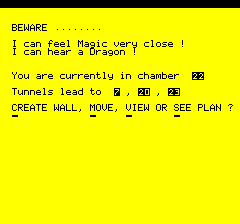
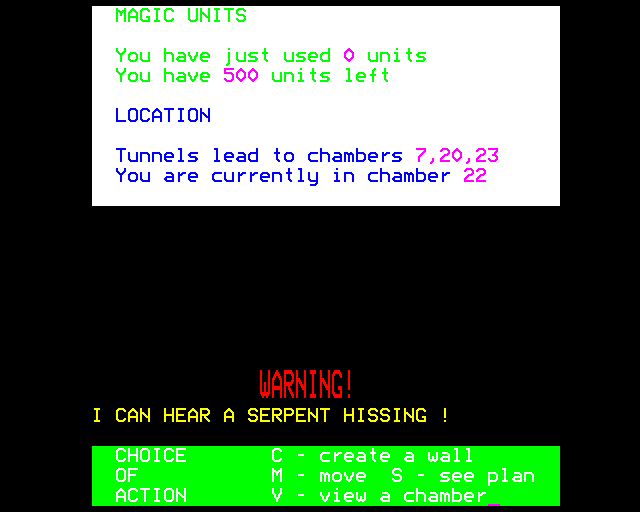
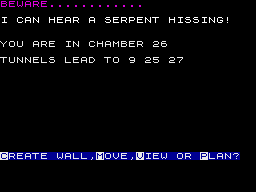
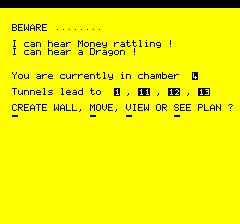
The first few moves put you in the right frame of mind: this is not a game about safely checking every door. You are deposited at random into a network of barrows and must work out a route toward the wizard before your magic points disappear. Viewing connecting rooms costs magic, raising a magic wall in an adjacent room costs magic, and the initial pool of 400 points makes both actions feel like commitments rather than conveniences.
That economy gives the text-based exploration real bite. You are trying to locate one wizard somewhere in a map of about 40 rooms, while gnomes, trolls, dragons, and other dangers occupy other locations. The map turns what could have been simple room-to-room movement into a logic problem: learn enough about nearby spaces to make an informed choice, but do not spend so freely that you run out of the very resource needed to finish the hunt.
The design will click with you if you enjoy drawing conclusions from limited information and accepting that a bad decision can matter for the whole run. Random starting positions add uncertainty, while the option to build a wall suggests defensive or route-shaping choices when an adjacent room looks troublesome. It is a compact challenge, but a stern one; impatience and compulsive checking are exactly the habits its point system punishes.
Graphics
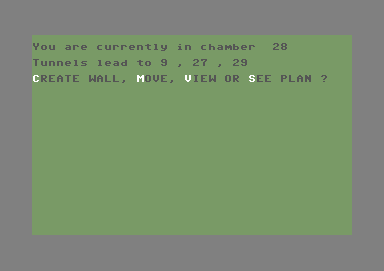
The White Barrows is a text game with a single graphical map showing how the rooms connect. That map is the key image you will use most, turning the maze from an imagined dungeon into a visible network you can study as you plan the next move.
Story
The story is stripped down to a clear adventure-game task: a bad wizard has stolen a magic chalice, fled into ancient burial grounds, and you are the adventurer sent to retrieve it. There is no ambiguity about what matters. Find the wizard, recover the chalice, and survive the consequences of taking the wrong path through the barrows.
That simple setup suits the game’s pressure-cooker structure. The burial grounds are not a backdrop for lengthy character drama; they are the reason a small map can feel threatening, with monsters scattered among rooms and the wizard concealed somewhere within. You are pushed toward the practical question that drives every turn: where can he be, and what can you afford to learn next?
If you come in wanting a richly told fantasy tale, the premise alone will not carry you very far. The reward is instead the role-playing of your own decisions: acting as a cautious explorer with a dwindling magical reserve, trying to turn scraps of knowledge into a route to the thief.
Overall Experience
The White Barrows has the directness of an early home-computer game that knows exactly where its challenge lives. Its dungeon is a connected map, its objective is a hidden target, and its central twist is that information is a resource. By refusing to make exploration free, it turns each look ahead into a small gamble.
That also makes it easy to see where frustration can set in. You can start in an unfavorable part of the maze, encounter threats while still trying to orient yourself, and watch your 400 points decline because you needed answers. The game asks you to enjoy that pressure rather than resent it. If the idea of losing because you investigated too much sounds irritating, its core loop is unlikely to soften with time.
For fans of terse text games, map puzzles, and resource-constrained dungeon crawling, this is a worthwhile curio with a genuinely sharp strategic hook. Give it a chance when you want a short, focused exercise in restraint and deduction. The payoff is not a grand fantasy journey; it is the satisfaction of finally reading the maze well enough to reach the wizard before your magic runs dry.


Reviews
There are no reviews yet.