 Retro Replay Retro Gaming History, Reviews & Emulation

Retro Replay Review
Gameplay
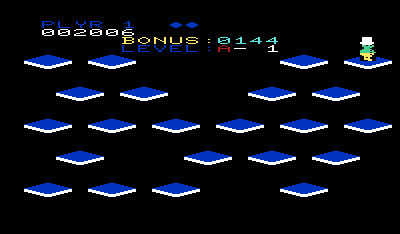
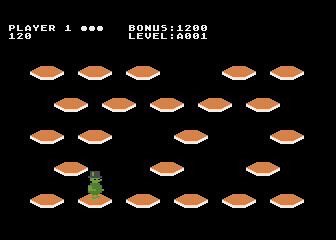
The first few moments of Topper are pleasingly direct. You move Topper the Turtle diagonally from tile to tile, and every landing repaints a tile. That clear objective makes it easy to start playing without any warm-up: scan the board, pick a path, and keep moving until every tile has changed color.
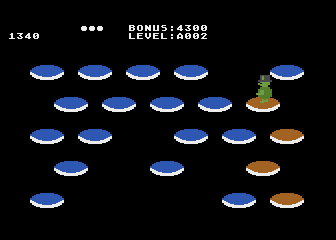
The trouble is that the board refuses to remain a friendly puzzle for long. Some tiles blink out, and falling because the tile beneath you disappears—or because you jumped toward one at the wrong moment—costs a life. That turns route planning into something more urgent than simply covering untouched spaces. You are not just asking where to go next; you are trying to avoid committing yourself to a bad landing.
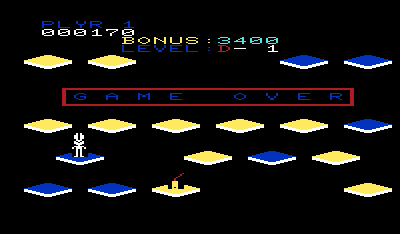
Dynamite raises the stakes further by hopping from tile to tile. Landing with it means an explosion and another lost life, while rabbits become an additional moving threat once they arrive. Every four levels the difficulty climbs, so the game’s modest rules gain bite through accumulation rather than through a pile of new ideas. The result can feel unforgiving, especially when a tile vanishes at the worst possible time, but the pressure is also what makes a clean run satisfying.
Two-player play alternates rather than putting both turtles on the board together, which suits the score-driven arcade structure. Passing the controller after a costly mistake gives Topper a competitive little edge: you get to watch the other player tackle the same escalating hazards, then try to do better on your next turn.
Graphics
Topper’s action is built around a field of color-changing tiles, with Topper, rabbits, and hopping dynamite serving as the key things you need to spot. The changing tile colors make your progress easy to judge at a glance, while the disappearing tiles and moving hazards give the board a more active look than a static paint-the-floor challenge.
Story
There is barely a story, and that is appropriate. Topper wants to brighten things up by painting tiles; the tiles resist, dynamite threatens to blow them up, and rabbits are apparently still bitter about a race. It is a playful excuse for the action rather than a narrative you follow.
The turtle-versus-rabbits gag gives the hazards a bit more character than anonymous enemies would have. Still, Topper’s personality comes through mainly in the basic image of a determined turtle continuing to hop across an increasingly hostile board.
Anyone looking for plot, progression outside of harder levels, or a destination beyond the next high score will find very little to hold onto. This is an arcade premise meant to get you into the next attempt quickly.
Overall Experience
Topper is a lean, tough arcade game whose pleasures come from mastering a small set of rules. Its debt to Q*bert is obvious, but the unreliable tiles, dynamite, and rabbits make the board feel more treacherous than a straightforward color-changing exercise. When your movement is flowing and you escape a collapsing route by a single jump, it has the right kind of old-school tension.
Frustration is part of the deal. Lives disappear quickly, and the challenge ramps up every four levels, so you need to enjoy repetition and be willing to treat failed runs as practice. The game does not soften its consequences or offer much room to recover once the board gets crowded.
Give Topper a chance if you like compact arcade games that demand fast diagonal movement, route awareness, and a tolerance for sudden reversals. Its concept is narrow, but it stays engaging for as long as you are chasing a cleaner, longer run. For the right gamer, that is enough: a brisk tile-hopping contest with a mean streak and a charmingly silly hero.



Reviews
There are no reviews yet.