 Retro Replay Retro Gaming History, Reviews & Emulation

Retro Replay Review
Gameplay
The first few moves in Go-Moku / Renju feel almost casual. You put down one stone, the computer responds, and the board still looks wide open. Then a pair of nearby stones becomes a possible row, a defensive reply creates another threat somewhere else, and every turn starts carrying real weight. The core rule—make five in a row horizontally, vertically, or diagonally—is wonderfully direct, but it produces the sort of tactical arguments that can make a short match feel intensely personal.
Having both Go-Moku and Renju matters. Ordinary Go-Moku has a known first-player advantage when played perfectly, while Renju adjusts the opening rules to address that imbalance. If you simply want quick, familiar five-in-a-row games, Go-Moku is the immediate choice. If you care about a fairer competitive contest, Renju is the more interesting long-term option and gives repeated play a stronger sense of discipline.
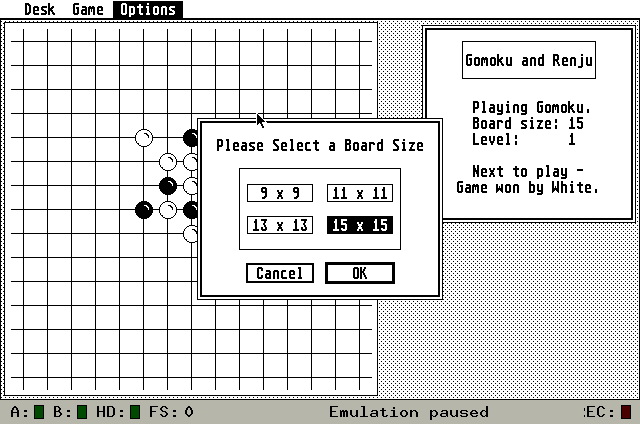
The selectable 9×9, 11×11, 13×13, and 15×15 boards are more than a cosmetic toggle. Smaller boards get you into danger quickly and suit a brisk game; the 15×15 board leaves room for broader plans and more distractions. Nine AI levels also let you begin without being flattened immediately, although this is still a game where better opposition can make your mistakes painfully obvious.
Hints and unlimited turn undo are sensible aids for learning rather than crutches to be ashamed of. Use them to test why a move fails, spot a blocked line, or rewind a greedy attack that leaves an obvious response. That makes this a better solo practice tool than a version that merely drops you onto a board and expects mastery.

Graphics
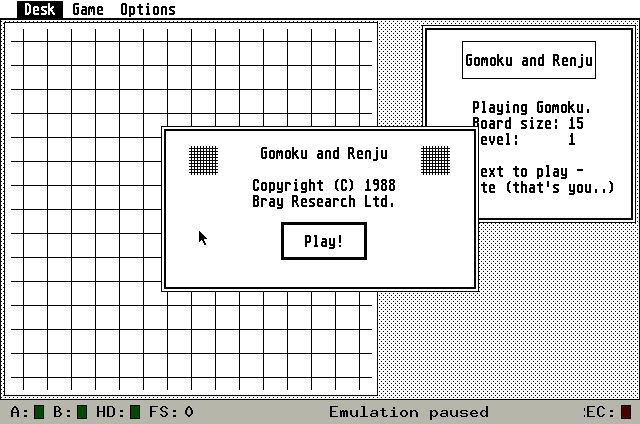
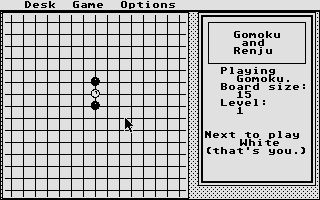
You spend the game looking at a square grid and placed stones, exactly as a board-game adaptation should allow. The important visual task is following lines across the board, and the uncluttered arrangement keeps attention on emerging rows and intersections rather than burying the match in decoration.

Story
There is no authored plot here, and forcing one onto five-in-a-row would miss the point. Each match creates its own tiny story: an opening claim for space, a threat that demands an answer, and the moment one overlooked diagonal decides everything.
Renju adds a more interesting competitive angle to that familiar board-game drama. Its modified opening rules exist because the first move can be too strong in standard Go-Moku, so the contest begins with a question of balance rather than pure initiative.
That stripped-down focus is a strength. You are not working through characters or chapters; you are reading another mind through a sequence of stones, trying to determine whether a defensive move is genuinely safe or merely delays the inevitable.
Overall Experience
Go-Moku / Renju is a strong fit if you enjoy abstract strategy that teaches its rulebook in seconds and spends the rest of its time exposing how little you initially understand. The first hour can be pleasantly deceptive: wins on a small board may make you feel clever, while stronger AI and larger boards quickly reveal how many directions a position can collapse from.
Its frustrations are the honest frustrations of the game itself. A single lapse can lose a match, and careful play can become methodical when both sides are blocking threats. But the undo function, hints, adjustable AI, and board-size choices give you practical ways to learn instead of making every loss feel final.
For an Atari ST board-game library, this is a worthwhile, flexible rendition of a classic tactical duel. Start with Go-Moku on a smaller board to grasp the rhythm, then move to Renju when you want the opening to matter as much as the finishing line. For background on the game and its variants, the Go-Moku / Renju history is useful context.


Reviews
There are no reviews yet.