 Retro Replay Retro Gaming History, Reviews & Emulation

Retro Replay Review
Gameplay
Camelot’s first stretch puts you in the uncomfortable but compelling position of having almost nothing to waste. You need 3,000 points to reclaim the throne, and bags of gold scattered through the castle are the main way forward. Enemies add to the score too, but less generously, so treating every witch or demon as a mandatory target is a quick way to misunderstand the game.
The finite fireball supply gives the shooting real tension. A fireball spent to clear a threat might make the next room safer, but it is still one fewer answer for whatever waits deeper in the castle. That turns combat into a judgment call rather than a simple reflex test. The platforming and puzzle elements fit that same mindset: avoid energy-draining water, work out where an item is useful, and try not to burn time on a route that leads nowhere helpful.
Object handling is one of the more interesting constraints. You can carry up to five different items, and keys can open access to new areas, making exploration more than a hunt for points. The castle’s flip-screen layout asks you to remember where you have been and what was blocked before. That can be frustrating when a mistake costs your only life, but it also means progress feels earned rather than handed over.
The timer and energy system keep Camelot from becoming a leisurely scavenger hunt. Both can be replenished during play, which offers a little breathing room, yet the pressure never entirely disappears. You are constantly weighing a gold run against survival, and that is where the game’s modest mix of genres starts to click.

Graphics
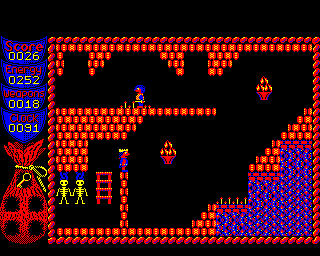
The view is built around flip-screen castle areas, with the king moving through rooms populated by hazards and fantasy enemies such as witches and demons. It is a straightforward BBC Micro look, but the room-by-room structure suits a game where remembering entrances, obstacles, and locked paths matters.
Fireballs and the castle’s water hazards are especially important visually because they represent resources and danger at a glance. The graphics are functional rather than ornate, but they serve the tense, room-by-room crawl well.
Story
There is not much narrative decoration around Camelot’s premise, and that restraint is probably for the best. You are a deposed king trying to prove you deserve the throne again; recovering enough gold is the test. It is an uncomplicated excuse to put a crown-bearing hero into a dangerous castle, but it gives the score target more purpose than a bare arcade tally.
The strongest story beat is one you create through play. A king with only one life, limited fireballs, and a dwindling clock does not feel especially secure, which makes the recovery quest feel suitably desperate. Every newly opened route can read as a small step toward restoring that lost standing.
Do not come expecting characters, dialogue, or a detailed Arthurian tale. Camelot uses its royal-fantasy setup as a frame for action and exploration. For this kind of game, that is enough: the throne is the promise, while the castle is the real adversary.
Overall Experience
Camelot is appealing because it refuses to let any one part of its design carry the whole game. Shooting enemies helps, but gold matters more. Exploring is necessary, but wandering wastes time. Items open possibilities, but your life and energy are always at risk. That interlocking pressure gives the game more bite than its simple objective initially suggests.
Its rough edge is also obvious. One life and a time limit make it a stern game, and limited fireballs can turn an aggressive approach into a losing one. If you want a relaxed platformer or a pure combat game, the constant accounting may feel punishing. Patience, map memory, and the willingness to retreat from an unnecessary fight are more valuable than bravado.
For BBC Micro fans, Camelot is worth trying as a focused fantasy challenge that blends several familiar ingredients into a resource-conscious castle run. The payoff is the satisfaction of learning when to collect, when to unlock, when to fight, and when to leave a monster alone. It is a demanding little game, but its rules give you enough to think about that persistence can be rewarding.


Reviews
There are no reviews yet.