 Retro Replay Retro Gaming History, Reviews & Emulation
Retro Replay Review
Gameplay
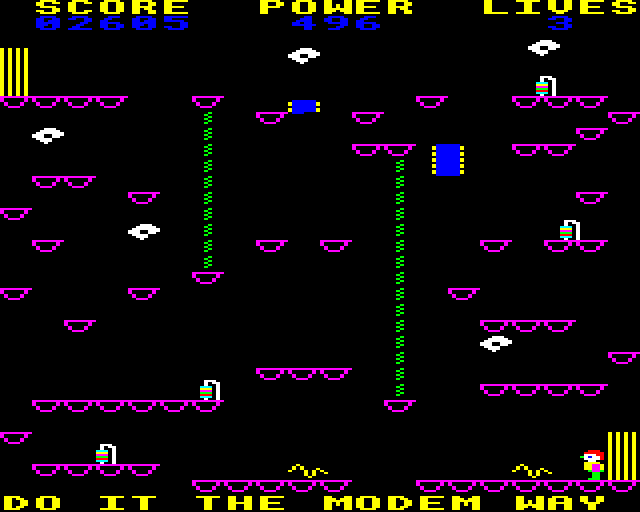
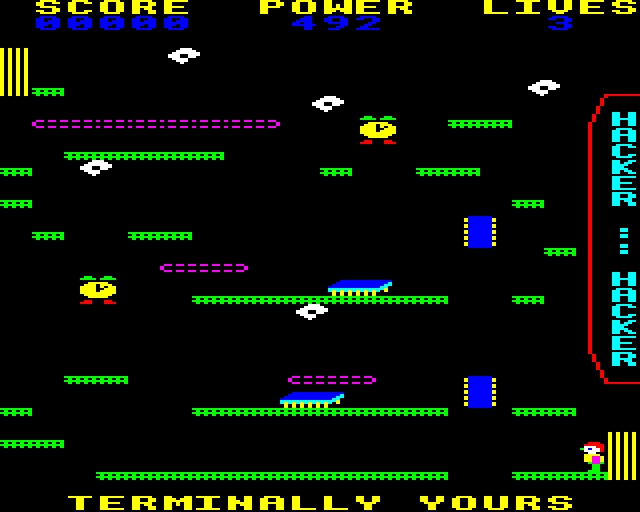
The Hacker’s first screen tells you almost everything you need to know, which is a compliment. You begin at the bottom left, the exit waits at the top right, enemies guard the circuit, and five white disks must be collected before you can move on. The resulting loop is direct: climb, jump gaps, avoid trouble, and find a route that does not burn through your power meter.
The timer is the part that gives the game its teeth. Power drains as you work through a level, and leftover power becomes bonus score, so simply scraping through is not the whole goal. A safe-looking route can become a bad one if it takes too long, while a riskier jump or tighter path may be what turns a barely completed stage into a strong run. That is a good fit for single-screen platforming, where a level can be learned, retried, and gradually handled with more confidence.
Frustration is likely to arrive when the five-disk requirement pulls you away from the obvious route to the exit. You cannot just make a quick upward dash; you have to account for every collectible while dealing with gaps and defenders. That pressure is exactly why the game has replay value, but it also makes it better suited to short, focused sessions than relaxed wandering. If you enjoy old-school platformers that ask for route planning as well as timing, there is a worthwhile challenge in its 12-level climb.
Graphics
Each level is shown from the side on a single screen, with Hank’s route running from the lower-left starting point toward the upper-right exit. Platforms, gaps, enemies, and the white disks all serve the immediate job of making the climb and collection route easy to understand at a glance.
Story
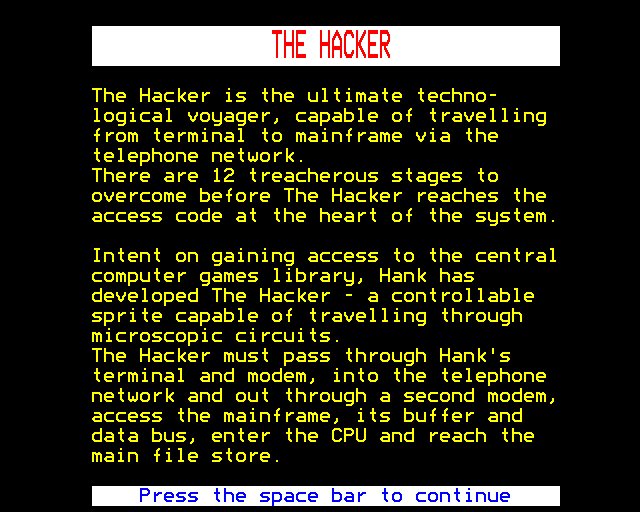
The setup is cheerfully pulpy: Hank has created a sprite called The Hacker and sends it through his terminal, modem, telephone network, and microscopic circuits toward the Central Computer Games Library’s main file store. It is a small premise, but it gives the platform stages a more memorable excuse than “climb to the exit.”
Rather than placing Hank in a physical world, the game turns a break-in through computer systems into a succession of guarded circuits. That makes the white disks feel at home as objectives, and the hostile figures become the defenders of each electronic barrier. The story is mostly there to frame the action, not to carry dramatic weight.
Still, the theme has charm. For a 1985 BBC Micro game, the notion of travelling through a modem and telephone network to infiltrate a library computer has the right kind of era-specific imagination. Do not come for a deep narrative; come for a concise sci-fi wrapper that makes the repeated screen-by-screen assaults feel connected.
Overall Experience
The Hacker is a lean, demanding platform game whose best idea is how firmly it ties completion to efficiency. Collecting every disk, escaping the screen, and preserving power all point in the same direction: learn the level and do it better next time. That gives a small game a satisfying competitive edge.
Its limits are also plain. The format remains tightly focused across 12 levels, and the core demands do not change from their essentials: platforms, gaps, defenders, disks, exit. If you need constant surprises or a broad adventure around the action, this will feel narrow. If you value games that establish a challenge quickly and expect you to master it, that narrowness is a strength.
Give The Hacker a chance if the thought of plotting a cleaner route through a timed, single-screen obstacle course sounds satisfying. The premise is a neat piece of computer-age fantasy, but the real payoff comes when a previously messy climb turns into a crisp run with power to spare. It is stern rather than expansive, and that focus suits it.


Reviews
There are no reviews yet.