 Retro Replay Retro Gaming History, Reviews & Emulation
Retro Replay Review
Gameplay
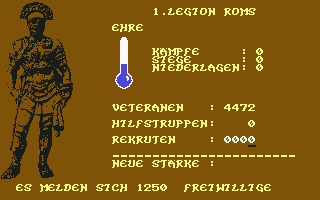
The first hour is largely about learning to respect the budget. You have 30 Gallic tribes to pacify, but money does not simply exist to be spent: it comes back through tribute from tribes you have already subdued. That turns diplomacy into more than a peaceful alternative to war. Paying one tribe can be a calculated investment if its tribute helps bankroll the next agreement or keeps your legions free for a tougher opponent.
War is the more immediate answer, and the game lets you commit one of four legions when negotiation is not worth the price. The shift from menus to moving a character across the map to select a military target gives these choices a welcome bit of directness. Still, this is not a game about lingering on battles. The real work happens before you march, while studying each tribe’s statistics and deciding whether force will solve a problem or create a costly loss you cannot easily absorb.
That is where Julius Cäsar becomes engaging, but also where its narrowness can grate. Much of your time is spent in menus, weighing figures and making hard calls with limited resources. If you want elaborate tactical combat, this will feel spare. If you enjoy a compact turn-based campaign where every payment, campaign, and recovered soldier matters, the economy starts to click into a tense little puzzle.
Graphics
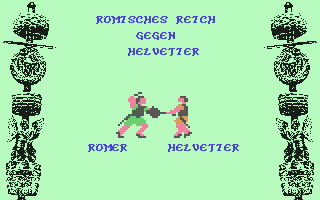
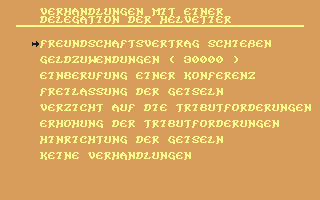
The game is mostly built around functional menus and tribe statistics, with a map used when sending Caesar toward a military target. The map movement breaks up the accounting, but the interface-focused view remains the dominant image: this is a strategy board of information first and foremost.
Story
There is a strong historical frame even if the game is more concerned with command decisions than dramatic storytelling. You step into Julius Caesar’s role in ancient Rome and face the broad task of pacifying Gaul, tribe by tribe. The stakes come from conquest, tribute, and political survival rather than from a cast of characters or a sequence of scripted scenes.
The annual report to the senate is the best piece of that framing. At the end of each year, your leadership must be approved, and the senate’s willingness to reinforce depleted legions depends on how well you have done. It makes the campaign feel like more than a string of isolated choices: failure has to be explained to Rome, while success earns another year to finish the job.
That setup gives even the cold arithmetic some personality. A peace deal is not merely a number leaving your treasury, and a lost legion is not merely a reduced combat option; both feed into Caesar’s standing with the senate. The historical theme works because it is tied directly to your constraints instead of being pasted over an unrelated ruleset.
Overall Experience
Julius Cäsar is a small, stern strategy game that asks you to think several moves ahead without burying you under a huge rules manual. Its strongest moments come when diplomacy, tribute, and military strength pull in different directions. You may have enough money to buy peace, but not enough to buy peace with everyone; you may have legions ready to march, but not enough political goodwill to waste them carelessly.
The trade-off is a very dry rhythm. Menus carry most of the experience, and the direct map movement is only a brief change of pace. That can make the game feel more like managing a campaign ledger than commanding an empire. For some, that is exactly the point. For others, it will feel like the interesting decisions are trapped behind too much bookkeeping.
Give it a chance if you like old-school turn-based strategy that finds drama in resource pressure and long-term planning. The senate’s yearly judgment creates a worthwhile payoff for disciplined play, and the need to turn pacified tribes into future income gives the campaign a satisfying internal logic. It is not broad or flashy, but it has a clear strategic spine and enough pressure to make a successful year feel earned.


Reviews
There are no reviews yet.