 Retro Replay Retro Gaming History, Reviews & Emulation
Retro Replay Review
Gameplay
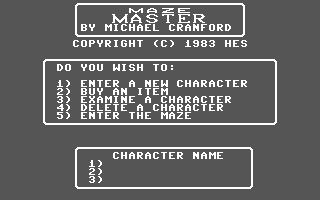
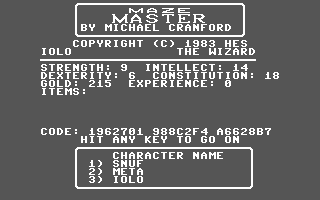
Maze Master starts with the kind of preparation modern dungeon games often skip. You make a party of three, choosing Warriors and Wizards, spend your initial funds on equipment, and then walk into a maze that gives very little away. That setup immediately creates some ownership over the expedition. A party heavy on Warriors sounds sturdy; more Wizards promises a different kind of strength. Either way, the game makes you live with the group you assembled once the maze closes around you.
The first hour is likely to be more about orientation than conquest. The labyrinth is shown in 3D wireframe, and the sensible advice to map it on graph paper is also the central test of whether Maze Master is for you. Keeping notes, tracking turns, and preserving a route back to the exit are not optional bits of extra immersion; they are the work. If you enjoy gradually turning an unknown maze into a chart you understand, each safe return feels earned. If that sounds like homework, frustration will arrive early.
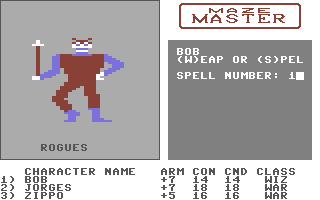
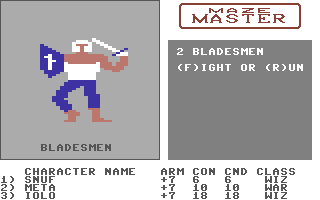
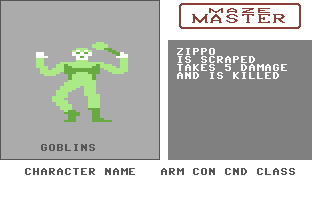
Combat feeds a clean, durable role-playing loop. Dwarves, goblins, rogues, and other monsters stand between you and gold or experience; that money buys stronger weapons, armor, and magic items, while experience improves your party members. The deeper levels raise the pressure with harder foes, so progress has a useful rhythm: explore, survive, improve, and push deeper. It is simple, but the steady sense that your group is becoming capable enough for the next descent gives the crawling a purpose.
The Balrog is a smart long-term target because you cannot simply force your way to the bottom. Its mystical aura blocks access to the lowest level, and you need to find clues that explain how to get past it. That gives exploration more weight than blindly seeking stronger encounters. Still, this is a demanding game of memory, notes, and deliberate movement, not a breezy fantasy adventure. Keyboard and joystick control give you options, but neither changes the fact that careful navigation is the main skill.
Graphics
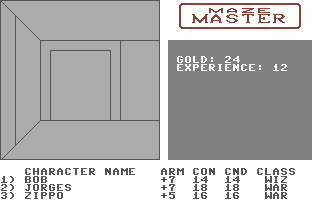
The maze is drawn as a 3D wireframe view, putting you inside a stark network of corridors rather than showing a richly illustrated fantasy world. It is functional and immediately suited to the game’s mapping focus: you see the passages in front of you, then translate that information onto paper. The trade-off is obvious—this is a very spare-looking dungeon crawl.
Story
Maze Master keeps its story lean: your created party enters a monster-filled labyrinth, grows stronger, and seeks a confrontation with the Balrog at its depths. There is no need for a complicated tale here, because the descent itself supplies the momentum. Every lower level carries the promise that you are getting closer to the real challenge.
The best narrative hook is the barrier around that final destination. Learning how to pass the Balrog’s mystical aura turns clues into something more valuable than flavor text: they are the key to continuing the journey. That is enough to make the maze feel like a place with a destination rather than a set of disconnected corridors.
Do not come in expecting characters or dramatic scenes to carry you. The story lives in the party you chose, the route you mapped, the equipment you earned, and the moment you decide you are ready to descend again. For a game built around a labyrinth, that stripped-back approach fits surprisingly well.
Overall Experience
Maze Master has a stern, specific charm. It asks you to meet it halfway with graph paper, concentration, and a willingness to make your own record of the dungeon. In return, it offers the pleasure of hard-won familiarity: corridors that once felt threatening become part of a map you can navigate with confidence, while deeper areas remain a genuine risk.
The payoff depends almost entirely on your appetite for that process. The Warrior-and-Wizard party building, equipment purchases, experience gains, and deepening monster challenge create a solid reason to keep exploring, but they do not soften the maze’s demands. You will either find the manual mapping absorbing or regard it as an obstacle between you and the role-playing.
Give it a chance if you want a compact early fantasy crawl that treats getting lost as part of the adventure and makes preparation matter. Skip it if you need lush dungeon imagery, quick guidance, or a story that does more than point you toward the next dangerous level. For the right kind of patient explorer, reaching the point where your own notes guide you through the labyrinth is the reward before the Balrog ever enters the picture.


Reviews
There are no reviews yet.