 Retro Replay Retro Gaming History, Reviews & Emulation

Retro Replay Review
Gameplay
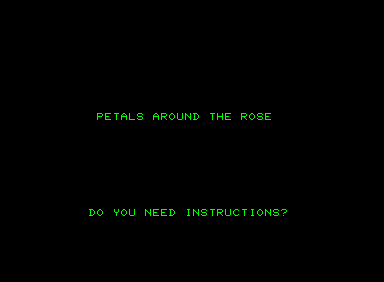
The first few rolls of Petals around the Rose are wonderfully disorienting. You see five dice, make a guess, and receive either confirmation or the correct answer. That feedback loop is brutally simple, but it gives each failure a purpose. You are not grinding through a quiz; you are collecting evidence against your own assumptions.
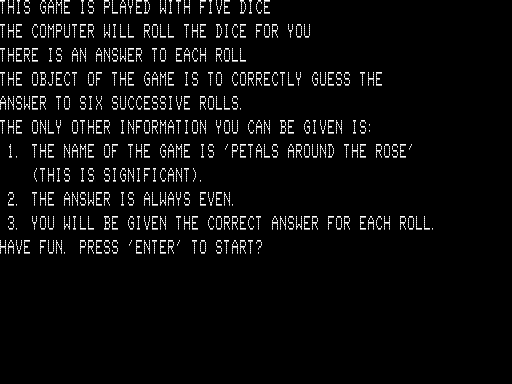
The puzzle’s strength is its restraint. The title and the fact that every answer is even are the whole opening brief, so progress depends on whether you can stop looking at the dice in the most obvious way. It is the sort of riddle that can make you feel foolish for ten minutes and clever for the next ten seconds. Once a possible rule occurs to you, each new roll becomes a test of whether you have truly cracked it or merely found a coincidence.
That narrowness also defines the frustration. There is one central secret, and the computer’s response is limited to right or wrong plus the actual value after a miss. If the riddle’s particular line of thinking does not grab you, there is nowhere else for the game to go. But for a patient puzzle fan, that austerity is fair: the answer is consistently encoded in the dice, and the game gives you the information needed to keep thinking.
Getting several answers right in a row is a smart little coda. A lucky correct guess is not enough; you have to demonstrate that you understand the pattern well enough to apply it repeatedly. Earning Potentate of the Rose is a modest reward, yet it lands because you know exactly what you have overcome.
Graphics
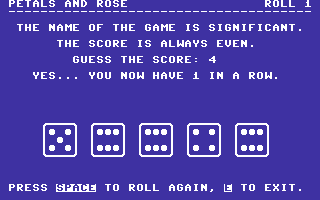
The visual focus is the five rolled dice. Their faces are the puzzle, so every pip matters more than decoration; you will spend most of the game studying their arrangement and comparing one roll against the last.
Story
There is no conventional adventure wrapped around the riddle. The title is itself part of the challenge, turning “Petals around the Rose” from a whimsical phrase into a clue you will keep reconsidering.
The closest thing to a character role is the title of Potentate of the Rose. It gives the solution a playful ceremonial payoff without distracting from the actual business of deduction.
That light touch suits the game. A more elaborate premise would only compete with the central question; here, the tiny bit of mystery is all concentrated in what the dice are trying to tell you.
Overall Experience
Petals around the Rose is a compact brain teaser with a very particular kind of satisfaction. It is not about accumulating skills across many systems or seeing new content unfold. It is about staring at a small set of evidence until your perspective changes.
Give it a chance if you like classic riddles that reward observation over speed. The best way to play is to resist random guessing: look closely at each die, compare rolls with identical totals, and treat every disclosed answer as a clue. The moment of realization is the entire prize, and it is a good one.
Its limits are obvious after you know the answer, since the mystery cannot be solved twice in the same way. Still, as a computerized version of a famous-style dice riddle, it is cleanly structured and pleasantly merciless. A short session can leave you either gloriously triumphant or annoyed enough to keep turning the rule over in your head.


Reviews
There are no reviews yet.