 Retro Replay Retro Gaming History, Reviews & Emulation
Retro Replay Review
Gameplay
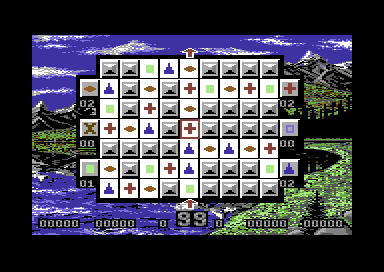
Riddles and Stones gets straight to the good stuff: two arrows on a grid, a route that needs building, and sliding blocks that refuse to stop until they hit an obstacle. That last rule gives the first few minutes their bite. You are not merely filling empty floor; you are committing a block to a long trip and trying to predict where it will finally matter.
The symbol rule is the real hook. Generated blocks only remain on floor squares carrying the same symbol, which turns every generator and marked tile into part of a larger routing problem. A move that looks useful can become useless if the block slides past its intended resting place, while a wall can suddenly become the essential brake that makes the whole solution possible. Once that relationship starts clicking, the puzzle feels less like trial-and-error and more like reading a small machine.
Frustration will set in if you dislike hard commitment. The joystick controls are simple, but the puzzles demand patience because a wrong sliding block can wreck the path you had in mind. Still, the rules are focused enough that failure should send you back to reconsider the grid rather than blame a pile of exceptions. It is a good fit when you want a concentrated logic puzzle that asks you to pause, visualize, and then make one deliberate move.
Graphics
The top-down view keeps the grid, walls, symbol-marked floor tiles, generators, and sliding blocks in the same clear space. Since the challenge depends on judging where a block will travel and stop, that straightforward board view makes the action easy to follow.
Story
Riddles and Stones finds its momentum in the puzzle itself: get from one arrow to the other. There is no need for a grand detour when the grid can pose a complete problem in a single glance.
Each layout creates a tiny, wordless bit of tension. The start arrow establishes the challenge, the destination arrow gives your plan a purpose, and the marked tiles dictate the narrow set of moves that can bridge the gap.
That stripped-back approach suits the game. You are not being asked to remember plot details between attempts; you are asked to remember what the board taught you when the last plan failed.
Overall Experience
This is a compact, rules-first puzzle game with a properly mean streak. Its best moments come when an apparently blocked route reveals itself through a carefully placed block and a well-used wall, making the solution feel earned rather than accidental.
The narrow focus is also its strength. Instead of distracting you from the board, Riddles and Stones keeps returning to one strong question: can you control a block that will not stop moving until the level stops it for you? That is a satisfying question to work through if you enjoy spatial puzzles with strict movement rules.
Give it a chance if you like old-school puzzle games that reward thought more than speed. You may hit a wall—sometimes literally—but the clean logic underneath makes the payoff worth pursuing for patient puzzle fans.


Reviews
There are no reviews yet.