 Retro Replay Retro Gaming History, Reviews & Emulation

Retro Replay Review
Gameplay
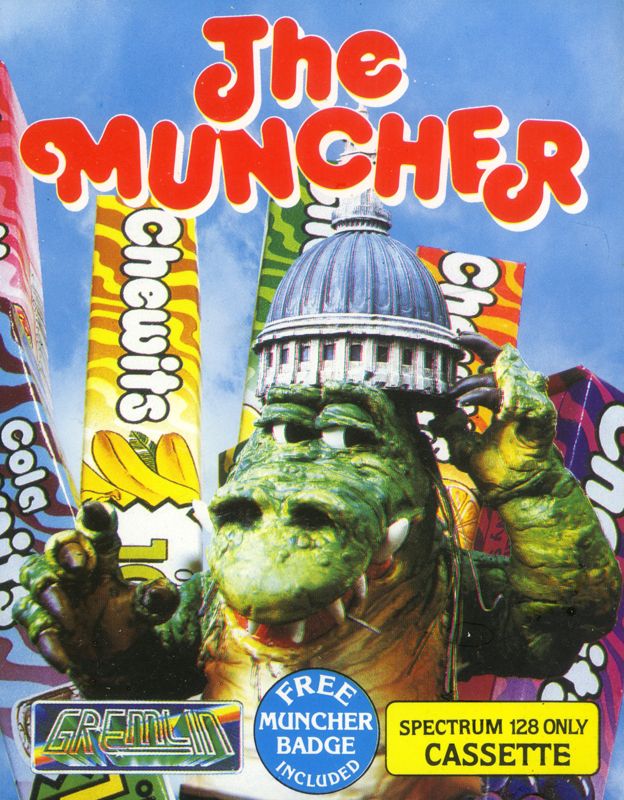
The Muncher wastes little time asking what sort of game it wants to be. You control a prehistoric monster, move through a scrolling landscape, smash houses, and deal with the people attacking you. That immediate destructive loop is the reason to try it. There is something satisfying about being the oversized problem rather than another hero cleaning one up, and chasing a higher score gives every wrecked building a clear, uncomplicated reward.
The first layer of strategy comes from where your monster is standing. Its available moves change between the ground and a building, so climbing is more than a bit of scenery; it changes how you deal with threats. Limited fireballs prevent you from simply blasting through everything, and the need to eat petrol trucks to recharge them creates a useful priority in the middle of the mayhem. You are not just tearing up the route—you are watching for the fuel that keeps your strongest ranged option available.
The eggs give the action its most distinctive wrinkle. Finding one is only half the job: getting it to a waste disposal site turns it into an extra life. That makes an egg feel valuable in a way points do not. Carrying it pushes you to think beyond the next target, especially when attackers are still demanding your attention.
Fights with another giant monster provide the clearest spike in tension. Scrolling stops until one of you is defeated, turning the usual forward-moving destruction into a focused showdown. It is a smart break in rhythm, though anyone hoping for a deeper brawler may find the rest of the game’s score-driven structure fairly straightforward.
Graphics
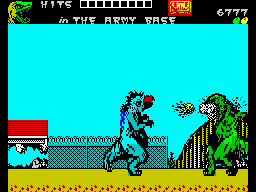
The side-view scrolling gives you a clear look at the monster’s path through houses, attackers, petrol trucks, and the occasional rival giant monster. The building-climbing action is especially important visually because it lets you immediately see when the monster has shifted from ground-level trouble to a different set of attacks.

Story
There is a cheeky B-movie hook beneath the score attack: Japanese explorers have taken the monster’s eggs, and the monster responds by smashing its way through the world to get them back. It is a thin setup, but it is exactly the right kind of excuse for this sort of arcade rampage.
More importantly, the story goal feeds back into play instead of disappearing after the opening premise. Eggs are not merely collectibles attached to a rescue plot; taking them to the disposal sites turns them into extra lives. That connection gives the quest a practical reason to matter while you are playing.
Do not come in expecting a detailed adventure or a heavily developed cast. The Muncher uses its monster-on-a-mission premise as a clean frame for destruction, and it works because the game stays committed to that simple idea. For game-specific background and release history, the The Muncher overview is a useful companion.
Overall Experience
The Muncher is at its best when you treat it as a compact arcade score chase with a few clever survival wrinkles. Smashing buildings has a satisfying directness, while fuel management and egg delivery stop the action from becoming entirely mindless. The contrast between indiscriminate wrecking and carefully protecting an egg is its strongest idea.
Frustration is most likely to set in if you want a long campaign or lots of mechanical variety. The core remains destruction, attackers, limited fireballs, and the occasional giant-monster fight. Once that loop has shown you what it has, there is not much indication that it transforms into something grander.
Still, the payoff is worthwhile if you enjoy old-school action games that get to the point. Give it a chance for the oddball pleasure of playing a building-climbing monster with a practical need for petrol and extra lives. It is not a classic on the strength of the material here, but it is a solid curiosity with enough purpose behind its chaos to earn a look.


Reviews
There are no reviews yet.